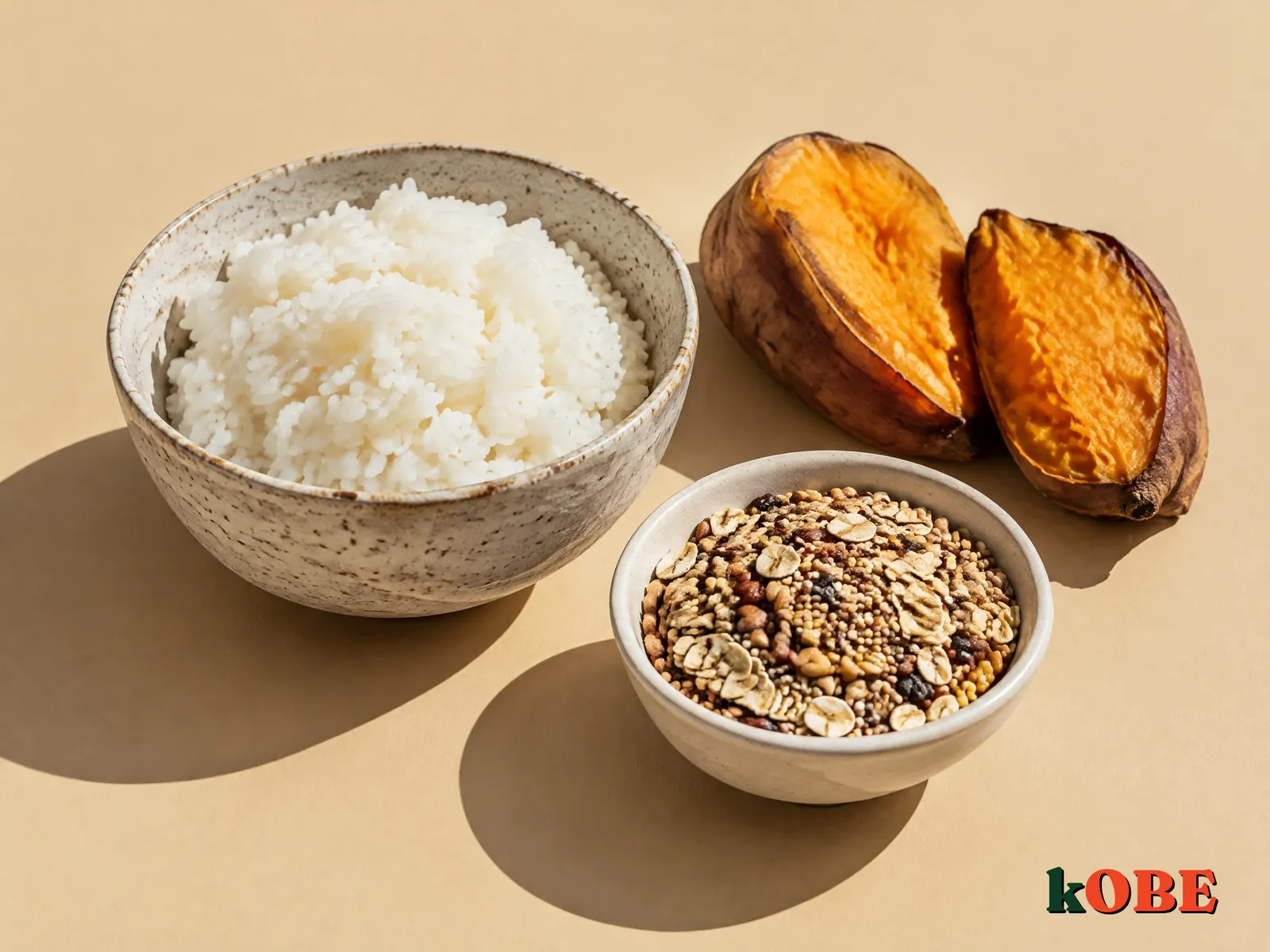
You have probably heard someone say it at dinner: "I've quit rice lately." Everyone at the table nods, as if they just heard about a brave life decision.
Now look at a Vietnamese family table. Grandma has eaten rice three times a day for eighty years. People in Vietnam, Japan and Korea all grew up next to a rice cooker. Half of the world's population gets most of its energy from rice.
So is starch really the villain? The short answer: no. The long answer is far more fun, and it lets you enjoy your rice without the guilt.
In this article
- What is starch? A very long string of sugar beads
- Your brain is one of glucose's biggest customers
- Starch and refined sugar: distant cousins, very different personalities
- Not all starch behaves the same
- So how much is the right amount?
- Keeping rice tasty and safe is part of the story too
- Inside the kOBE kitchen
- Frequently asked questions
What is starch? A very long string of sugar beads
Picture a necklace. Every bead on it is one molecule of glucose, the sugar your body burns as fuel.
Starch is thousands of those glucose beads linked together. Rice plants, sweet potatoes and corn store their energy this way, a bit like dropping coins into a piggy bank.
The beads come in two arrangements:
- Amylose: an almost straight string. Rice high in amylose cooks up fluffy, with separate grains.
- Amylopectin: a string that branches out like a tree canopy. Rice high in amylopectin cooks up soft and sticky. Sticky rice (gạo nếp) is almost pure amylopectin.
How these two strings explain fragrant sticky rice versus fluffy, separate rice is a story we tell in What is amylose.
Once you swallow, your small intestine snips the string into single glucose beads. Glucose enters your blood and feeds every cell. At heart, starch is sugar in slow-release packaging.
A tiny experiment for your next meal: put a spoonful of plain white rice in your mouth and chew slowly for about thirty seconds. It will start to taste sweeter.
That is not your imagination. Your saliva contains an enzyme called amylase. It starts cutting the starch chains right there in your mouth, releasing little bits of sugar that your tongue reads as sweet.
This fun fact tells us something big: the human body comes "pre-equipped" to digest starch, from mouth to gut. We have been eating grains and root vegetables for thousands of years.
Your brain is one of glucose's biggest customers
Your brain weighs only about 1.4kg, yet it uses around 120g of glucose every day. It prefers glucose over most other fuels.
That is why nutrition experts in the US set a minimum of about 130g of carbohydrate a day for adults. That amount keeps the brain running smoothly, before counting any energy for your muscles.
What does 130g of carbohydrate look like? Roughly three medium bowls of rice, or two bowls of rice plus one sweet potato and a banana.
In Vietnam, the National Institute of Nutrition recommends that carbohydrate (glucid) make up about 55 to 65% of daily energy. In other words, for Vietnamese eaters, starch is still the lead actor at the table. It just needs to play the role well.
Starch and refined sugar: distant cousins, very different personalities
If starch is also glucose, why do experts tell us to cut sugar but not to quit rice?
Because they travel into the body in very different ways:
| Refined sugar (a cup of milk tea) | Starch (a bowl of rice, a sweet potato) | |
|---|---|---|
| Form | Loose sugar, already dissolved | Long chains that need cutting |
| Comes with | Almost nothing else | A little protein, fiber, B vitamins, minerals |
| Fullness | Still hungry after drinking | Chewing and swallowing keep you full longer |
| WHO advice | Under 10% of energy, ideally under 5% | No separate upper limit |
The World Health Organization (WHO) sets limits on free sugars: sugar added to food and drinks, plus the sugar in honey and fruit juice. The starch in rice and sweet potatoes is not part of that group.
One more picture to help: a large cup of milk tea can hold 40 to 50g of sugar, about 10 to 12 teaspoons. A bowl of rice also has around 40g of carbohydrate, but it arrives with a real meal: fish, greens and a bowl of soup.
Not all starch behaves the same
This is where rice gets interesting. It is all starch, but each kind reaches your blood at a different speed.
1. Whole grain or polished. Brown rice still has its bran and germ, where most of the fiber, vitamin B1 and vitamin E live. White rice has been milled out of that coat. The calories are almost the same, but the "luggage" that comes along is very different. See How brown rice and white rice differ.
2. The color of the grain. Red and black brown rice carry extra natural pigments in the bran. Which one to pick comes down to taste, and we compare them in Red, black or plain brown rice. Sprouted brown rice is softer and sweeter, with extra GABA: What is germinated brown rice.
3. How it is cooked. Long-simmered cháo (rice porridge) reaches your blood faster than steamed rice. Bún and phở, noodles made from rice flour, are a little slower than white rice, which surprises a lot of people (Bún, phở, mì: the starch in noodle soups). Sweet potatoes change with every cooking method: Boiled, steamed or roasted sweet potato. The actual numbers are in The glycemic index of different rices.
4. Hot or cold. Rice kept in the fridge overnight forms a little extra resistant starch, the part of starch that "slips past" the small intestine. It is real, but small. Read How cold rice differs from hot rice.
5. What you eat it with. A bowl of rice eaten with meat or fish, vegetables and a little oil sends sugar into your blood more gently than a bowl of plain rice. This trick is easy and does far more than switching rice varieties. See "Dressing up" your starch.
So how much is the right amount?
There is no single number for everyone. An office worker needs something different from someone riding a motorbike all day. But there are some very everyday ways to estimate:
- By the plate: the Harvard T.H. Chan School of Public Health suggests starch fill about a quarter of your plate. Half the plate is vegetables, and the last quarter is protein.
- By the fist: one serving of starch per meal is about the size of your fist. Bigger hands, bigger portion. Smaller hands, smaller portion. Very fair.
- By the bowl: a medium bowl of rice is about 150g, giving roughly 190 kcal and 40g of starch. For most adults, one to two bowls per meal is reasonable.
More important than any number is changing gradually. Try mixing half brown rice into your pot of white rice. Or swap one rice meal for sweet potato or boiled corn. Your body adjusts slowly, and it never feels like a diet. How to measure starch for each meal is in How much starch should one meal have.
Keeping rice tasty and safe is part of the story too
Cooking one big pot for several meals saves time. But rice needs a little care:
- Cooked rice left out in the kitchen for too long can build up toxins from bacteria. How to store it properly: Storing cooked rice.
- Frozen rice can be reheated to taste freshly cooked, if you know the trick: Reheating frozen rice.
- New to brown rice and finding it hard? The problem is usually the soaking: How to cook soft brown rice.
Inside the kOBE kitchen
We do not quit rice. We choose rice that fits.
Our Red Brown Rice, Black Brown Rice and White Rice are all cooked, then frozen. Every 100g of White Rice has 130 kcal and 28g of carbs. Red Brown Rice has 123 kcal and 25.6g of carbs. Black Brown Rice has 100 kcal and 21.2g of carbs, plus anthocyanins, the natural purple pigment of black rice.
Beyond rice, we have Japanese, Purple and Honey Sweet Potato, roasted with a little olive oil, as well as Quinoa and Glutinous Coix Seed. The point is to let you rotate your starch every day without cooking each one yourself.
And in our 1,480 home recipes, every dish lists calories, protein, fat and sugar per 100g. One look tells you how "heavy" your bowl of rice is. Eat what fits.
Frequently asked questions
Do active people need more rice?
Is it a problem to cut out starch completely?
Do bún, phở and bánh mì count as starch?
Is sweet potato "better" than rice?
Keep reading
Sources
- Institute of Medicine (2005). Dietary Reference Intakes for Energy, Carbohydrate, Fiber, Fat, Fatty Acids, Cholesterol, Protein, and Amino Acids. National Academies Press (carbohydrate RDA 130g/day).
- WHO (2015). Guideline: Sugars intake for adults and children.
- National Institute of Nutrition (Vietnam) (2016). Recommended Dietary Allowances for Vietnamese People.
- Harvard T.H. Chan School of Public Health, The Nutrition Source. Healthy Eating Plate.
- USDA FoodData Central: long-grain white rice, cooked.
- Further reading: Understanding Nutrition 16th ed., chapter 4; Tian J. et al. (2023), Science of Rice: Chemistry and Nutrition, chapter 2.