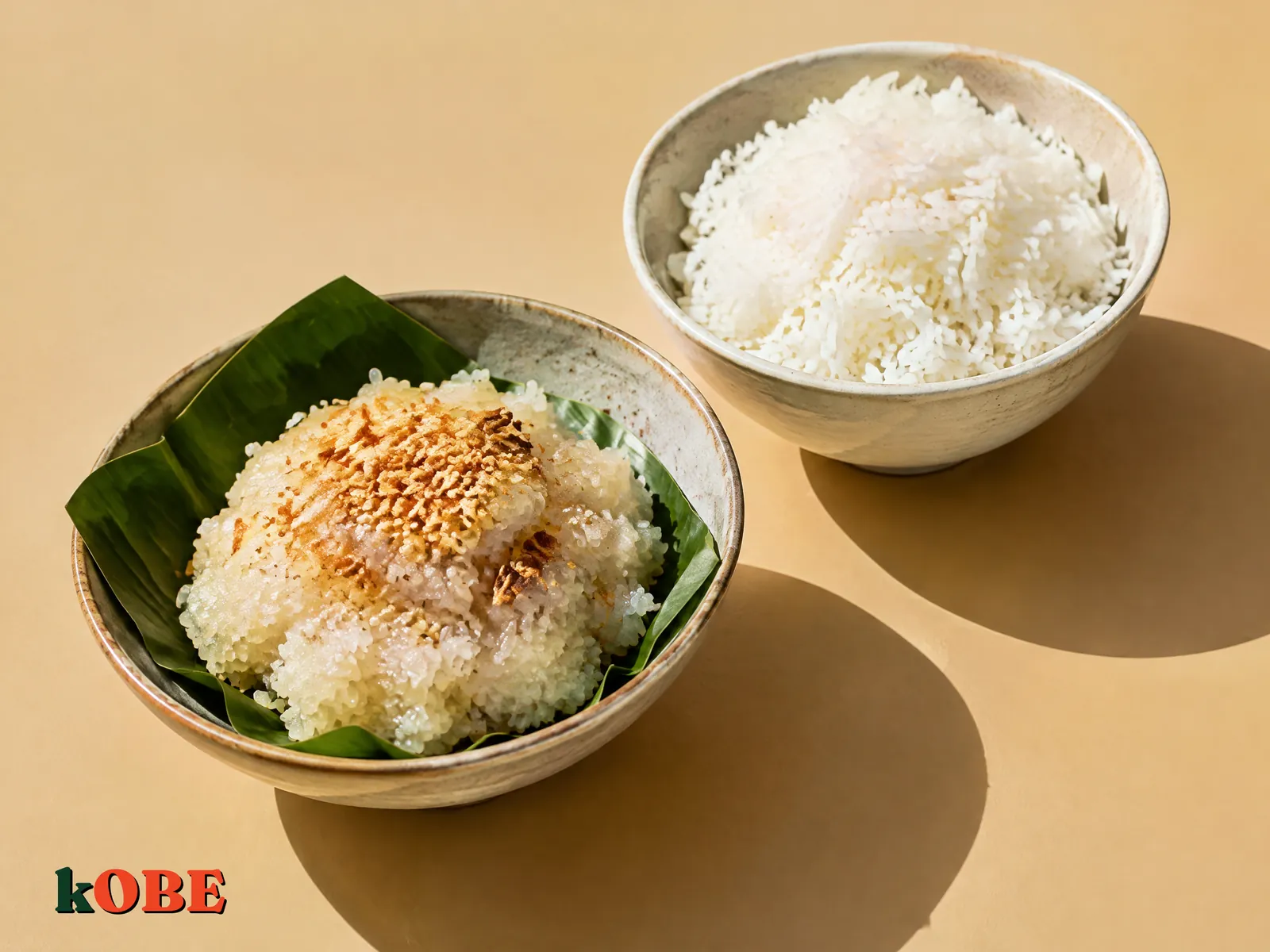
Buy rice at a Vietnamese market and the seller will ask: "Soft rice or fluffy rice?" (gạo dẻo hay gạo nở).
Soft rice cooks up tender, fragrant and a little sticky, tasty even on its own. Fluffy rice gives separate, airy grains that you never tire of, and fried rice where every grain stands apart. And then there is sticky rice (nếp), so sticky you can press it into a ball.
The three grains look almost alike, so why do they cook so differently? The answer lies with two starch "siblings" with slightly tongue-twisting names: amylose and amylopectin.
In this article
- Two siblings inside one grain of rice
- The rice lineup: from sticky rice to fluffy rice
- Amylose makes rice firm, amylopectin makes it sticky
- Why does fluffy rice harden so fast when it cools?
- Amylose and blood sugar: connected, but not simple
- Fun fact: amylose "changes color" with iodine
- Inside the kOBE kitchen
- Frequently asked questions
Two siblings inside one grain of rice
Starch is long chains of glucose. Inside a grain of rice, those chains come in two shapes:
- Amylose: almost a straight string, with very few branches.
- Amylopectin: a bushy tree, with lots of short, crowded branches.
Picture a handful of dry spaghetti (amylose) and a handful of small forked twigs (amylopectin). Straight strands pack neatly side by side. Forked twigs tangle, hook onto each other and refuse to stack.
These personalities decide almost everything about whether your rice is sticky or fluffy. If you would like the big picture on starch first, read Starch is not the enemy.
The rice lineup: from sticky rice to fluffy rice
Scientists sort rice by the share of amylose in its starch:
| Rice group | Amylose in starch | How the rice usually cooks |
|---|---|---|
| Sticky / glutinous (waxy) | under 2% | Very soft, sticky, can be pressed into balls |
| Very low amylose | about 5 to 12% | Soft, very sticky |
| Low amylose | about 12 to 20% | Soft, moderately sticky, fragrant |
| Intermediate amylose | about 20 to 25% | Moderately soft, grains fairly separate |
| High amylose | about 25 to 33% | Fluffy, light, separate grains, hardens quickly when cold |
Sticky rice is almost pure amylopectin. That is why xôi (steamed sticky rice) is so soft and clings to your fingers: those bushy trees hook onto each other and will not let go.
Many familiar fragrant, soft rices in Vietnam tend to fall into the low amylose group. The "fluffy" rice that fried rice stalls and cơm phần (rice plate) shops like tends to be higher in amylose. The exact numbers depend on the variety and the harvest.
Amylose makes rice firm, amylopectin makes it sticky
Research on rice texture shows a fairly clear division of labor:
- Amylose mainly decides firmness. The more amylose, the firmer the grain.
- Amylopectin mainly decides stickiness. Its branched structure gives the grains their stickiness and glossy surface.
One more interesting point: high-amylose rice needs more water to taste its best. If you buy fluffy rice and find it a bit dry, try a little more water. On the other hand, soft rice with too much water turns mushy.
Why does fluffy rice harden so fast when it cools?
Remember the dry spaghetti? Straight strands pack together easily.
When rice cools, the amylose chains quickly find each other again and line up neatly. This process is called starch retrogradation. The branched amylopectin lines up too, but much, much more slowly, over days rather than hours.
You can see the results right in the kitchen:
- Fluffy rice left to cool turns firm within a few hours. In surveys, Southeast Asian shoppers often mention "hard when cold" as a sign of poor rice.
- Soft rice stays tender longer.
- Xôi also firms up in the fridge, but more slowly than fluffy rice.
And that is why chefs say to make fried rice with cold, fluffy rice. The grains are already firm with dry surfaces, so they do not break or stick in the hot oil. Try making fried rice with hot sticky rice and you will end up with a pan of... rice cake.
The story of cold rice and resistant starch has its own article: How cold rice differs from hot rice.
Amylose and blood sugar: connected, but not simple
Many studies find that high-amylose rice tends to digest more slowly, with a gentler rise in blood sugar after the meal. Sticky rice is the opposite, usually in the group that raises blood sugar quickly.
But here is a detail few people know. Recent analyses suggest most of the difference comes from when the rice cools a little, giving amylose time to line up again. When starch is measured fully cooked and still hot, the link between amylose and digestion speed gets much weaker.
In short: amylose is one factor, but how the rice is cooked, how hot it is when you eat it, and what you eat with it matter just as much. Specific glycemic index numbers are in The glycemic index of different rices.
Fun fact: amylose "changes color" with iodine
In chemistry class, you may have dripped iodine on a slice of potato and watched it turn deep blue-black. That is amylose at work.
Amylose strands coil up like springs. Iodine molecules slip inside the coils and create the blue-black color. Amylopectin, with its many short branches, cannot hug iodine as well, so it only gives a pale reddish brown.
Rice labs use this very trick to measure the amylose in rice. A high school chemistry experiment turns out to be grading every sack of rice.
Inside the kOBE kitchen
The kOBE kitchen has several kinds of starch so you can mix things up: White Rice, Red Brown Rice, Black Brown Rice, and Glutinous Coix Seed (130 kcal, 4g of protein per 100g).
All of them are cooked and then frozen. Remember how amylose lines up fastest when rice is chilled in the fridge? Freezing "pauses" that process, so when you reheat in the microwave on low, the rice turns soft again, almost freshly cooked.
Want fried rice with separate grains? Take a pack of White Rice and thaw it in the fridge overnight. By morning the grains are just firm enough for the wok.
Frequently asked questions
Does soft rice have more calories than fluffy rice?
How can I tell which type my rice is?
Can I mix soft rice and fluffy rice?
Keep reading
Sources
- Tian J. et al. (2023). Science of Rice: Chemistry and Nutrition. Springer. Chapter 2 (amylose classification, hardness and stickiness, retrogradation and starch digestion) and chapter 8 (rice preferences in Southeast Asia, water amount by amylose).
- FAO (1993). Rice in human nutrition. FAO Food and Nutrition Series No. 26 (prepared with IRRI).
- Atkinson F.S. et al. (2021). International tables of glycemic index and glycemic load values 2021: a systematic review. American Journal of Clinical Nutrition 114(5):1625 to 1632.
- Further reading: Understanding Nutrition 16th ed., chapter 4; Culinary Nutrition.