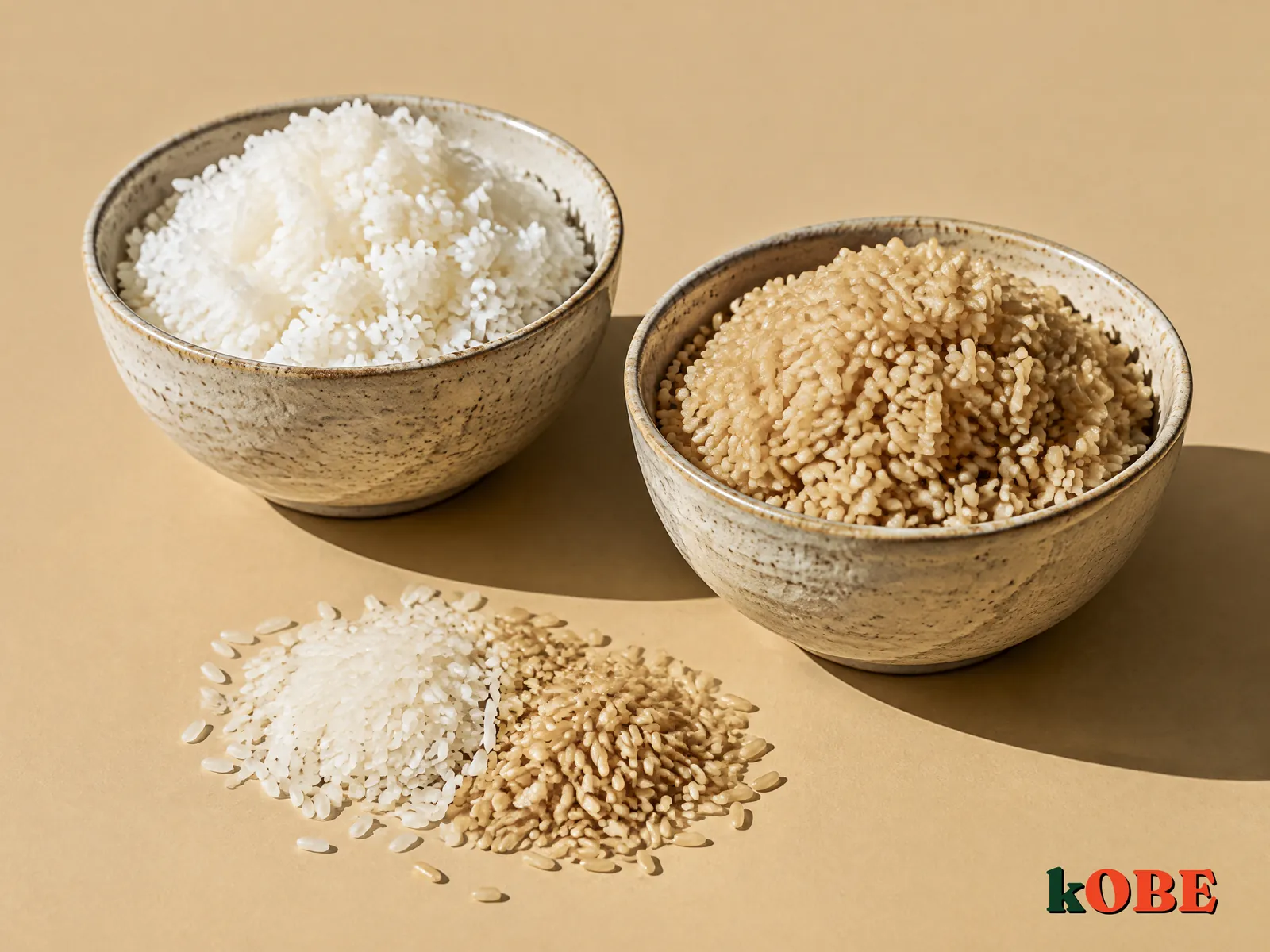
Quick quiz: 100g of brown rice or 100g of white rice, which has more calories?
Most people guess white rice. In fact the two are almost identical, both around 350 to 380 kcal per 100g of uncooked rice.
So why does everyone praise brown rice? The answer lies in a coat thinner than a sheet of paper, the one rice mills strip off every single day.
In this article
A grain of rice wears three layers
Peel a grain of rice fresh from the paddy and you will meet, in order:
- The husk: the hard outer shell, about one fifth of the grain. Not edible.
- The bran and germ: a thin brown skin hugging the grain, plus a tiny germ at one end.
- The endosperm: the white inside, almost pure starch.
Brown rice is rice with only the husk removed, keeping its bran and germ. White rice is brown rice that has been milled further until the bran and germ fall away.
Put simply: brown rice is a grain still wearing its jacket, white rice is a grain that took it off.
The bran is thin, but it is packed
The bran and germ make up only a small share of the grain's weight. But that is where the rice plant keeps almost all its "valuables".
Here is a comparison per 100g of uncooked rice, based on figures compiled in Science of Rice (2023):
| Per 100g uncooked rice | Brown rice | White rice |
|---|---|---|
| Energy | 355 to 385 kcal | 349 to 373 kcal |
| Protein | 7.1 to 8.3g | 6.3 to 7.1g |
| Fiber | 2.9 to 4.4g | 0.7 to 2.7g |
| Fat | 1.6 to 2.8g | 0.3 to 0.6g |
| Vitamin B1 | 0.4 to 0.6mg | 0.07 to 0.17mg |
| Vitamin E | 0.8 to 2.5mg | 0.1 to 0.3mg |
What the table shows:
- Calories and protein are nearly equal. Switching to brown rice does not make your bowl much "lighter".
- Brown rice has several times more vitamin B1. Vitamin B1 helps your body turn starch into energy.
- There is clearly more fiber. Fiber slows the meal down and keeps you full longer.
A lesson from history: vitamin B1
In the late 19th century, industrial rice mills made polished white rice cheap and common across Asia.
In many places, people ate little besides white rice. They developed a vitamin B1 deficiency called beriberi (known in Vietnamese as tê phù). Scientists of the time spent years working out that the missing piece sat right in the bran that had just been milled away.
Today a Vietnamese meal comes with meat, fish, eggs, beans and vegetables, so almost nobody runs short of B1 from eating white rice. But the story shows just how much that thin bran holds. To learn more about the bran, read What is in rice bran and rice bran oil.
Why does brown rice go "rancid" so quickly?
Remember the fat row in the table? Brown rice has several times more fat than white rice, and most of it sits in the bran.
When fat meets air, heat and humidity, it oxidizes. The rice starts to smell like old cooking oil, a little burnt. Saigon is hot all year round, so this happens faster than you think.
A few tips to keep brown rice smelling fresh:
- Buy only what you need for a few weeks. Skip the giant sack.
- Store it in an airtight jar somewhere cool, away from the stove.
- Keep it in the fridge if your home is hot or you use it slowly.
White rice has far less fat, so it keeps much longer. That is one reason white rice won out in history.
Does brown rice raise blood sugar more slowly?
Yes, but not as much as you might think.
The glycemic index (GI) measures how much a food raises blood sugar compared with glucose. According to the 2008 international tables, white rice averages about 73 and brown rice about 68.
The gap is real, but smaller than the gap between different rice varieties. How you cook it, how much you eat and what you eat it with matter just as much. Details in The glycemic index of different rices.
So we see brown rice as a gentle nutrition upgrade, not magic. If you love white rice, a bowl of white rice with plenty of vegetables and protein is still a very good meal.
Brown rice feels too hard. How do you learn to like it?
The bran makes brown rice nutritious, but it also makes it slow to absorb water. That is why rushed brown rice often comes out hard and chewy.
Three ways to ease in:
- Soak before cooking. White rice needs only about 30 minutes, brown rice needs much longer. See How to cook soft brown rice.
- Go half and half. Cook half brown, half white. Next week, nudge up the brown.
- Try sprouted brown rice. It is much softer and sweeter than regular brown rice: What is germinated brown rice.
Inside the kOBE kitchen
We make both, so you never have to pick a side.
Our White Rice has 130 kcal and 28g of carbs per 100g, in 200g packs. Red Brown Rice has 123 kcal, 2.7g of protein and 25.6g of carbs per 100g. Black Brown Rice has 100 kcal, 4g of protein and 21.2g of carbs, plus the anthocyanins that give it its purple color.
All three are cooked and then frozen, so the hardest part of brown rice, the soaking and cooking, is already done. Just thaw it in the fridge overnight, or reheat it in the microwave on low.
New to brown rice? Try one pack of Red Brown Rice mixed with half a bowl of your own white rice. The "half and half" approach is much easier to get used to.
Frequently asked questions
Does brown rice have fewer calories than white rice?
Do I need to rinse brown rice?
Can young children eat brown rice?
Keep reading
Sources
- Tian J. et al. (2023). Science of Rice: Chemistry and Nutrition. Springer. Chapter 2 (composition tables for brown rice, white rice and rice bran) and chapter 7 (milling).
- Atkinson F.S., Foster-Powell K., Brand-Miller J.C. (2008). International tables of glycemic index and glycemic load values: 2008. Diabetes Care 31(12):2281 to 2283.
- USDA FoodData Central: long-grain brown rice and long-grain white rice, raw and cooked.
- Harvard T.H. Chan School of Public Health, The Nutrition Source. Whole Grains.
- Further reading: Understanding Nutrition 16th ed., chapter 4 and chapter 10 (thiamin).