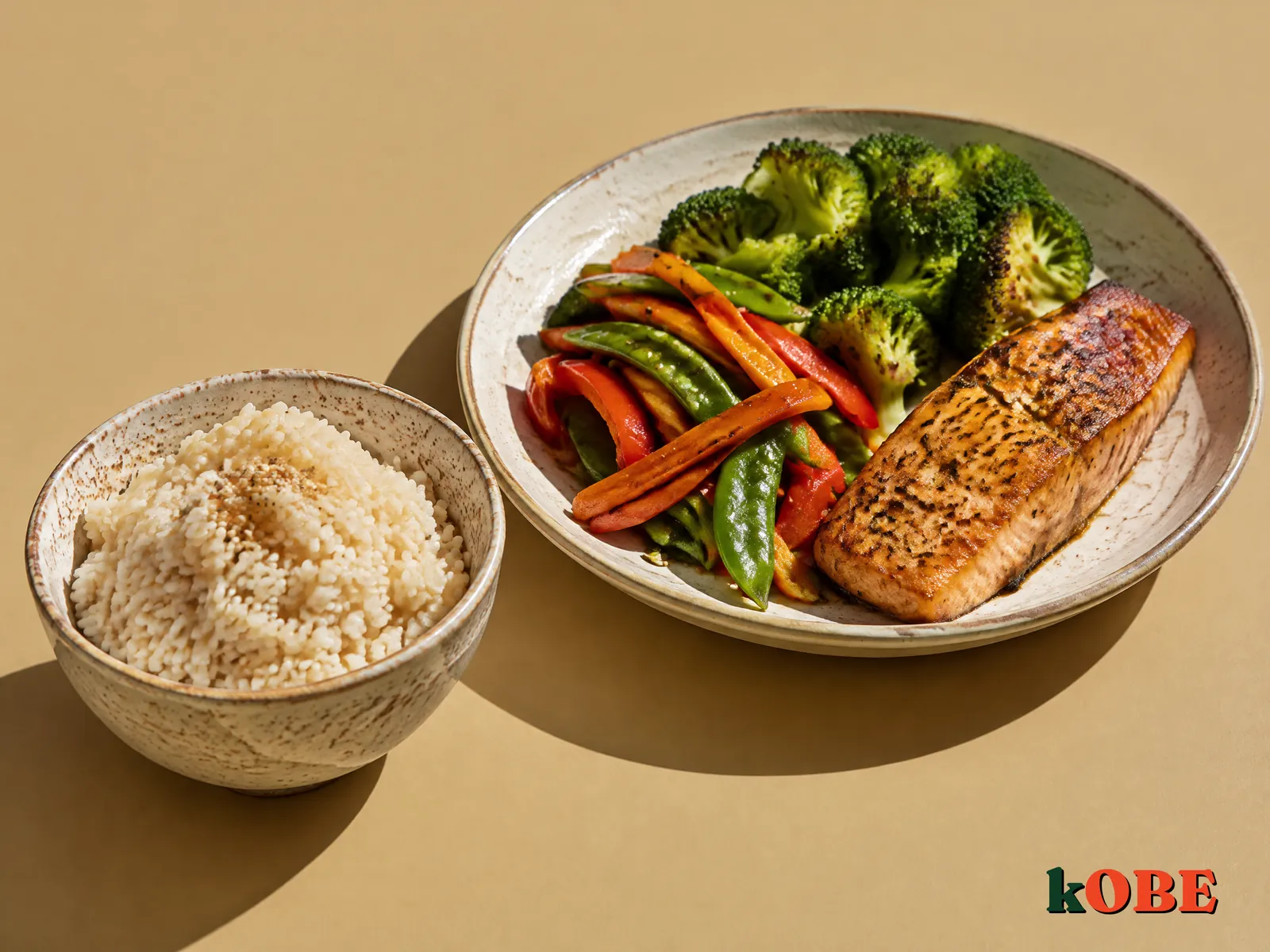
"Have another bowl, sweetie, how will you have any energy eating so little!" If you've grown up around a Vietnamese family table, you've probably heard this a hundred times.
Online, it's the exact opposite: some say cut rice out completely, others say you're only allowed a few spoonfuls per meal.
So how much rice per meal is actually right? The answer isn't one number for everyone. It's right there in the palm of your hand.
In this article
What's in a bowl of rice?
First, let's "weigh" the familiar rice bowl. According to the USDA food database, 100g of cooked white rice has about 130 kcal and 28g of carbs.
Every household's rice bowls are a different size. A moderately filled bowl, not packed down, is usually about 120 to 150g of rice. That means:
| About | |
|---|---|
| Carbs | 34 to 42g |
| Calories | 155 to 195 kcal |
| Roughly equal to | a small bánh mì, or one medium sweet potato |
A heaped, tightly packed bowl can reach 200g, which is close to 60g of carbs. Both are "one bowl", yet one holds nearly half as much again as the other.
That's why counting bowls isn't very accurate. And it's why we prefer using your hand.
Your hand: the measuring tool you always carry
Hands have one brilliant advantage: bigger people usually have bigger hands, and smaller people have smaller hands. So portions measured by hand automatically adjust to your body.
It's very simple:
- A fist (closed): about one portion of starch, like a medium bowl of rice, one sweet potato, one bundle of bún (rice vermicelli).
- Your palm (not counting fingers): one portion of protein, like a piece of fish, a piece of chicken, a block of tofu.
- Two cupped hands: one portion of vegetables.
- Your thumb: one portion of fat, like a spoonful of oil or a small handful of peanuts.
This is an estimate, not a digital scale. But it's good enough to tell whether you're eating "more" or "less" than usual.
So how many fists of starch per meal?
According to the recommendations of the National Institute of Nutrition (Vietnam) (2016), carbohydrates (starch and sugars) should provide about 55 to 65% of daily energy for Vietnamese adults.
That sounds like a lot, but remember the number includes carbs from every source: rice, noodles, bread, sweet potato, fruit, milk, beans. Not just the rice bowl.
To make it easy to picture, here's a starting point many people use, then adjust gradually based on how they feel:
| Lifestyle | Starch per main meal |
|---|---|
| Office job, not very active | about 1 fist |
| On your feet a lot, light exercise a few times a week | about 1 to 1.5 fists |
| Physical labor, hard training | 2 fists or more |
Older adults and smaller people usually need less. Growing teenagers and athletes need a lot more.
This table isn't a rule. It's a marker to help you start watching how your body responds.
Your body will tell you
After a few days of eating by "fists", notice these signals:
- Totally drowsy at 2 p.m.? Your lunch may have had too much starch, or not enough protein and veggies.
- Ravenous and shaky before the next meal? The previous meal may have been too small, or all white starch.
- Running out of steam during workouts? You may need more starch around your training.
- Comfortably full and alert until the next meal? You've probably found your portion.
Starch isn't the enemy. It's the main fuel for your brain and muscles. The only questions are how much and what you eat it with.
Four tips so you don't "accidentally" add another bowl
- Switch to a smaller bowl. The same full bowl feels more satisfying when the bowl is smaller.
- Serve once, and don't keep the rice cooker on the table. If you want more, you have to get up, and you'll ask yourself whether you're really hungry.
- Eat veggies and protein first. By the time you get to the rice, you're already half full and naturally eat a moderate amount.
- Count the "hidden" starch too. If the meal already has bread, noodles or sweet potato, cut back on rice to match. Many people forget that potato in the soup or bread dipped in curry is starch too.
Inside the kOBE kitchen
kOBE's ready-cooked rice lists its nutrition clearly, so you don't have to guess:
- White Rice: 130 kcal and 28g carbs per 100g. One 200g pack has about 260 kcal and 56g carbs, roughly one and a half fists.
- Red Brown Rice: 123 kcal, 25.6g carbs per 100g.
- Black Brown Rice: 100 kcal, 21.2g carbs per 100g.
If one pack is more than your portion, reheat half and put the rest back in the freezer. See our rice options on the Ingredients page.
Want to skip the math altogether? kOBE's Meal plans by calories page groups ready meals by energy level.
Frequently asked questions
Is it better to cut out rice completely?
Is it bad to eat rice at night?
Can I eat more if it's brown rice?
Keep reading
Sources
- National Institute of Nutrition (Vietnam) (2016). Recommended Dietary Allowances for Vietnamese People (share of energy from carbohydrates).
- USDA FoodData Central, SR Legacy: Rice, white, long-grain, regular, cooked.
- WHO. Healthy diet (fact sheet).
- Harvard T.H. Chan School of Public Health, The Nutrition Source: Healthy Eating Plate.
- Further reading: Understanding Nutrition 16th ed., chapter 4; Campbell B., Sports Nutrition, carbohydrate chapter.