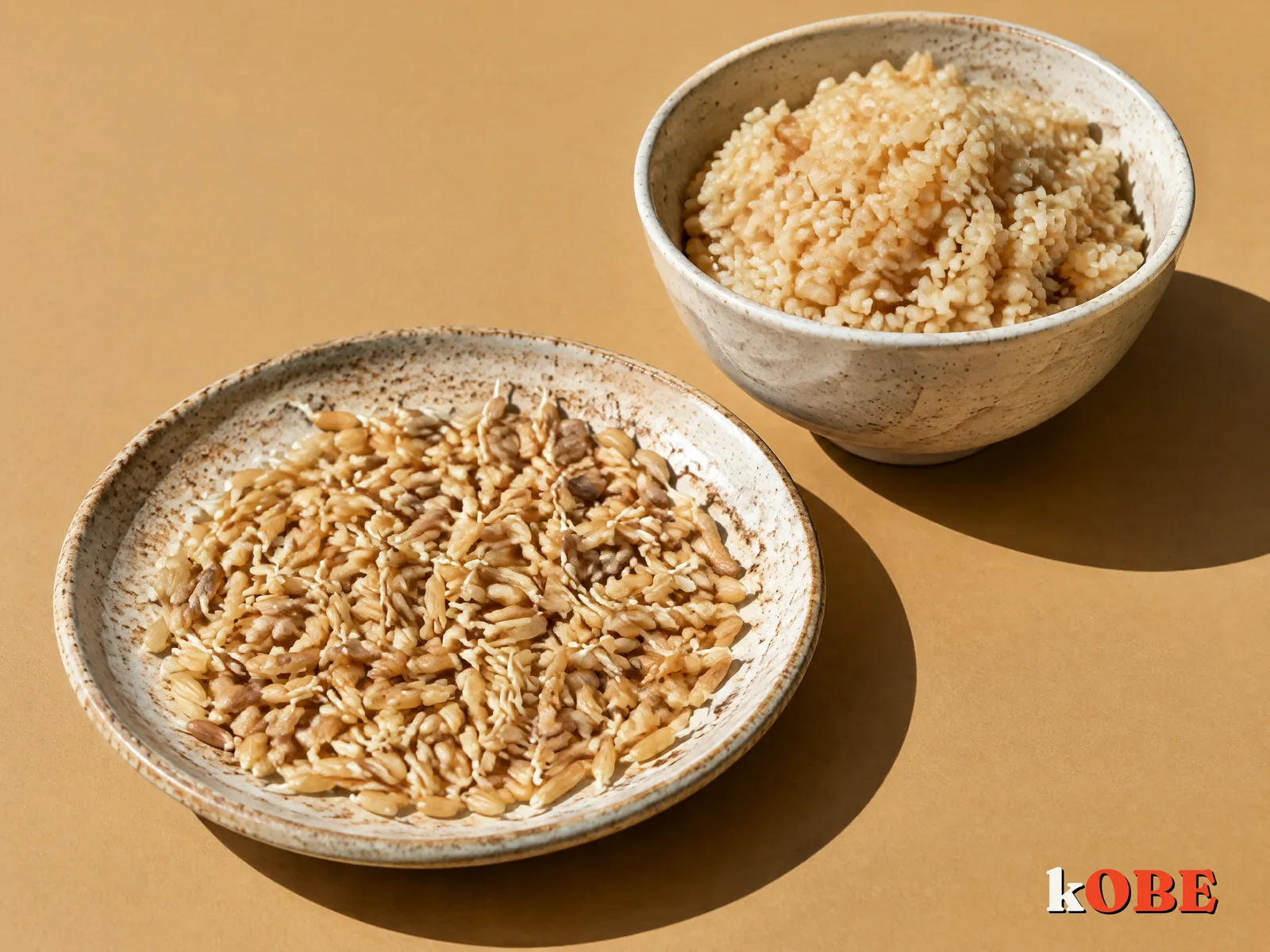
As a kid, you may have done the bean sprout experiment: soak some mung beans, wrap them in a damp towel, and a few days later little white shoots appear.
Brown rice can do exactly the same. All it needs is water, warmth and a bit of patience, and a tiny sprout will poke out of one end of the grain.
That sprout, less than a millimeter long, changes the grain more than you would expect. The rice cooks softer and tastes sweeter, and it gains a compound with a very "science class" name: GABA.
In this article
What is germinated brown rice?
It is brown rice soaked in water, then kept moist somewhere warm until a sprout of about 0.5 to 1mm appears. Then it is dried again. From the outside, it looks almost like regular brown rice.
In English it is called germinated or sprouted brown rice. In Vietnam people often just call it gạo mầm ("sprouted rice").
Only brown rice can sprout. White rice has had its germ milled away, so you could soak it for a week and nothing would grow.
Inside the grain, a whole "construction site" wakes up
A dry grain of rice is a sleeping seed. Give it water and warmth and it starts planning to grow into a rice plant, so it begins clearing out its pantry.
A whole team of enzymes switches on:
- Starch-cutting enzymes break some of the starch into small sugars. That is why the rice tastes sweeter.
- Protein-cutting enzymes release more free amino acids.
- Phytase breaks down some of the phytic acid, a compound that tends to "lock up" minerals like iron and zinc. As a result, those minerals may be easier to absorb.
- Some of the fat in the bran is burned as energy for the sprout.
The most obvious result is in your mouth: sprouted brown rice is softer, stickier and quicker to cook than regular brown rice. For anyone who finds brown rice too hard, it is a friendly way in.
What is GABA, and why does everyone mention it?
GABA stands for gamma-aminobutyric acid. It is an amino acid, but unlike most amino acids it is not used to build protein.
In the body, GABA is best known as a neurotransmitter. Its job is to "cool things down", helping nerve cells become less excitable. Your brain makes its own GABA.
When the grain sprouts, its enzymes turn glutamic acid into GABA. The amount rises sharply:
| Sprouting conditions | GABA compared with regular brown rice |
|---|---|
| About 24 hours at 35°C | about 4 times higher |
| Longer sprouting time | up to about 12 times |
| Soaked in a special solution (lab setting) | up to about 13 times |
Figures compiled in Science of Rice (2023). The actual increase depends on the rice variety, temperature, soaking time and incubation.
What is proven and what is still being studied
This is the part where we want to be really clear.
Proven:
- Sprouting raises the GABA in rice several times over.
- Sprouted brown rice is softer, sweeter and easier to eat than regular brown rice.
- Sprouted rice is still whole grain brown rice, bran and all.
Still being studied:
- Where does the GABA you eat go? Scientists are still debating whether GABA from food can cross the blood-brain barrier. That means "eat GABA and your brain gets calmer" is not proven.
- Blood sugar: a few studies found sprouted rice gives a gentler rise in blood sugar after meals. But other studies found sprouting increases the fast-digesting starch, because the enzymes have already pre-cut some of it. The results are mixed.
And one thing does not change: sprouted rice has almost the same calories and starch as regular brown rice. It is an easier-to-eat version of brown rice, not an "eat as much as you like" rice.
Making sprouted rice at home: yes, but keep it clean
Warm water and long-soaked grains are also a place bacteria love. If you make your own, remember these steps:
- Rinse the brown rice well and discard any shriveled or floating grains.
- Soak in clean water at room temperature. Saigon's roughly 30°C is just right.
- Change the water every 4 to 6 hours. Water left too long starts to ferment and smell unpleasantly sour.
- Rest it in a colander under a damp towel until you see a tiny white sprout at the tip of the grain, usually after one to two days.
- Cook it right away or keep it in the fridge and use it soon. Do not leave damp rice sitting in the kitchen.
If the rice smells off, feels slimy or grows mold, throw it out. It is not worth it.
Sprouted rice has already absorbed water, so cook it with less water than dry brown rice. For water ratios and soaking times for regular brown rice, see How to cook soft brown rice.
Inside the kOBE kitchen
Sprouted rice and regular brown rice share one thing: they take time to soak, sprout and cook. That is exactly why so many people give up.
Our answer to the time problem is to cook ahead and freeze. Red Brown Rice (123 kcal, 25.6g of carbs per 100g) and Black Brown Rice (100 kcal, 21.2g of carbs, with anthocyanins) are both cooked and then frozen, so all you do is reheat.
If you make sprouted rice at home, the same trick works: cook a big batch, portion it into one-bowl boxes, and freeze it as soon as it cools a little. For how to store and reheat rice so it stays soft, read Reheating frozen rice.
Frequently asked questions
Is sprouted rice genetically modified?
Do I still need to soak sprouted rice before cooking?
Should I switch entirely to sprouted rice?
Keep reading
Sources
- Tian J. et al. (2023). Science of Rice: Chemistry and Nutrition. Springer. Chapter 11 Germinated Brown Rice (summarizing Jirapa et al. 2016; Benincasa et al. 2019; Oh 2003; Patil and Khan 2011).
- Patil S.B., Khan M.K. (2011). Germinated brown rice as a value added rice product: a review. Journal of Food Science and Technology 48(6):661 to 667.
- Boonstra E. et al. (2015). Neurotransmitters as food supplements: the effects of GABA on brain and behavior. Frontiers in Psychology 6:1520.
- Further reading: Understanding Nutrition 16th ed., chapter 4 and chapter 6.