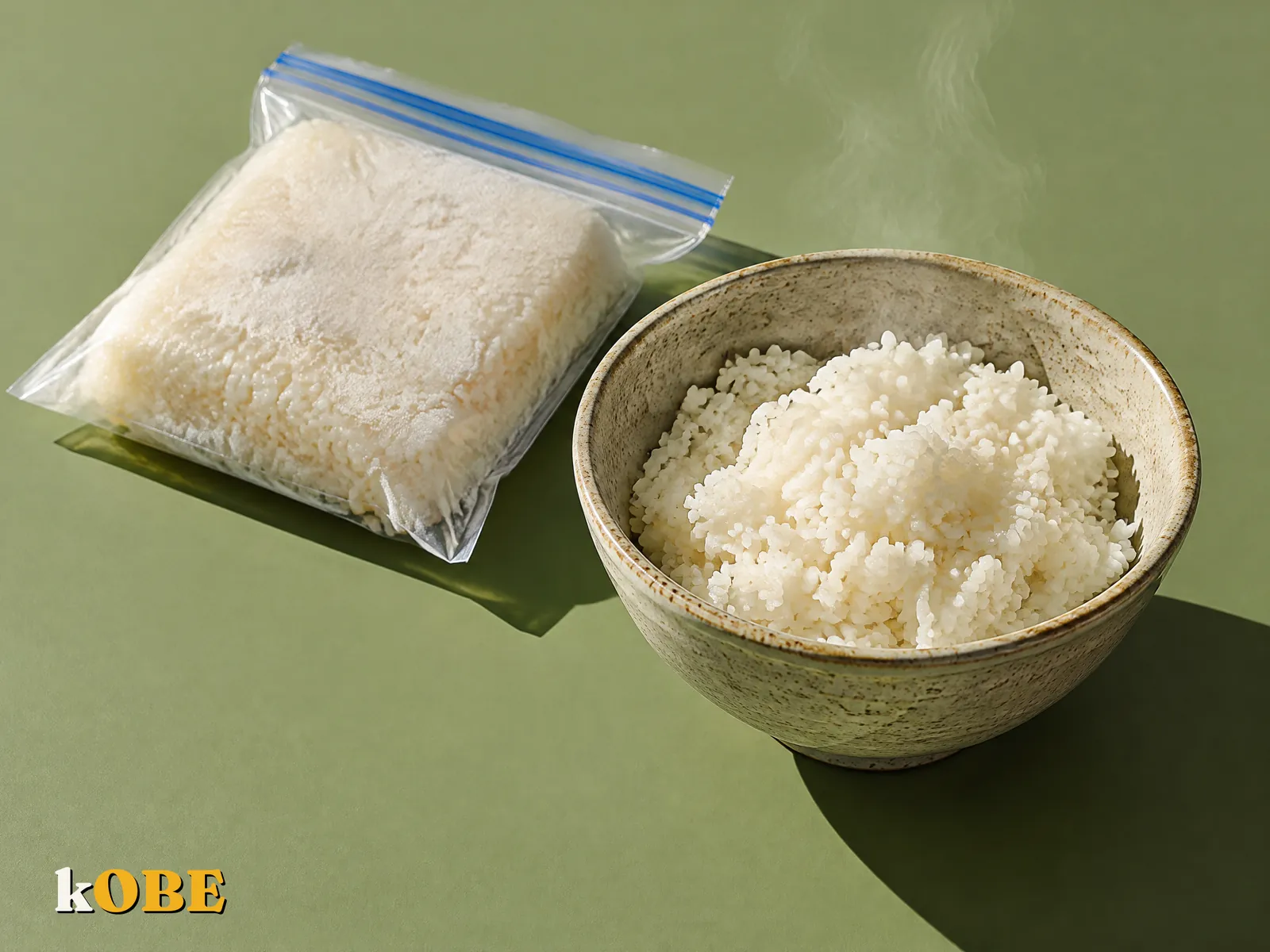
Anyone who has reheated frozen rice knows this scene: three minutes in the microwave, and the edges of the box are scorching hot while the middle is still a block of ice.
Or this one: you thaw it carefully, reheat it carefully, and the rice is still dry and firm, nothing like freshly cooked.
The good news is that both problems have a fix. And the fix starts with a very narrow temperature range: 0 to 5°C.
In this article
- The temperature where starch most loves to "line up"
- Freeze it right from the start: small ice crystals, soft rice
- Why does the microwave give you "half boiling, half ice"?
- The recipe for soft microwave-reheated rice
- No microwave? There are still two ways
- Inside the kOBE kitchen
- Frequently asked questions
The temperature where starch most loves to "line up"
Rice is soft because the starch inside has swollen open and soaked up water. As rice cools, the starch chains want to huddle together and line up the way they were. The straighter the lines, the harder the rice.
Scientists have measured it: this lining up happens fastest at around 0 to 5°C, exactly the temperature of your fridge. In the freezer, the starch barely moves.
So the secret to soft frozen rice fits in one sentence: get through the 0 to 5°C zone as fast as possible, both when freezing and when reheating.
For more on starch lining up, read How cold rice differs from hot rice.
Freeze it right from the start: small ice crystals, soft rice
Great reheated rice begins the moment it goes into the freezer.
When the water in the grains freezes slowly, it forms fewer but bigger ice crystals. Big crystals pierce the cells inside the grain. When it thaws, water leaks out and the rice turns dry and crumbly.
When it freezes fast, the water forms lots of tiny ice crystals. The cells are less damaged, and the rice stays moist.
So how do you freeze quickly at home?
- Pack it while the rice is still warm, instead of letting it cool completely on the counter. It tastes better and it is safer.
- Portion it one bowl at a time into zip bags or small boxes.
- Press it flat, about 2 to 3cm thick. A flat slab freezes much faster than a round lump.
- Lay it flat against the freezer wall, the coldest spot. Stack the packs only once they are frozen solid.
- Write the date on the bag. The longer rice sits, the bigger the ice crystals grow, so it tastes best within a few weeks.
One more note: do not thaw and refreeze again and again. Each round costs the rice more water and makes it clumpier.
Why does the microwave give you "half boiling, half ice"?
A microwave heats food by making water molecules vibrate. But ice and liquid water react to microwaves very differently.
The thawed parts of the rice absorb microwave energy much more strongly than the still-frozen parts. That sets up a loop: whatever thaws first heats up faster and faster, while the icy parts stay cold.
That is why the edges bubble while the center is still ice. It is also why frozen food packaging so often says to reheat on a low power setting: the energy goes in more slowly, giving heat time to spread from the hot spots to the cold ones.
A fun extra detail: containers with rounded corners heat more evenly than square ones. In sharp corners, microwaves bounce around unpredictably, so some spots overheat while others stay cold.
The recipe for soft microwave-reheated rice
For one frozen portion of about 150 to 200g:
- Move the rice onto a microwave-safe plate or container. Ordinary plastic bags should not go in the microwave.
- Sprinkle about 1 tablespoon of water over the top. That little bit of water turns to steam and helps the grains take up moisture again.
- Cover loosely with a lid or an upside-down plate, leaving a gap for steam to escape.
- Heat on low to medium for a few minutes, then open it, fluff the rice with chopsticks, and move the middle to the outside.
- Finish on high for another minute or two until the rice is steaming hot all over, including the center.
- Let it stand for 1 minute before eating. The heat keeps moving inward.
Every microwave is different, so time it the first time and you will know it by heart after that.
For safety, the USDA recommends reheating leftovers until the center reaches about 74°C. No thermometer? Look for rice that is steaming evenly everywhere, with no lukewarm spots.
No microwave? There are still two ways
A steamer. Put the frozen rice (out of the bag) in a steamer basket and steam for about 10 to 15 minutes. The steam makes the rice moist and soft very evenly. This is the method that comes closest to "freshly cooked".
A lidded pan. Put the rice in a non-stick pan, add 2 to 3 tablespoons of water, cover, and keep the heat low. Stir gently now and then. About 5 to 7 minutes and it is done, handy if you plan to make fried rice anyway.
And the method to avoid: leaving the bag on the counter for hours to thaw on its own. The rice sits too long in the temperature range bacteria love, and it moves slowly through 0 to 5°C, so it hardens too. The safety reasons are explained in Storing cooked rice.
Inside the kOBE kitchen
Our White Rice (200g packs), Red Brown Rice and Black Brown Rice are all cooked and then frozen. We suggest two ways to reheat, each giving a slightly different result:
- Microwave on low, straight from the freezer. The rice moves quickly through 0 to 5°C, so it comes out softest, almost freshly cooked.
- Thaw in the fridge overnight, then reheat. Handy if you pack lunch boxes the night before. The rice will be a little firmer, but in return it gains a little resistant starch, as we explain in our cold rice article.
There is no wrong choice. Whether you like your rice soft or firm, pick that method.
Frequently asked questions
Does frozen rice lose nutrients?
How long does frozen rice keep?
Should I add water when reheating rice?
Keep reading
Sources
- Tian J. et al. (2023). Science of Rice: Chemistry and Nutrition. Springer. Chapter 9 (freezing, ice crystals, thawing and microwave reheating; summarizing Kono et al. 2015, 2017; Lee and Yoo 2020).
- USDA FSIS. Leftovers and Food Safety.
- USDA FSIS. Cooking Safely in the Microwave Oven.
- Further reading: Culinary Nutrition; Understanding Nutrition 16th ed., chapter 4.