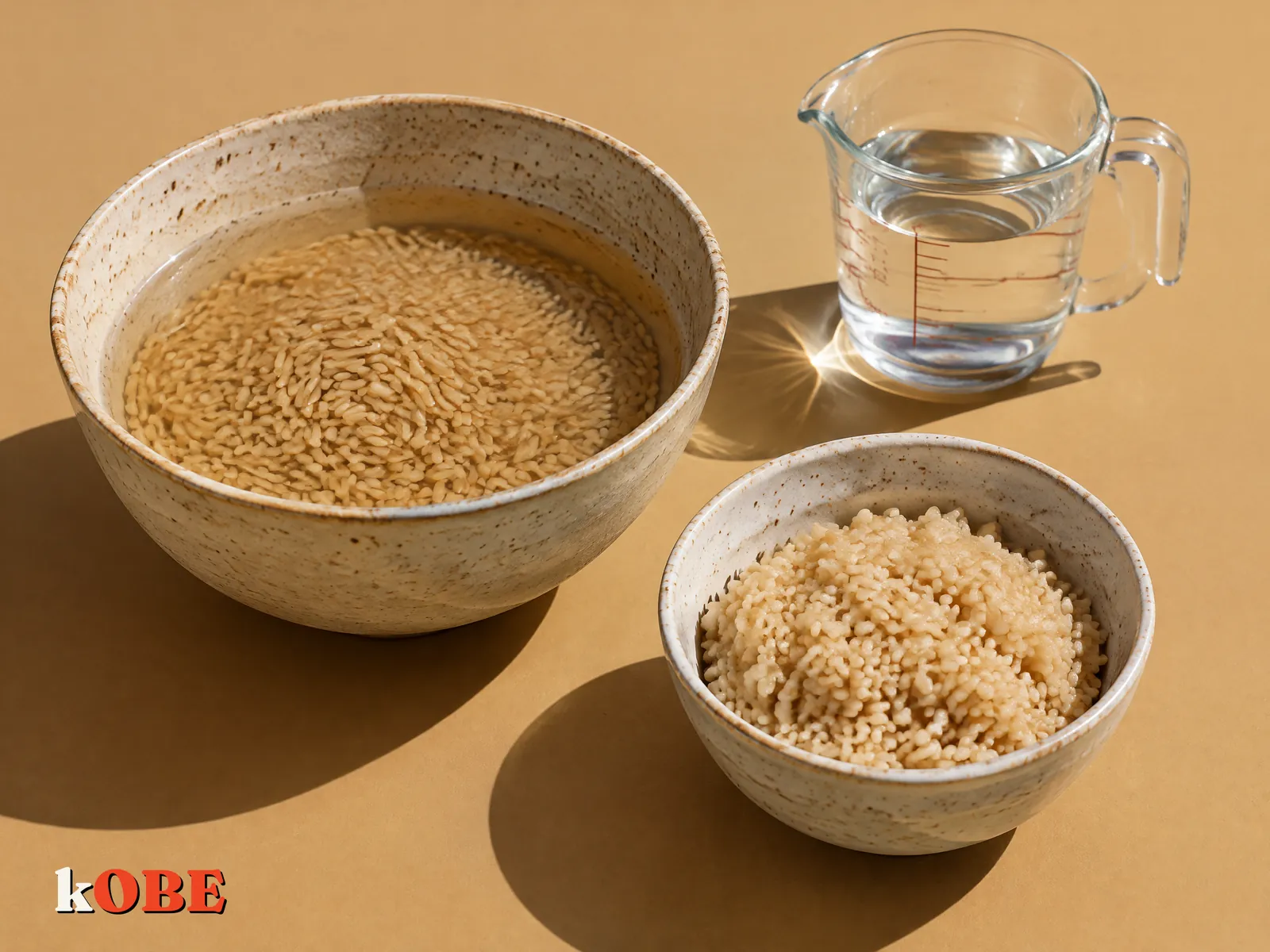
The first time they cook brown rice, many people handle it exactly like white rice: rinse, add water, press the button. The cooker clicks off, the lid opens, and the grains are hard, swollen on the outside but still chalky in the middle.
Then comes the verdict: "Brown rice is just hard to eat."
In truth, brown rice is not hard to eat. It is just slow to absorb water. Once you understand that, you can cook soft, tender brown rice without any fancy tricks.
In this article
- Why does brown rice take longer to soften than white rice?
- How long is long enough? It depends on the water temperature
- Do not soak too long in hot weather
- How much water? An easy starting point
- Do not open the lid the moment it clicks off
- Tips for beginners: one step at a time
- Inside the kOBE kitchen
- Frequently asked questions
Why does brown rice take longer to soften than white rice?
Brown rice still wears its bran. The bran holds fiber and a little fat, and it works like a thin raincoat: water takes a long time to sneak through to the starchy center.
For starch to cook soft, water has to reach the very core of the grain. If it does not, the core stays undercooked. That is the chalky, "not quite done" bite.
Scientists have measured how fast rice absorbs water depending on how much it is milled. The more polished the rice, the faster it absorbs water. Unmilled brown rice absorbs the slowest, many times slower than white rice.
To see what that bran holds and why it is worth the patience, read How brown rice and white rice differ.
How long is long enough? It depends on the water temperature
This is the most interesting number. A Japanese study measured how long brown rice needs to soak to absorb as much water as white rice does at its maximum:
| Soaking water temperature | Time needed |
|---|---|
| About 20°C (cool water) | about 17 hours |
| About 30°C (room temperature in Saigon) | about 7 hours |
| About 60°C (hot water) | about 2 hours |
Compared with white rice, which usually needs only about 30 minutes, brown rice really is a "slow learner".
Good news for anyone in Saigon: room temperature of about 30°C shortens the wait a lot. Practical suggestions:
- Soak in the morning, cook in the evening, about 6 to 8 hours.
- Or soak at night, cook in the morning, but no more than about 8 hours at room temperature.
- Too busy? Even 2 hours of soaking is far better than none. Just add a little more water when cooking.
Do not soak too long in hot weather
Does a longer soak mean softer rice? Up to a point, no, and past it, it does harm.
Research shows that rice soaked in 30°C water for 12 hours scored lower on taste, turned yellow and smelled odd when kept warm after cooking. Soaking water left too long in hot weather also starts to ferment and go sour.
A few rules to keep your rice smelling good:
- Rinse the rice two or three times before soaking, removing dust and shriveled grains.
- If soaking overnight, keep the bowl in the fridge, or change the water halfway.
- Smell the soaking water before cooking. If it smells sour, rinse the rice again well.
Many rice cookers with a "brown rice" setting are really doing exactly this: soaking the rice in warm water for a while before heating. Warm water helps the grains absorb faster and wakes up a few enzymes in the grain that make the rice taste sweeter.
How much water? An easy starting point
Brown rice needs more water than white rice, because the bran absorbs water too and it boils longer. Here is our suggested starting point, measured by cup:
| Type of rice | Water per 1 cup of rice |
|---|---|
| White rice | about 1 to 1.2 cups |
| Brown rice soaked 6 to 8 hours | about 1.5 cups |
| Brown rice soaked briefly or not at all | about 2 cups |
This is a starting point, not a rule. Every rice variety and every pot is different. Follow the table the first time, then add or remove a few spoonfuls of water to taste.
An interesting finding from research: brown rice soaked until it holds about 30% water cooks up clearly softer and stickier than rice holding only about 20%. In other words, soaking enough matters more than adding more water. Add lots of water without enough soaking and you tend to get rice that is mushy outside and hard inside.
Do not open the lid the moment it clicks off
When the cooker clicks off, the rice is not finished. The outside of the grains is still wet and the core is still cooking.
Rice cooking research shows that for starch to cook evenly, rice needs to stay at about 98°C or above for roughly 20 minutes through the boiling and drying stages. After that comes the resting stage (the Japanese call it murasu).
So:
- After it clicks off, leave it for another 10 to 15 minutes, lid closed.
- Open the lid and fluff gently from the bottom up with chopsticks or a rice paddle. This evens out the moisture between the top and bottom layers.
- Close the lid for a few minutes before serving.
Skip the fluffing and the top layer soaks up the condensed steam and slowly goes mushy, especially when kept warm for a long time.
Tips for beginners: one step at a time
- Week one: one part brown rice, two parts white. Soak the brown rice separately, then cook them together.
- The next week: half and half.
- Once you are used to it: all brown rice, or try germinated brown rice, which is naturally softer.
If you cook extra, portion it into boxes and freeze it while it is still warm. For how to reheat it soft again, see Reheating frozen rice.
Uncooked brown rice needs careful storage too: the bran contains fat, so it goes rancid easily in hot weather. Keep it in an airtight jar somewhere cool, or in the fridge if you use it slowly.
Inside the kOBE kitchen
All of the steps above (rinsing, soaking, measuring water, resting, fluffing) are the reason so many people give up on brown rice after a few weeks.
Our Red Brown Rice and Black Brown Rice are cooked and then frozen, so the time-consuming part is done. Every 100g of Red Brown Rice has 123 kcal and 25.6g of carbs. Black Brown Rice has 100 kcal, 21.2g of carbs and anthocyanins.
Just thaw it in the fridge overnight, or reheat it in the microwave on low. On days with time, cook your own using the guide above. On busy days, have rice ready to go. Both are fine.
Frequently asked questions
Does a pressure cooker make brown rice softer?
Should I cook brown rice with a little salt or oil?
Should I cook brown rice in its soaking water?
Keep reading
Sources
- Tian J. et al. (2023). Science of Rice: Chemistry and Nutrition. Springer. Chapter 8 Cooking of Rice (summarizing Kuwada et al. 2011; Han and Lim 2009; Kainuma and Seki 1986; Fukai et al. 2006; Muramatsu et al. 2006).
- USDA FoodData Central: long-grain brown rice, raw and cooked.
- Harvard T.H. Chan School of Public Health, The Nutrition Source. Whole Grains.
- Further reading: Culinary Nutrition; Understanding Nutrition 16th ed., chapter 4.