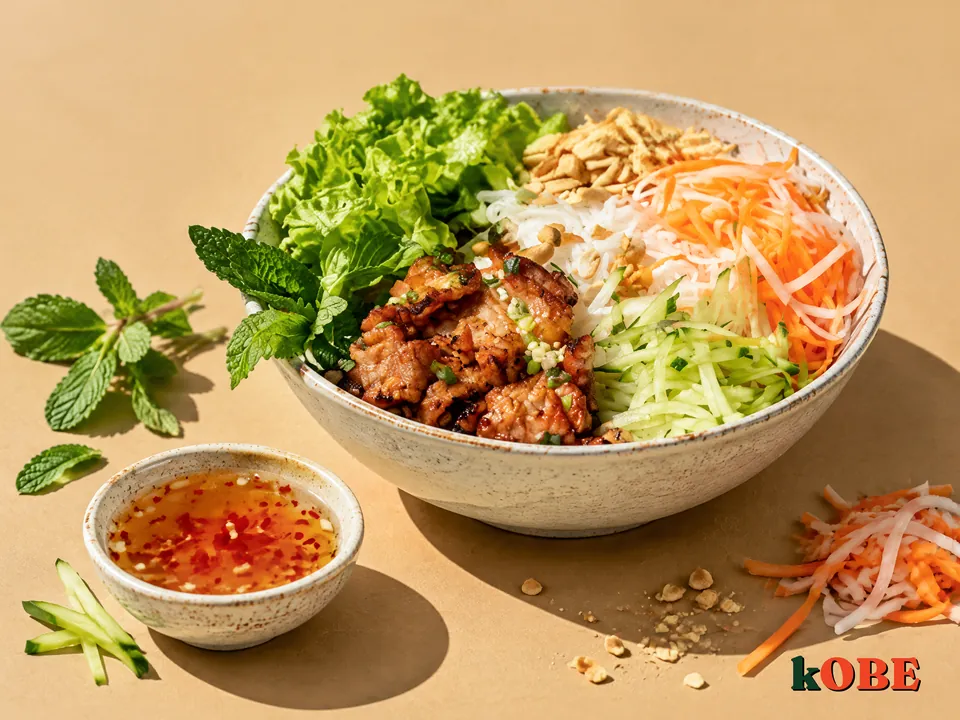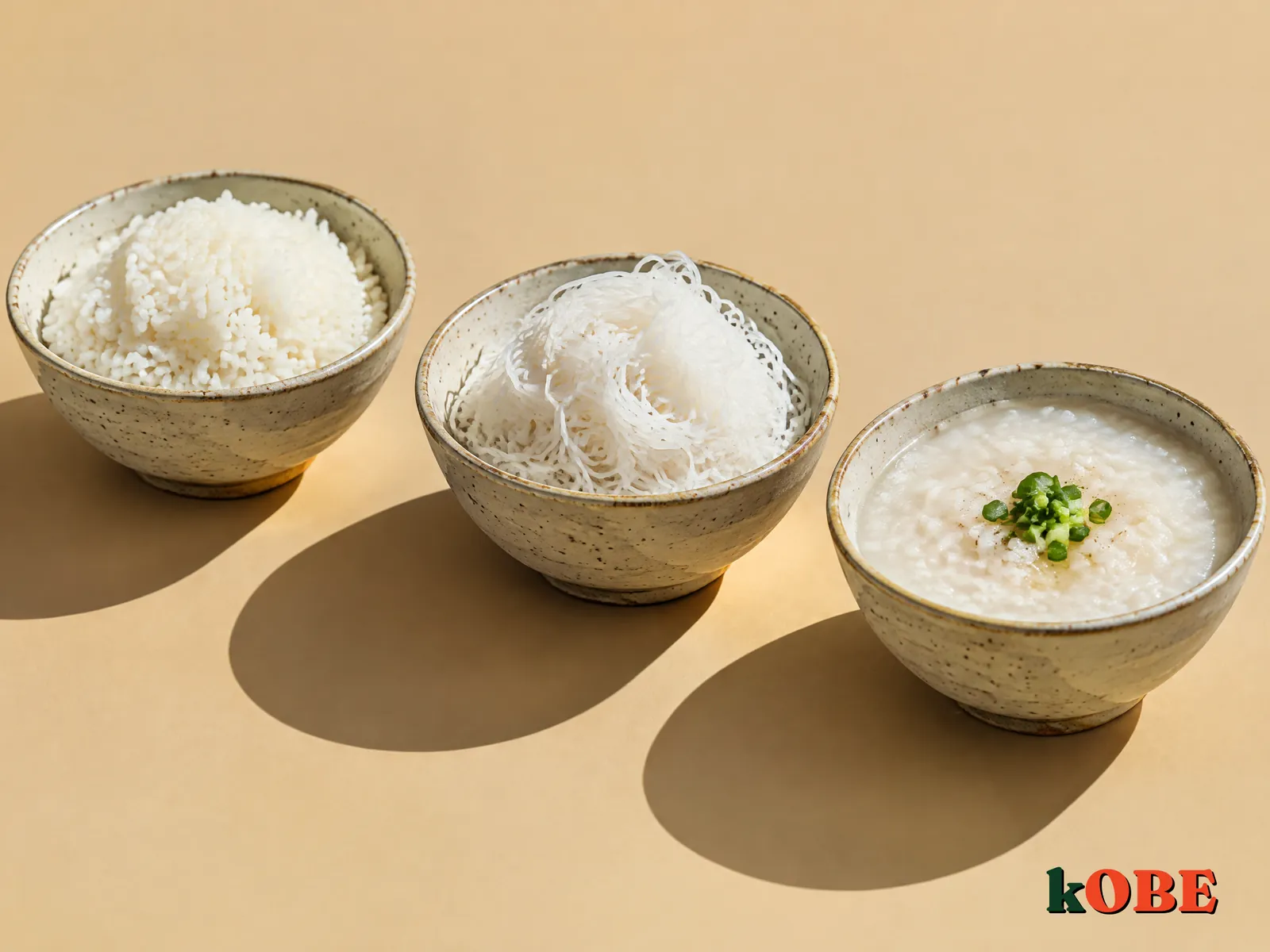
Quick question: a bowl of bún (rice vermicelli) or a bowl of white rice, which raises blood sugar faster?
Many people guess bún, because it is soft and slippery. But according to the international tables, rice noodles have a clearly lower glycemic index than white rice.
And the bowl of plain cháo (rice porridge) we cook when we are sick? It is higher than rice. Same grain, different cooking, and the number changes completely. The glycemic index of rice is full of surprises like that.
In this article
What is the glycemic index?
The glycemic index (GI) tells you how fast or slowly a food raises your blood sugar, compared with drinking pure glucose.
The idea behind the test is quite simple:
- Volunteers eat an amount of the food containing exactly 50g of digestible carbohydrate.
- Their blood sugar is measured over the next 2 hours.
- The result is compared with drinking 50g of glucose, which counts as 100.
Results fall into three groups:
- Low GI: 55 or below.
- Medium GI: 56 to 69.
- High GI: 70 or above.
Think of GI as the speed a vehicle drives into your blood. Glucose is a motorbike racing straight in. A low GI food is a bicycle taking its time.
GI of rice and other familiar starches
Here are the average figures from the University of Sydney's 2008 international GI tables (Atkinson et al.):
| Food | Average GI | Group |
|---|---|---|
| Glucose (for comparison) | about 103 | High |
| Plain cháo (rice porridge) | about 78 | High |
| White bread | about 75 | High |
| White rice | about 73 | High |
| Brown rice | about 68 | Medium |
| Boiled sweet potato | about 63 (varies widely by variety) | Medium |
| Rolled oat porridge | about 55 | Low |
| Bún, rice noodles | about 53 | Low |
A few things worth noticing:
- Brown rice is only about 5 points lower than white rice. There is a difference, but it is not night and day. Detailed comparison in How brown rice and white rice differ.
- Sticky rice and xôi are not in this average table, but individual studies usually place sticky rice in the high GI group.
- These are averages. Each food has a fairly wide range.
Same rice, so why the gap?
The 2021 tables recorded a very wide range of GI values for rice across studies, from the low group to the very high group. A few main factors:
1. Rice variety and amylose. High-amylose rice (fluffy rice) usually has a lower GI than low-amylose rice (soft, sticky rice). Sticky rice has almost no amylose, so it tends to be high. This is explained in What is amylose.
2. How it is cooked. The longer it cooks, the more the starch granules burst open and the easier enzymes can cut them. That is why cháo is higher than rice.
3. Its shape after processing. Bún and phở noodles are made from rice flour that is kneaded, pressed, boiled and then cooled. The starch in a noodle strand packs more tightly than in a grain of rice, so it digests more slowly.
4. Hot or cold. Rice kept in the fridge and then reheated gives a slightly lower blood sugar rise after the meal than freshly cooked rice. Read How cold rice differs from hot rice.
5. What you eat it with. A bowl of rice eaten with fish, vegetables and a little oil sends sugar into your blood more slowly than plain rice. The GI in the table is measured on the plain food, and a real meal is rarely eaten plain. See "Dressing up" your starch.
A number that matters just as much: how much you eat
GI only tells you the speed, not the amount. One bowl of rice and three bowls of rice have the same GI, but their effect on blood sugar is very different.
That is why scientists also use glycemic load (GL):
GL = GI × grams of carbohydrate in the serving ÷ 100
Let's try it with a medium bowl of white rice, about 150g of cooked rice with roughly 40g of carbohydrate:
- One bowl: 73 × 40 ÷ 100 = about 29, in the high GL group (20 or above).
- Half a bowl: about 15, the medium group.
It becomes clear: eating half a bowl less rice and adding a plate of vegetables does far more than straining to switch to a rice with a GI a few points lower.
Use GI wisely, do not let GI lead you by the nose
GI is a useful tool, but it has limits:
- Low GI does not mean healthier. French fries have a lower GI than boiled potatoes, because the oil slows digestion. But nobody thinks fries are something to eat more of.
- Everyone responds differently. The same bowl of rice can raise two people's blood sugar very differently.
- There is little data on Vietnamese rice. Most international GI tables measured rice from other countries. The rice in your kitchen may be higher or lower than the average.
The sensible way to use it: think of GI as a hint for choosing and pairing foods, not a scorecard that makes you afraid of any dish.
Inside the kOBE kitchen
We do not put GI labels on our products, because GI has to be measured on people with a specific protocol. What we do list clearly is carbs per 100g, so you can work out your own portion.
Every 100g of White Rice has 28g of carbs. Red Brown Rice has 25.6g, Black Brown Rice has 21.2g. All three are cooked and then frozen. To work out the GL of your portion, multiply the grams of rice by the carbs per 100g, then plug it into the formula above.
And in kOBE frozen rice bowls, the rice always comes with a main dish and Sesame Kale. In other words, the rice always has protein and vegetables as "travel companions", just like point 5 above.
Frequently asked questions
Is brown rice a low GI rice?
Is eating bún instead of rice better?
Should I avoid cháo?
Keep reading
Sources
- Atkinson F.S., Foster-Powell K., Brand-Miller J.C. (2008). International tables of glycemic index and glycemic load values: 2008. Diabetes Care 31(12):2281 to 2283.
- Atkinson F.S. et al. (2021). International tables of glycemic index and glycemic load values 2021: a systematic review. American Journal of Clinical Nutrition 114(5):1625 to 1632.
- Sonia S., Witjaksono F., Ridwan R. (2015). Effect of cooling of cooked white rice on resistant starch content and glycemic response. Asia Pacific Journal of Clinical Nutrition 24(4):620 to 625.
- Harvard T.H. Chan School of Public Health, The Nutrition Source. Carbohydrates and Blood Sugar.
- Further reading: Understanding Nutrition 16th ed., chapter 4; Tian J. et al. (2023), Science of Rice, chapters 2 and 11.