You are reading this with about 38 trillion bacteria. They are not far away. They live right inside your belly, mostly in your large intestine.
That number is roughly the same as the total number of cells in your own body. Head for head, you and your "lodgers" are almost evenly matched.
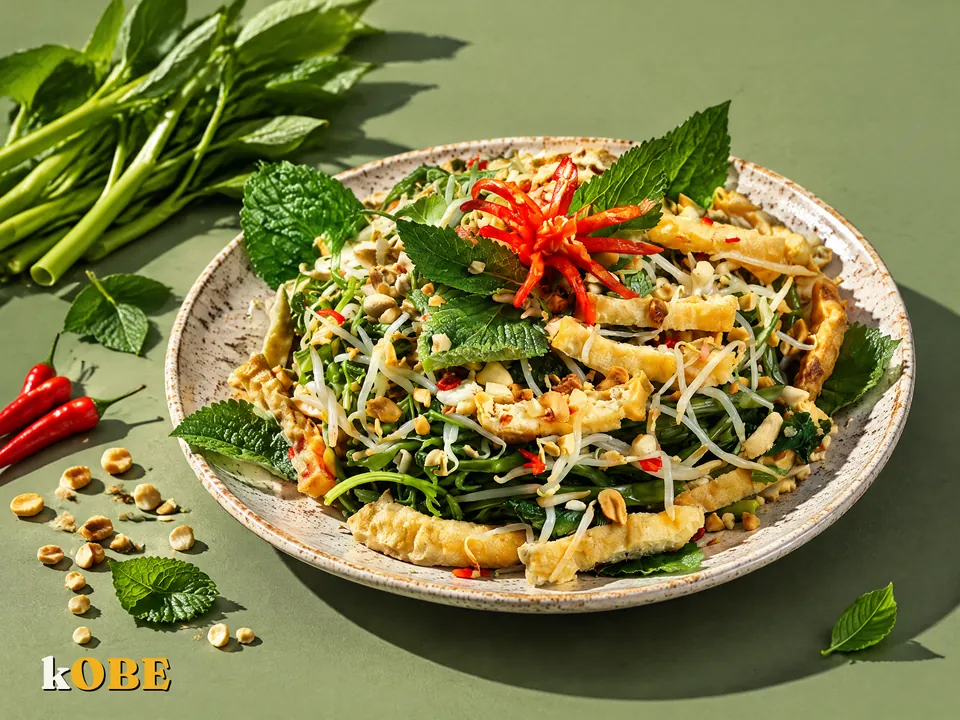
Every time you pick up a chopstick-load of rau muống (morning glory, the stir-fry green of every Vietnamese kitchen), part of it is not meant for you. It travels straight down to the large intestine and becomes dinner for those lodgers. That part is called fiber.
This article is the map for the whole series. We cover what fiber is, what bacteria do with it, what science is sure about and what is still being studied.
In this article
You never eat alone
The community of microbes living in your gut is called the gut microbiota. It includes bacteria, yeasts and even viruses, but bacteria are by far the biggest crowd.
A few numbers to picture it:
- About 38 trillion bacteria. A team of scientists in Israel recalculated this in 2016. The old claim of "ten times more than human cells" turned out to be inflated.
- Total weight of only about 200g, roughly three chicken eggs. A huge crowd, very light.
- Hundreds of different species in each person. And no two people match, not even siblings.
The small intestine is fairly empty. Acidic digestive juices and a fast flow of food make it hard for bacteria to settle. Further down, in the large intestine, the flow slows and there is almost no oxygen. That is the busiest "neighborhood" of all.
Fiber: the part of your meal you cannot digest yourself
Your body has its own set of "scissors" called digestive enzymes. They cut starch into glucose, protein into amino acids and fat into small pieces.
But there is one group of carbohydrates these scissors cannot cut. That is dietary fiber. You find it in the cell walls of vegetables, seed coats, the bran layer of rice, beans and fruit.
Fiber passes through the stomach and the small intestine almost untouched. In the large intestine it meets guests who own scissors that humans do not have.
Fiber is not one substance but a whole family. Some kinds soak up water into a gel, like soaked hạt é (basil seeds). Some keep their shape, like a rau muống stem. We go deeper in the article on soluble and insoluble fiber.
There is one more special family member: resistant starch. This is starch that "sneaks" past the small intestine and then behaves like fiber. Cooled rice is the familiar example; see cold rice and resistant starch.
Bacteria eat fiber, then what do they "cook"?
When bacteria eat fiber, they do something called fermentation. Just as yeast turns sugar water into alcohol, bacteria turn fiber into new substances.
The most important products are a group called short-chain fatty acids (SCFAs). Three names you will meet often:
| Name | Where it goes, what it does (fairly well established) |
|---|---|
| Butyrate | Main energy source for the cells lining the large intestine |
| Propionate | Mostly carried to the liver to be processed |
| Acetate | Enters the blood and reaches many other organs |
The most fun detail is butyrate. The cells lining your large intestine "eat" mainly what bacteria cook for them. Put simply, you feed the bacteria, and the bacteria feed your gut lining right back.
Another by-product of fermentation is gas. So if eating more beans and vegetables makes you pass more wind, that is normal. It is a sign the bacteria are at work.
What we know for sure and what is still being studied
The gut microbiome is one of the hottest areas in nutrition science right now. So hot that a lot of marketing runs ahead of the evidence.
So let us keep things clearly apart:
| Fairly well established | Still being studied |
|---|---|
| Fiber is the main food of bacteria in the large intestine | What a standard "healthy" microbiome looks like |
| Fermenting fiber produces short-chain fatty acids | How much bacteria affect mood and sleep |
| Fiber makes stools softer, bulkier and more regular | Which bacterial species suit which person |
| Changing your diet changes your microbiome, fairly quickly | What at-home stool tests mean for an individual |
Many of the most exciting studies today are done in mice. Many human studies are observational: they see two things travel together, but cannot yet say that one causes the other.
What we dare to say with confidence: eating enough fiber from many kinds of plants is a habit with good evidence behind it. Major organizations such as WHO all recommend it. As for promises like "one probiotic capsule will change your life", read those slowly.
Without fiber, what would bacteria eat?
A few mouse experiments have answered this question, and the answer is quite surprising.
In 2016, a team in the United States fed mice a diet with almost no fiber. The bacteria went hungry, and some species switched to eating the mucus layer that lines the inside of the gut. That mucus normally works like a protective carpet. In mice on low fiber, the carpet grew thinner.
That same year, another team at Stanford University fed mice a low-fiber diet over several generations. Each generation lost a few more bacterial species. By the fourth generation, going back to plenty of fiber did not bring back all the species that had been lost.
To be fair, let us repeat: these are mice, not people. But they give a memorable picture. Your gut bacteria are like a garden. Stop watering it and the plants do not die overnight, but the garden slowly grows poorer.
Series map: what to read next?
This series goes from the roots to the leaves. Pick the question you are most curious about:
- How many kinds of fiber are there? Read soluble and insoluble fiber.
- How much is enough? Read how much fiber you need a day. Hint: about 25g, more than you think.
- What order should you eat in? Read veggies first, starch last.
- How are probiotics different from the fiber that feeds them? Read prebiotics and probiotics.
- Do dưa cải and kimchi have live cultures? Read Vietnamese fermented foods.
- What about processed food? Read processed food and your gut.
- Do frozen vegetables lose nutrients? Read are frozen vegetables worse than fresh.
- Single foods up close: kale, green peas, and beta-glucan in oats.
If you remember just one thing from the whole series, make it this: variety matters more than any single "superfood". Every vegetable, bean and grain carries a different kind of fiber. Each kind feeds a different group of bacteria. A Vietnamese family meal with boiled greens, a soup, some pickles and tofu is already a very good start.
Inside the kOBE kitchen
On our Ingredients page we keep a few plant-rich items, cooked and then frozen: Sesame Kale, Chickpeas, Green Peas, Edamame, Red Brown Rice and Black Brown Rice.
Sesame Kale is kale massaged with sesame oil and toasted sesame seeds, Korean namul style. Our Chickpeas are cooked through but keep a firm bite. To use them, thaw overnight in the fridge or warm them in the microwave on low.
A small trick to "feed your bacteria a varied menu" without much cooking: add two different plants to every meal. For example, a spoonful of chickpeas and a handful of kale in a bowl of brown rice. See the items on our Ingredients page.
Frequently asked questions
What if eating more fiber makes me bloated?
Do I need probiotics to have a good microbiome?
Are at-home gut microbiome tests worth it?
Does vegetable juice keep the fiber?
Keep reading
Sources
- Sender R., Fuchs S., Milo R. (2016). Revised estimates for the number of human and bacteria cells in the body. PLoS Biology 14(8):e1002533.
- Desai M.S. et al. (2016). A dietary fiber-deprived gut microbiota degrades the colonic mucus barrier and enhances pathogen susceptibility. Cell 167(5):1339 to 1353.
- Sonnenburg E.D. et al. (2016). Diet-induced extinctions in the gut microbiota compound over generations. Nature 529:212 to 215.
- WHO (2023). Carbohydrate intake for adults and children: WHO guideline.
- Harvard T.H. Chan School of Public Health, The Nutrition Source: Fiber and The Microbiome.
- Further reading: Understanding Nutrition 16th ed., chapters 3 and 4.