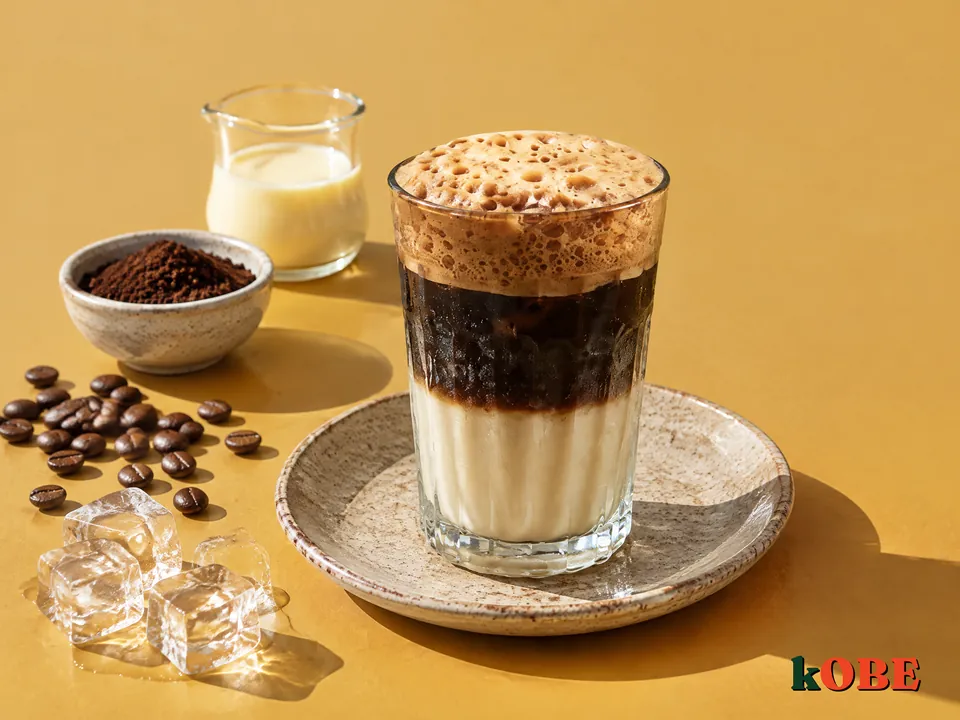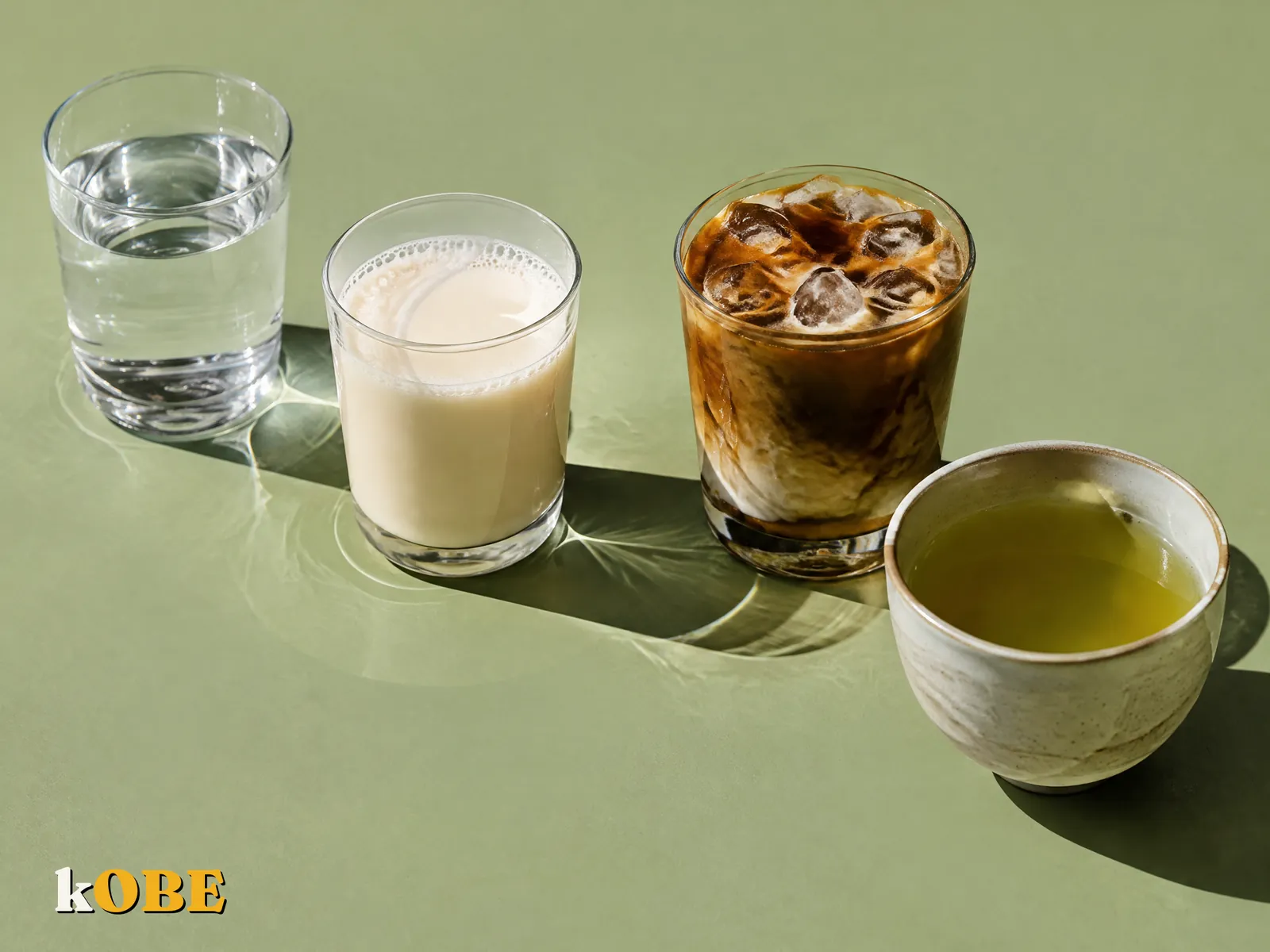
You can tell the story of a Saigon day in drinks. Morning: a cà phê sữa đá (iced coffee with condensed milk) from the street corner. Noon: the free glass of iced tea at the rice shop. Afternoon: bubble tea with coworkers. Evening: a bottle of water after the gym.
We count bowls of rice and pieces of meat. Hardly anyone counts glasses.
Yet drinks are where sugar and caffeine hide best. They don't fill you up, so you forget you just had them.
This article is the map for our whole drinks series. No cup is banned. We just want you to know what each one brings along.
In this article
- Your body is a walking water bottle
- Level one: plain water, your default drink
- Level two: sweet drinks, where sugar hides best
- Level three: coffee and tea, caffeine in the right dose
- Level four: cow's milk and plant milk, almost a "mini meal"
- Redraw your drinking day
- Inside the kOBE kitchen
- Frequently asked questions
Your body is a walking water bottle
About 60% of an adult body is water. Blood, muscle, brain, even bone all hold water.
Every day you lose water through sweat, breath and urine. In Ho Chi Minh City, with 33 degree sun and heavy humidity, you sweat even more than people in cooler places.
So the question isn't "do I need to drink?" It's what to drink, and how much.
The European Food Safety Authority (EFSA) suggests a total water intake of about 2 liters a day for women and 2.5 liters for men. That number includes water from food, like soup, rice porridge, vegetables and fruit. The part you actually drink is smaller. We go into detail in how much water should you drink a day.
Level one: plain water, your default drink
If one drink gets to be the "floor" of your day, it's plain water. No calories, no sugar, no caffeine, and it's cheap.
Unsweetened iced tea from the rice shop sits close to this level too. It's mostly water, with a little tea flavor and a bit of caffeine.
A few tricks to drink more water:
- Keep a bottle on your desk. If you see it, you remember it.
- Drink a glass when you wake up and one before each meal.
- Add natural flavor: a few slices of lemon, calamansi (the tiny Vietnamese lime called tắc), ginger or mint.
Water won't "flush out toxins" or give you "miracle skin" the way the rumors say. It simply keeps your body hydrated enough to work normally. That's reason enough.
Level two: sweet drinks, where sugar hides best
The World Health Organization (WHO) advises keeping free sugars under 10% of daily energy, and ideally under 5%. For someone eating about 2,000 kcal, 5% is about 25g of sugar, or 6 teaspoons.
"Free sugars" means sugar added to food, plus the sugar in honey, syrups and fruit juice. The sugar that naturally sits inside whole fruit and milk doesn't count.
Now look at some familiar cups:
| Drink | Estimated sugar | Compared with the 25g mark |
|---|---|---|
| 1 can of soda (330ml) | about 35g | Over the mark in a single can |
| 1 cà phê sữa đá | about 20 to 30g, depending on the shop | Close to the mark |
| 1 glass of fresh orange juice | depends on the oranges, can be over 20g | Juice sugar still counts as free sugar |
| 1 bubble tea with pearls | varies a lot, many cups go over | See the dedicated article |
Why do sweet drinks deserve more attention than sweet foods? Because liquids don't fill you up the way food does. Drink a soda and you still eat your usual lunch. Eat a pastry and you might eat a little less rice.
For the cup-by-cup details, read how much sugar is in cà phê sữa and bạc xỉu and how much sugar is in a cup of milk tea.
What about sweeteners that sound "natural", like coconut nectar or palm sugar? They're still sugar. See what is coconut nectar.
Level three: coffee and tea, caffeine in the right dose
Vietnamese people drink some of the strongest coffee in the world. And Vietnamese coffee is mostly robusta, a bean with nearly twice the caffeine of arabica.
EFSA concluded that for healthy adults, up to about 400mg of caffeine a day raises no safety concerns. Pregnant women should stay under 200mg.
How much is 400mg? Roughly four cups of Western-style brewed coffee. But one strong robusta phin (the little Vietnamese drip filter) can pack a lot more than one of those cups. So with Vietnamese coffee, two glasses a day is already plenty for many people.
Tea is gentler. A cup of tea usually has less caffeine than a cup of coffee, plus a group of compounds called polyphenols. We talk about tea in tea and polyphenols.
Two small tips:
- Coffee after 2 p.m. can keep many people awake. Caffeine takes many hours to fade from your body.
- The part of a Vietnamese coffee worth watching usually isn't the caffeine. It's the condensed milk. See level two.
Level four: cow's milk and plant milk, almost a "mini meal"
Milk isn't just water. It has protein, fat, milk sugar and calcium. A 250ml glass of cow's milk has about 8g of protein, close to one and a half eggs.
Plant milks like soy, almond and oat are very different from each other:
| Type (unsweetened) | Strength | Worth knowing |
|---|---|---|
| Soy milk | Protein close to cow's milk | Street-bought versions are often very sweet |
| Almond milk | Very low in calories | Very low in protein |
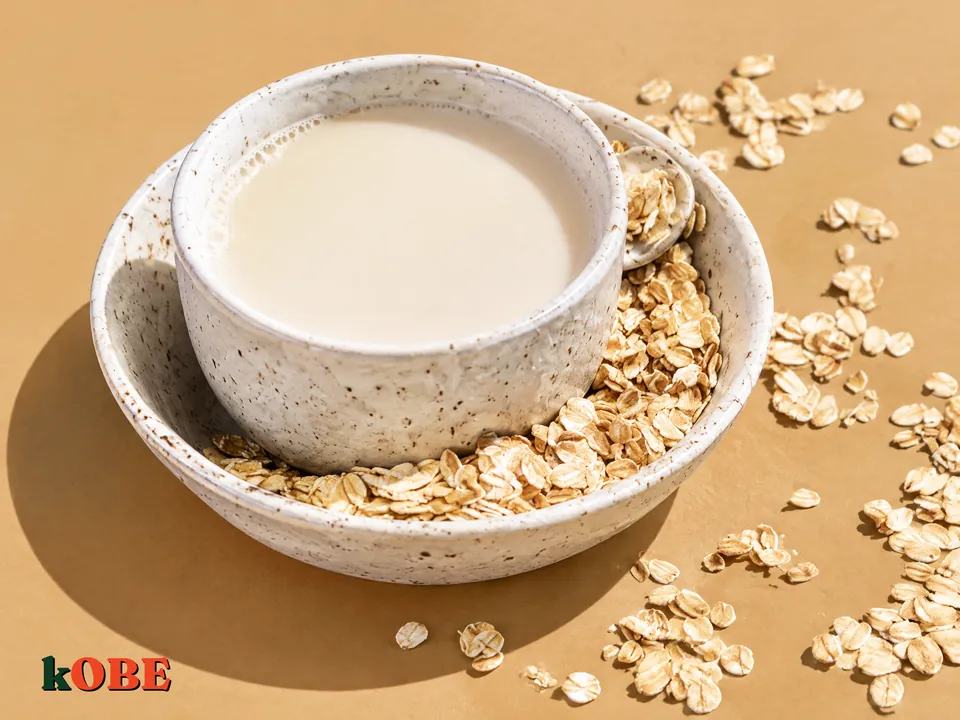
| Oat milk | Lightly creamy, great in coffee | Low protein, has natural starch |
No single type suits everyone. Want protein? Pick cow's milk or soy. Want something light and lactose-free? Oat or almond milk feels easier. And check the label for added calcium.
This series has three articles just about choosing milk:
Redraw your drinking day
You don't need to give up any cup you love. Just "change the size" and change the order:
| When | Before | After |
|---|---|---|
| Morning | Iced coffee with 3 spoons of condensed milk | Coffee with less milk, or with unsweetened plant milk |
| Noon | Soda | Unsweetened iced tea |
| Afternoon | Large milk tea, 100% sugar | Small size, 30% sugar, or just once every few weeks |
| All day | Forgetting to drink water | A bottle waiting on your desk |
Swaps like these can trim a few dozen grams of sugar a day, while you keep your morning coffee and your milk tea dates with coworkers.
One more trick: cut back slowly instead of stopping cold. Your taste buds adjust to sweetness over time. Drop one spoon of condensed milk this week, another a few weeks later. Many people say that after a month or two, their old sweet coffee tastes almost harsh.
And remember, no cup is "forbidden". A milk tea on a catch-up with friends is still a joy worth keeping. What matters is your everyday habit, not one single cup.
Inside the kOBE kitchen
We make three versions of oat milk, all on our Ingredients page:
- kOBE Oat Milk: cooked fresh in small batches, no refined sugar added. 34 kcal, 0.6g protein, 4.5g carbs, 1.5g fat per 100ml.
- kOBE Oat Milk, Monk Fruit: sweetened with kOBE Signature Monk Fruit Blend, still with the natural sugar from oats. 36 kcal, 9g carbs per 100ml.
- kOBE Oat Milk, Coconut Nectar: sweetened with coconut nectar sugar. 53 kcal, 9.3g carbs per 100ml. Honestly: coconut nectar is still sugar, so enjoy this one in moderation.
If you want to make your morning coffee with less condensed milk, the unsweetened or monk fruit version is a gentle swap. See our oat milk on the Ingredients page.
Frequently asked questions
Does coffee dehydrate you?
Can fruit juice replace whole fruit?
Is fresh coconut water high in sugar?
What should kids drink?
Keep reading
Sources
- EFSA NDA Panel (2010). Scientific Opinion on Dietary Reference Values for water. EFSA Journal 8(3):1459.
- EFSA NDA Panel (2015). Scientific Opinion on the safety of caffeine. EFSA Journal 13(5):4102.
- WHO (2015). Guideline: Sugars intake for adults and children.
- Harvard T.H. Chan School of Public Health, The Nutrition Source: Healthy Drinks.
- USDA FoodData Central: whole cow's milk; coconut water.
- Further reading: Understanding Nutrition 16th ed., chapter 12 (water and minerals).