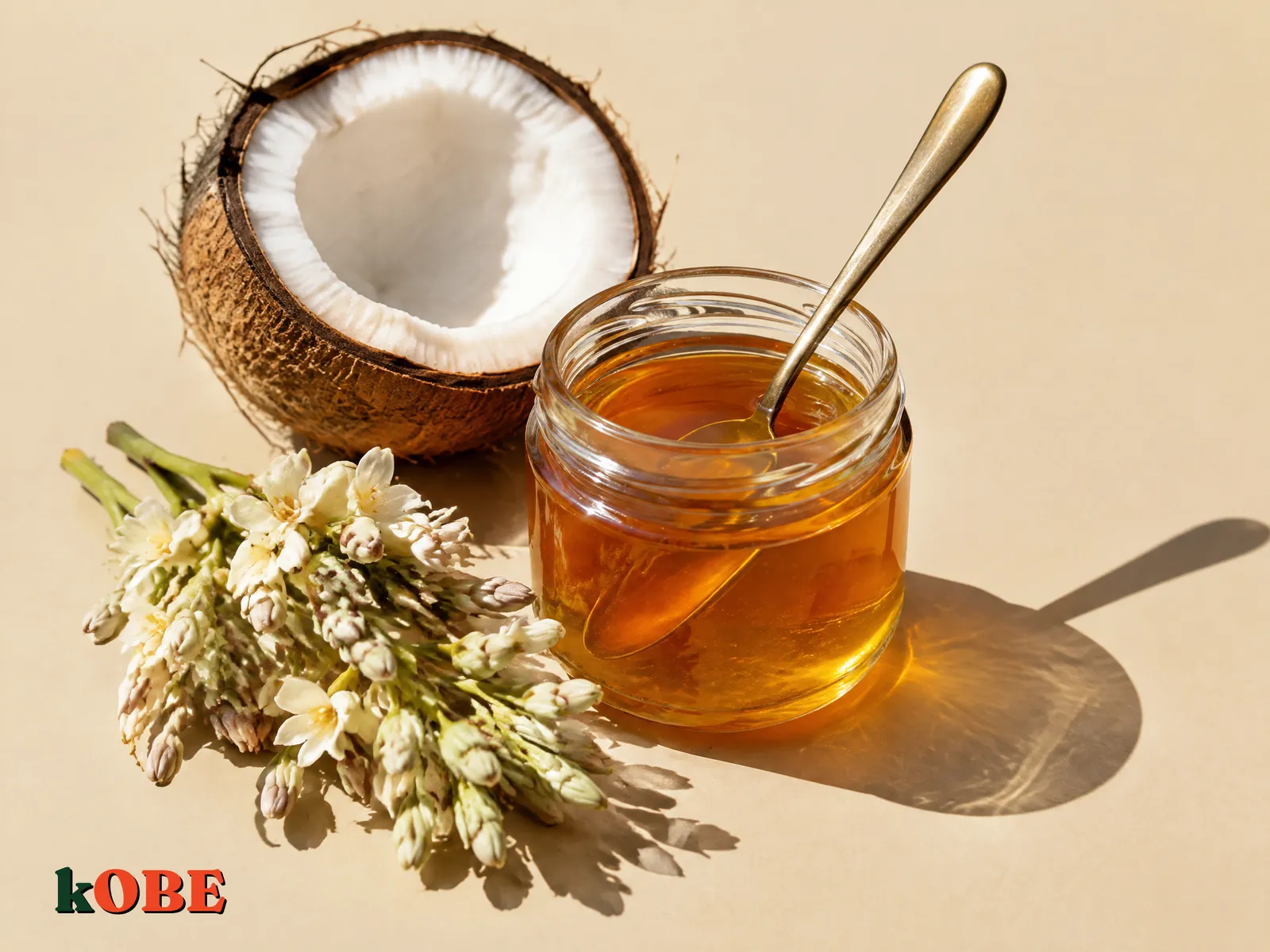
In the Mekong Delta (miền Tây), some people climb coconut trees without picking a single coconut. They climb up to "collect nectar". Every morning and every evening, they gently slice the tip of a young coconut flower stalk and hang a tube to catch each drop of clear sap.
That sap is cooked down into a thick, amber syrup that smells like caramel. That's coconut nectar.
It sounds wonderfully natural and homegrown. And plenty of places market it as a "healthy sugar". We love coconut nectar, but we also want to be straight with you about it.
In this article
From flower stalk to jar
A coconut palm flowers in clusters wrapped in a woody sheath. Left alone, the flower cluster becomes a bunch of coconuts.
Nectar collectors do something different:
- Cut the tip of a young flower stalk and hang a collecting tube. The sap drips out slowly, clear and lightly sweet.
- Collect every day, shaving off another thin slice so the sap keeps flowing.
- Cook the sap over a fire for hours, letting the water slowly evaporate. The sap thickens into syrup.
- Keep cooking and stirring and the syrup crystallizes into granulated coconut sugar.
A flower stalk that's been tapped for nectar won't grow coconuts anymore. So coconut nectar is a grower's choice: harvest the fruit, or harvest the nectar.
But what's actually in the jar?
This is the most important part. The main component of coconut nectar and coconut sugar is sucrose, the very same sugar found in cane sugar. The rest is a little glucose, fructose, water, and a tiny amount of minerals.
Put simply: chemically, most of coconut sugar is the same substance as white table sugar. The only difference is that it hasn't been refined, so it keeps its brown color, its aroma and a few natural impurities.
The energy is the same too. Each gram of coconut sugar gives about 4 kcal, like cane sugar. Coconut nectar contains water, so it's a bit more dilute, but it's still sugar in liquid form.
The World Health Organization (WHO) counts the sugar in honey, syrups and plant nectars as free sugars. That means coconut nectar counts toward your daily sugar limit, just like table sugar.
"Low glycemic index": the story is more complicated
You may come across claims that coconut sugar has a glycemic index (GI) of only about 35, lower than cane sugar.
That number comes from one measurement in the Philippines. Another measurement in Australia came out at a little over 50, much closer to cane sugar. The difference could come from the sugar sample, how it was made and how it was tested.
We take away two things:
- There's no agreed GI number for coconut sugar yet.
- Even if its GI is a bit lower, you're still eating sugar with about the same calories. A lower GI doesn't turn it into "not sugar".
To understand what GI means, see glycemic index GI and GL.
What about the minerals?
Coconut sugar does have a little potassium, iron and zinc, because it isn't refined. That's true.
But the amounts are tiny compared with how much you eat. To get a meaningful amount of potassium from coconut sugar, you'd have to eat so much sugar that you'd blow far past the daily limit. One banana or a bowl of greens gives you much more potassium with no sugar attached.
So don't choose coconut nectar for its minerals. Choose it because you love how it tastes, and use it in moderation. That's the most honest reason there is.
Coconut nectar, palm sugar, coconut candy: who's who?
These three names often get mixed up:
| Name | Made from | Notes |
|---|---|---|
| Coconut nectar, coconut sugar | Sap from the coconut palm's flower stalk | Caramel aroma, amber color |
| Palm sugar (đường thốt nốt) | Sap from the flowers of the palmyra palm | A specialty of the Bảy Núi (Seven Mountains) area in An Giang |
| Coconut candy (kẹo dừa) | Coconut milk cooked with sugar and malt syrup | Not coconut sugar |
All three are delicious, and all three are "sugar with flavor". We compare the different brown sugars in detail in coconut sugar, palm sugar and brown sugar.
Inside the kOBE kitchen
We make kOBE Oat Milk, Coconut Nectar, sweetened with coconut nectar sugar. Each 100ml has 53 kcal and 9.3g of carbs. A 250ml glass comes to about 130 kcal and over 23g of carbs.
As we said above, plainly: coconut nectar is still sugar. Compared with kOBE Oat Milk with no refined sugar added (34 kcal, 4.5g carbs per 100ml), the coconut nectar version has about 19 kcal and nearly 5g more carbs per 100ml. So it's one to enjoy in moderation, as an occasional indulgence.
If you want sweetness with fewer carbs, there's kOBE Oat Milk, Monk Fruit (36 kcal per 100ml). And if you're getting used to a plainer taste, the unsweetened version is the gentlest pick. See all three on the Ingredients page.
Frequently asked questions
Is coconut nectar better than table sugar?
Can I swap table sugar for coconut nectar in cooking?
Does coconut nectar raise blood sugar less than table sugar?
Keep reading
Sources
- WHO (2015). Guideline: Sugars intake for adults and children.
- Glycemic Index Research Service, University of Sydney: GI database (coconut sugar entry).
- Harvard T.H. Chan School of Public Health, The Nutrition Source: Added Sugar.
- USDA FoodData Central: sucrose.
- Further reading: Understanding Nutrition 16th ed., chapter 4; Diet Cults.