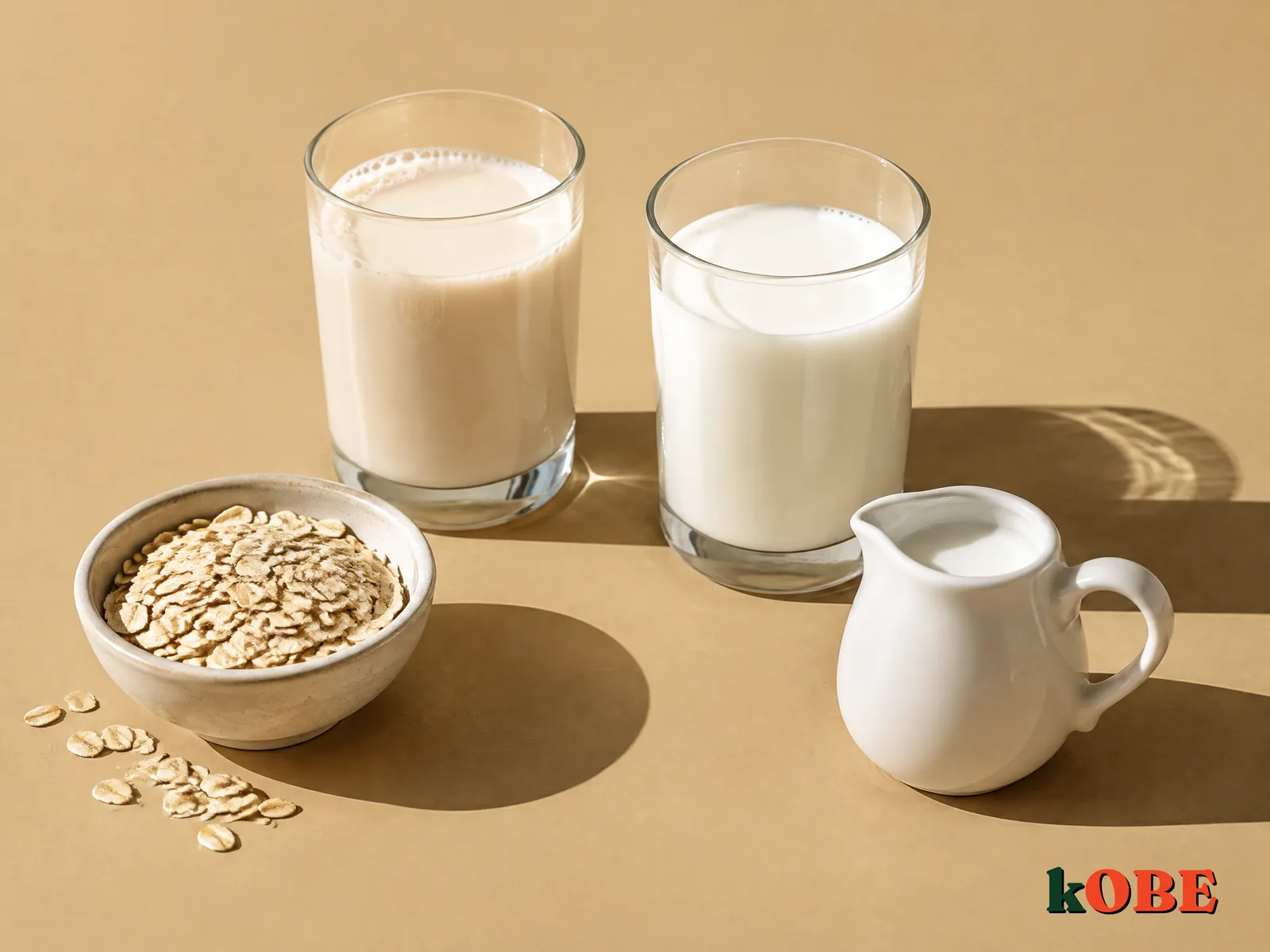
At the coffee counter, the barista asks: "Regular milk, or would you like to switch to oat?"
Plenty of people pick oat milk because they think it's "lighter". Others pick cow's milk because they think it's "more nourishing". Both are partly right, and both are partly wrong.
We put the two glasses side by side and read every line of the nutrition panel. A few things surprised us.
In this article
Surprise one: the calories can be identical
Here are the numbers per 100ml. Cow's milk comes from the USDA database, oat milk from kOBE Oat Milk with no refined sugar added:
| Per 100ml | Whole cow's milk | Skim cow's milk | kOBE Oat Milk |
|---|---|---|---|
| Energy | about 61 kcal | about 34 kcal | 34 kcal |
| Protein | about 3.2g | about 3.4g | 0.6g |
| Carbs | about 4.8g (lactose) | about 5g (lactose) | 4.5g |
| Fat | about 3.3g | under 0.2g | 1.5g |
Unsweetened oat milk and skim cow's milk have practically the same calories: 34 kcal. So if you choose oat milk only because you think it has fewer calories than cow's milk, that's only true next to whole milk.
Surprise two: a fivefold protein gap
Look at the protein line: 3.4g versus 0.6g. Cow's milk has more than five times the protein.
In a 250ml glass, to make it easy to picture:
- Glass of cow's milk: about 8g protein, close to one and a half eggs.
- Glass of kOBE Oat Milk: about 1.5g protein, less than a quarter of an egg.
Cow's milk protein is also complete protein, with all the essential amino acids. We say more in complete protein and plant protein.
So oat milk is a drink, while cow's milk is closer to a light snack with protein. Neither is wrong. They just play different roles.
Carbs: about 5g each, but from different "families"
The two glasses have similar carbs, but the sources are completely different:
- Cow's milk: nearly all the carbs are lactose, the natural sugar already in milk. WHO doesn't count the lactose in milk as free sugar.
- Oat milk: the carbs come from oat starch, and some of it may have turned into sugar during processing. Details in how oat milk is made, and what's in it.
Lactose is the key point for many Vietnamese people. To digest lactose, your gut needs an enzyme called lactase. In most Asian adults, lactase levels drop after early childhood. Drink a lot of cow's milk at once and they may feel bloated or hear a rumbling tummy.
This is very common and usually nothing to worry about. Many people can still handle a small amount, or find yogurt and cheese easier because some lactose is already gone. Oat milk has no lactose, which makes it a comfortable pick for anyone who often feels off after cow's milk.
Calcium: a question for the label
Cow's milk comes with calcium built in, about 110 to 120mg per 100ml, and the body absorbs it well.
Oats don't naturally contain much calcium. Many big oat milk brands add calcium, vitamin D and vitamin B12 to get closer to cow's milk. Some don't.
So here's a simple rule: if the label doesn't say calcium-fortified, don't count on your plant milk to replace the calcium in cow's milk. Top up calcium from other foods like tofu, small fish eaten bones and all, and leafy greens. See also calcium-rich foods besides milk.
What about the environment?
A large 2018 study in the journal Science compared the environmental footprint of dozens of foods. Per liter, plant milks, including oat milk, produced far fewer greenhouse gas emissions and used far less land than cow's milk.
This isn't a nutrition point, but it's a reason many people choose oat milk. We think it's worth knowing as you weigh your options.
So which glass?
| If you want | Choose |
|---|---|
| Extra protein and calcium from a drink | Cow's milk (skim if you want less fat) |
| No lactose, easy on the stomach | Oat milk |
| A lightly creamy, toasty coffee | Oat milk |
| As few calories as possible | Skim cow's milk or unsweetened oat milk, roughly equal |
And you can absolutely have both. Cow's milk in the morning alongside a low-protein breakfast, oat milk in your afternoon coffee. For a comparison with soy and almond milk, read which plant milk to choose.
Inside the kOBE kitchen
kOBE Oat Milk is cooked fresh in small batches, with no refined sugar added. Each 100ml has 34 kcal, 0.6g protein, 4.5g carbs and 1.5g fat, exactly the numbers in the comparison table above.
Because oat milk is low in protein, we often suggest pairing it with something that has protein. For example, a morning glass of oat milk with a boiled egg, or an oat milk flan made with eggs.
Oat milk can also stand in for cow's milk in lots of cooking: soups, curries, baking. See our oat milk on the Ingredients page.
Frequently asked questions
Can kids drink oat milk instead of cow's milk?
Does oat milk have more sugar than cow's milk?
If cow's milk makes me bloated, does that mean I'm allergic to milk?
Keep reading
Sources
- USDA FoodData Central: Milk, whole, 3.25% milkfat; Milk, nonfat.
- Poore J., Nemecek T. (2018). Reducing food's environmental impacts through producers and consumers. Science 360(6392):987 to 992.
- Storhaug C.L., Fosse S.K., Fadnes L.T. (2017). Country, regional, and global estimates for lactose malabsorption in adults: a systematic review and meta-analysis. The Lancet Gastroenterology & Hepatology 2(10):738 to 746.
- NHS (UK). Lactose intolerance.
- Further reading: Understanding Nutrition 16th ed., chapters 4 and 12.