"You have to drink 8 glasses of water a day." You've probably heard this a hundred times. From your mom, your teachers, news articles, the water reminder app on your phone.
But few people know where it came from. And even fewer know it once had a second half, which everyone quietly forgot.
We'll retell that story, then look at what science says your body really needs.
In this article
The forgotten half sentence
In 1945, a US nutrition board suggested that adults need about 2.5 liters of water a day.
In the very next sentence, they added: most of this water is already contained in food.
Over the years, the first half got repeated again and again, and the second half vanished. And "2.5 liters" slowly turned into "8 glasses of plain water a day".
In 2002, a physiology professor in the US went back and read through a mountain of literature. He found no scientific evidence that healthy people must drink exactly 8 glasses of plain water.
That doesn't mean drinking water doesn't matter. It just means that rigid number doesn't stand on the solid ground we assumed.
Today's scientific numbers
The European Food Safety Authority (EFSA) suggests a total water intake per day for adults in normal conditions:
| Total water per day | |
|---|---|
| Women | about 2 liters |
| Men | about 2.5 liters |
The key word is total. It includes both drinks and the water in food. EFSA estimates food usually contributes about 20 to 30%.
With a Vietnamese family meal, the food share can be even bigger:
- A bowl of canh (clear soup) already holds about 200ml of water.
- A bowl of rice is more than half water.
- A slice of watermelon is about 90% water.
- A morning bowl of phở or bún (rice noodle soup) comes with a big bowl of broth.
So if you eat a normal day with soup, vegetables and fruit, the amount you need to drink on top might be only about 1.5 to 2 liters, depending on the person.
How much extra in Saigon heat?
There's no one number, because people sweat very differently. An office worker in air conditioning is nothing like a delivery rider out in the sun all day.
Instead of counting glasses, your body comes with two built-in "gauges":
- Thirst. For healthy adults, thirst is a pretty reliable signal. Thirsty? Drink.
- Urine color. Pale yellow like weak lemonade is fine. Dark yellow, small amounts and a strong smell mean you should drink more.
Times to drink more on purpose:
- Working outdoors in hot weather.
- Exercising, especially for more than 45 minutes.
- Fever, diarrhea or vomiting, when your body loses water fast.
- Pregnancy and breastfeeding, when EFSA suggests needing more than usual.
Do coffee and tea count?
Yes. This surprises a lot of people.
Caffeine has a mild diuretic effect. But in regular coffee drinkers, that effect weakens. A 2014 study in the UK had habitual coffee drinkers have about four cups a day. The result: their bodies held on to water about as well as when they drank the same amount of plain water.
So your iced tea and your coffee still count toward your daily water. Just keep an eye on the sugar and condensed milk that come along, which we cover in how much sugar is in cà phê sữa and bạc xỉu.
Soda and milk tea do contain real water, but lots of sugar too. Better not to count them as your way of "drinking enough".
Can you drink too much?
Rarely, but yes.
Healthy kidneys can only handle a bit under 1 liter of water per hour. If you drink far too much in a short time, say several liters in an hour or two, the sodium in your blood can get diluted too much. This is called hyponatremia, and it has happened to marathon runners who drank nonstop and in water-drinking contests.
In everyday life, you don't need to worry. Just remember: sipping steadily through the day beats downing several bottles at once.
Who needs to pay more attention?
- Older adults. The sense of thirst fades with age, so it's easy to run low without noticing. Keeping a glass of water in sight is a great trick.
- Kids. Busy playing, children often forget to drink. Nudge them toward water instead of soda.
- People who sit in air conditioning a lot. You don't sweat much, but the air is dry, and it's very easy to forget to drink.
For the big picture on all kinds of drinks, read our pillar guide: what to drink every day.
Inside the kOBE kitchen
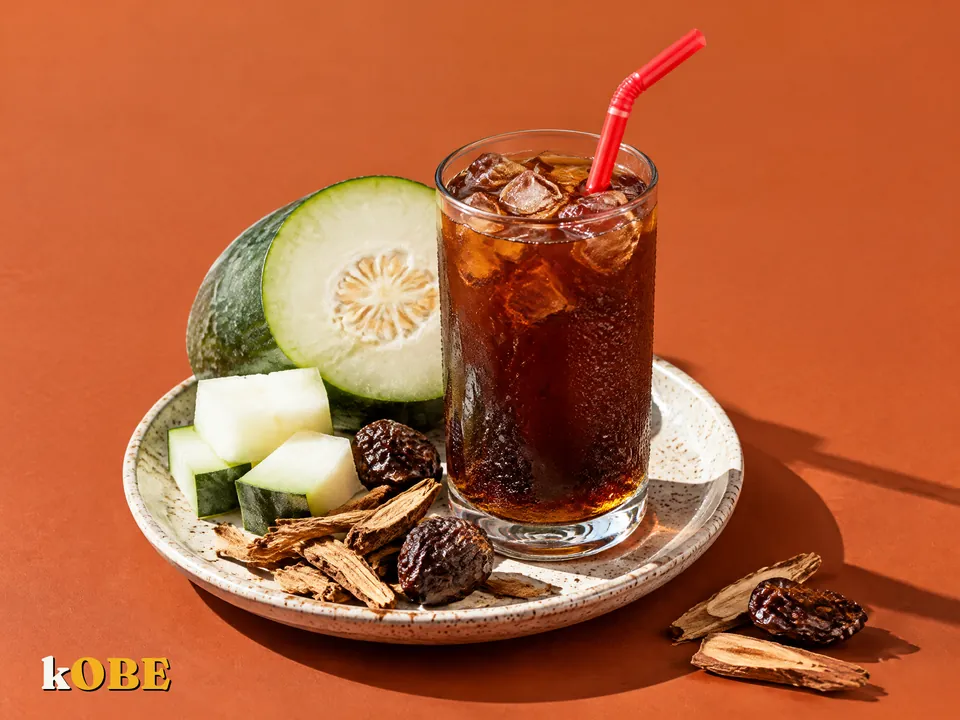
Our collection of 1,480 home recipes includes plenty of Vietnamese thirst-quenchers: trà tắc (calamansi tea), nước sâm bí đao (winter melon herbal drink), artichoke flower black tea, passion fruit tea. Any that need sweetness are sweetened with kOBE Signature Monk Fruit Blend, with no refined sugar.
Every recipe lists calories, protein, fat and sugar per 100g. That way you can see how much lighter a jug of homemade trà tắc is than one from the shop.
A tip from our kitchen: make a jug of unsweetened tea or nước sâm ahead and keep it in the fridge. Lightly flavored water is easier to drink than plain water, without dragging sugar along.
Frequently asked questions
Does drinking lots of water give you better skin?
Is ice water bad for you?
Does fruit juice count toward my water intake?
Keep reading
Sources
- EFSA NDA Panel (2010). Scientific Opinion on Dietary Reference Values for water. EFSA Journal 8(3):1459.
- Valtin H. (2002). "Drink at least eight glasses of water a day." Really? Is there scientific evidence for "8 × 8"? American Journal of Physiology: Regulatory, Integrative and Comparative Physiology 283(5):R993 to R1004.
- Killer S.C., Blannin A.K., Jeukendrup A.E. (2014). No evidence of dehydration with moderate daily coffee intake: a counterbalanced cross-over study in a free-living population. PLoS ONE 9(1):e84154.
- NHS (UK). Water, drinks and your health.
- Further reading: Understanding Nutrition 16th ed., chapter 12.