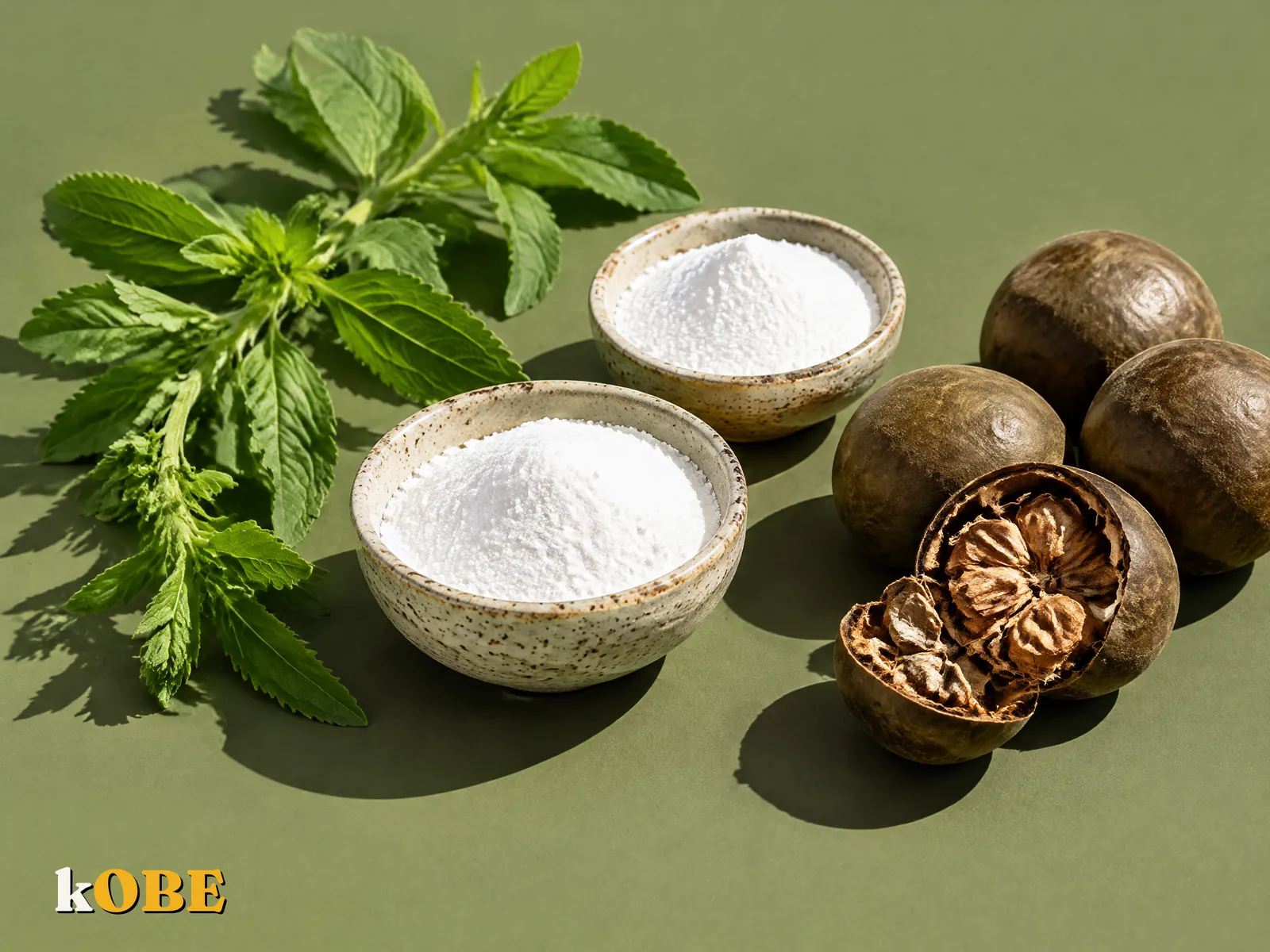
At a Vietnamese market or herbal shop, you'll sometimes spot a small bag of dried grey-green leaves labeled "cỏ ngọt," literally "sweet grass." Drop a pinch into a teapot and the tea turns as sweet as if you'd added sugar.
A few steps away sits dried monk fruit: round, brown, feather-light. Also sweet, also not sugar.
These two often stand side by side on sugar substitute labels. But they come from opposite ends of the world, and their personalities differ more than you'd think.
In this article
- A South American shrub and a fruit from the far south of China
- Where does the sweetness live, and how sweet is it?
- Why does stevia sometimes leave a bitter note?
- What happens once they're inside you?
- Why do so many sweetener jars use both?
- How to choose for your own kitchen
- Inside the kOBE kitchen
- Frequently asked questions
A South American shrub and a fruit from the far south of China
Stevia is a small shrub native to the border region of Paraguay and Brazil. The Indigenous Guaraní people have used its leaves to sweeten drinks for a very long time. Today stevia is grown in many places, including Vietnam.
Monk fruit (la hán quả) is a vine in the gourd family that grows in the mountains of southern China. The fresh fruit spoils fast, so it has been dried since ancient times. That's the form you usually find in herbal shops.
One is sweet in its leaves. The other is sweet in its fruit. That's difference number one.
Where does the sweetness live, and how sweet is it?
Neither one is sweet because of sugar. They contain molecules shaped just right to "trick" the sweet receptors on your tongue.
- Stevia leaves hold a group called steviol glycosides. The two names you'll see most are stevioside and rebaudioside A (often shortened to Reb A on labels).
- Monk fruit holds a group called mogrosides, the star being mogroside V.
A quick comparison:
| Stevia | Monk fruit | |
|---|---|---|
| Part used | Leaf | Fruit flesh |
| Sweet compound | Steviol glycosides | Mogrosides |
| Sweeter than sugar | about 200 to 300 times | about 100 to 250 times |
| Calories | Almost zero | Almost zero |
| Heat stability in cooking | Good | Good |
| Common aftertaste | Slightly bitter, a hint of licorice in large amounts | Round sweetness, sometimes a whiff of dried fruit |
To picture it: a pinch of extract powder the size of a chopstick tip is enough to sweeten a big glass of tea. That's why neither can be measured by the spoonful like white sugar.
Why does stevia sometimes leave a bitter note?
This is a fun story about your tongue.
Your tongue has sweet receptors and bitter receptors. Steviol glycosides bind very strongly to the sweet ones. But at high concentrations, some of them also brush against the bitter ones. The result: sweetness first, with a little bitterness or a licorice-like note trailing behind.
How much depends on the type. Stevioside turns bitter more easily than Reb A. Newer types such as Reb M are considered even less bitter.
For many people, the mogrosides in monk fruit give a rounder taste. But everyone's palate is different. Some find monk fruit a bit "dried fruit," others find stevia perfectly pleasant.
So if you once tried a jar of stevia and found it bitter, don't write off the whole group. Chances are it was the type of extract, or a heavy hand.
What happens once they're inside you?
These two siblings take a pretty similar route.
Both steviol glycosides and mogrosides are barely absorbed in the small intestine in their whole form. They travel down to the large intestine. There, gut bacteria snip off the "sugar tails" attached to the molecule.
- For stevia, the remaining core (steviol) is absorbed, processed by the liver, then leaves through urine.
- For monk fruit, most of it leaves through the digestive tract.
Neither gives your body meaningful energy. Neither raises blood sugar the way cane sugar does. Steviol glycoside and monk fruit extracts have both been reviewed by international food safety bodies such as JECFA (part of FAO and WHO) and the US FDA before being allowed in food.
Why do so many sweetener jars use both?
If each one is already a hundred times sweeter than sugar, why mix?
Because in cooking, a blend of sweeteners usually tastes rounder than any one alone. Each sweetener has its own "taste curve." Some hit fast, some arrive slowly and linger. Put them together and the gaps in one get filled by the other.
There's another perk: using a little of each makes each one's aftertaste harder to notice. It's like seasoning a soup with both salt and fish sauce: the flavor gets deeper than with just one.
As for the "bulk" needed to measure 1:1 like white sugar, neither stevia nor monk fruit can handle that. That's the job of sidekicks such as erythritol or allulose.
How to choose for your own kitchen
A few practical ideas:
- Read the first ingredient. A jar of "stevia sweetener" or "monk fruit sweetener" is usually mostly bulking agent. Knowing which one helps you understand the taste.
- Test it in a glass of warm water first. Mix a small glass, taste it warm and again once it cools. The aftertaste shows most clearly then.
- Dried stevia leaves suit tea. A small pinch is plenty. Too much and the grassy, slightly bitter side comes through.
- Bold flavors hide aftertaste better. Coffee, cocoa, ginger and cinnamon all help plant sweeteners taste more "real."
Inside the kOBE kitchen
The kOBE Signature Monk Fruit Blend uses both siblings. Monk fruit is a main member. Stevia appears in a small amount, enough to add to the flavor without showing its aftertaste.
These two super-sweet ingredients team up with erythritol (the sweet base and bulk), allulose (browns in the oven, tastes close to cane sugar) and inulin (a fiber that adds no sweetness). The five ingredients cover for each other, so the blend swaps for sugar 1:1 with no bitter aftertaste.
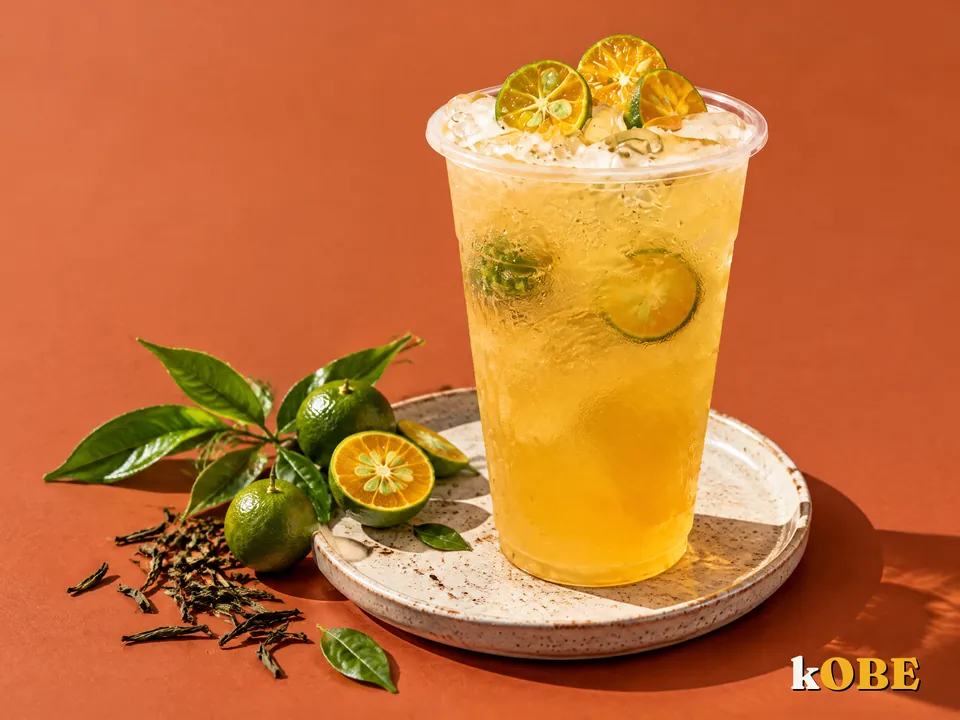
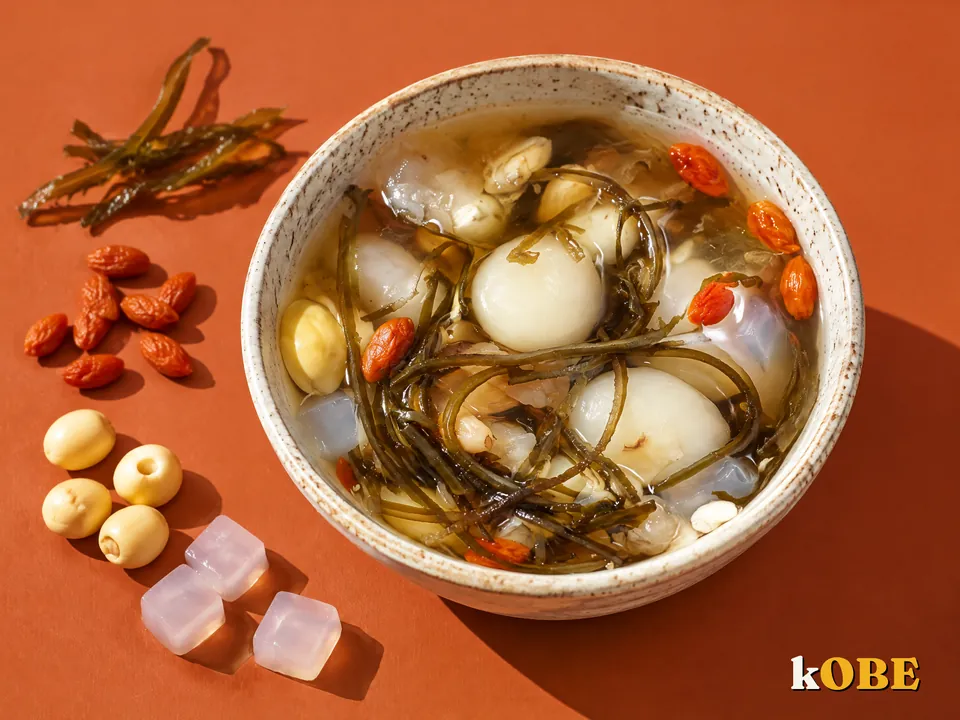
It's what we use to sweeten kOBE dishes, from a glass of trà tắc (kumquat iced tea) to a pot of chè (Vietnamese sweet soup).
Frequently asked questions
Which is sweeter, stevia or monk fruit?
Is dried stevia leaf tea the same as stevia powder?
Can I braise or make chè with stevia or monk fruit?
Do they have calories?
Keep reading
Sources
- Geuns J.M.C. (2003). Stevioside. Phytochemistry 64(5):913 to 921.
- Pawar R.S. et al. (2013). Sweeteners from plants: with emphasis on Stevia rebaudiana and Siraitia grosvenorii. Analytical and Bioanalytical Chemistry 405:4397 to 4407.
- EFSA Panel on Food Additives and Nutrient Sources added to Food (2010). Scientific Opinion on the safety of steviol glycosides for the proposed uses as a food additive. EFSA Journal 8(4):1537.
- JECFA (FAO/WHO), evaluations of steviol glycosides; U.S. FDA, GRAS notices on monk fruit extract.
- Further reading: Understanding Nutrition 16th ed., chapter 4.