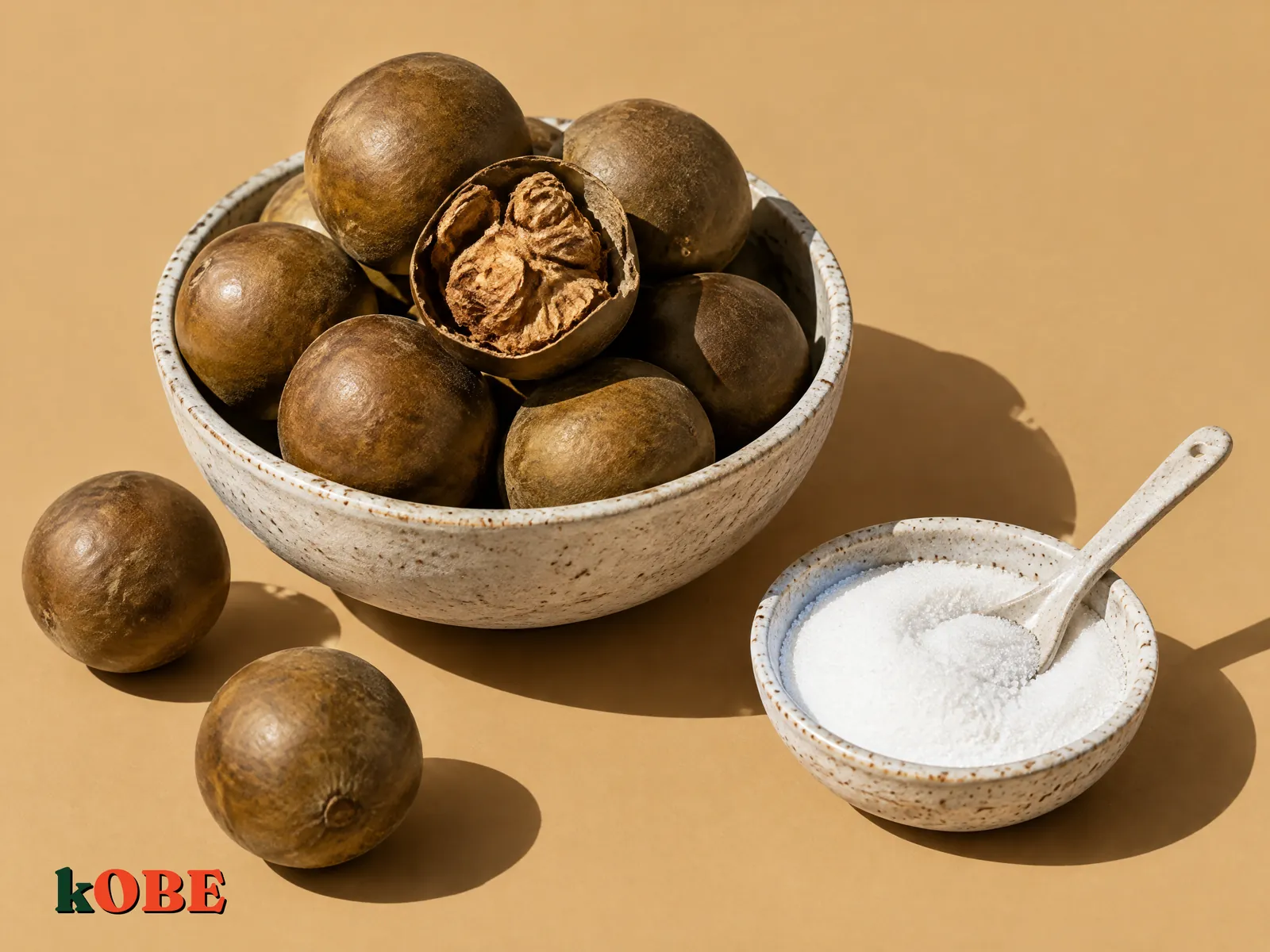
If you've ever walked into a traditional Chinese herbal shop in Vietnam, you've probably seen dried monk fruit (la hán quả). Round, brown, feather-light, and it rattles when you shake it. Moms love dropping one into a pot of cooling summer tea.
That humble fruit now sits in millions of sugar-free coffees around the world. And its sweetness has a secret: it isn't sugar.
In this article
- 1. One spoon is as sweet as a hundred spoons of sugar
- 2. Your tongue tastes sweet, but your body barely "accepts the delivery"
- 3. Its English name means "the monks' fruit"
- 4. Every jar of "monk fruit sweetener" comes with a sidekick
- 5. Dried monk fruit tea is not the same as monk fruit sweetener
- 6. It can braise fish, but it can't make caramel color
- Inside the kOBE kitchen
- Frequently asked questions
1. One spoon is as sweet as a hundred spoons of sugar
Monk fruit extract is roughly 100 to 250 times sweeter than cane sugar.
Picture it like this: one teaspoon of the extract powder could stand in for a whole big jar of sugar. To sweeten a cup of coffee, you'd need just a few specks smaller than grains of sand.
The source of all that sweetness is a group of compounds called mogrosides. They occur naturally in the fruit, not chemicals added in.
2. Your tongue tastes sweet, but your body barely "accepts the delivery"
This is the best part.
When you eat cane sugar, your gut splits it into glucose and sends it straight into your blood. Blood sugar goes up, and your body takes in calories.
Mogrosides work differently. They touch your tongue and flip the "sweet" light on. But once they reach the small intestine, your body hardly absorbs them. They travel on to the large intestine, where gut bacteria break them down, and then they leave.
Think of it as a package where your tongue gets the reward and your body mostly signs "return to sender." That's why monk fruit extract has almost no calories and doesn't raise blood sugar the way cane sugar does.
3. Its English name means "the monks' fruit"
In English, la hán quả is called monk fruit. According to old stories, Buddhist monks in the mountains of southern China were the first to grow and use it.
The fresh fruit spoils very quickly and doesn't keep. So since ancient times people have dried it. That's why in Vietnam you almost only ever see it dried.
4. Every jar of "monk fruit sweetener" comes with a sidekick
Remember fact number 1? The extract is so sweet that nobody could measure it in a home kitchen.
So makers blend it with a "bulking" ingredient, so the jar looks and measures like white sugar. The most common sidekicks are erythritol, allulose or stevia.
That means most of the weight in a jar of monk fruit sweetener is usually the sidekick. That's completely normal. You just need to know it so you can read the label right.
A 10-second label trick:
- Look at the first word of the ingredient list. Ingredients are listed by weight, largest first.
- Check for dextrose or maltodextrin. These two raise blood sugar like regular sugar. Some products add them to cut costs.
- Find the line that says how it swaps for sugar. Some are 1:1, some are twice as sweet.
5. Dried monk fruit tea is not the same as monk fruit sweetener
The dried fruit contains both mogrosides and a little fruit sugar. So a pot of tea brewed from the fruit still has some real sugar, though far less than a soda.
Powdered monk fruit sweetener keeps only the mogrosides and leaves the fruit sugar behind.
6. It can braise fish, but it can't make caramel color
Mogrosides handle heat well. You can braise pork, make nước chấm (the everyday dipping sauce) and bake cakes with them.
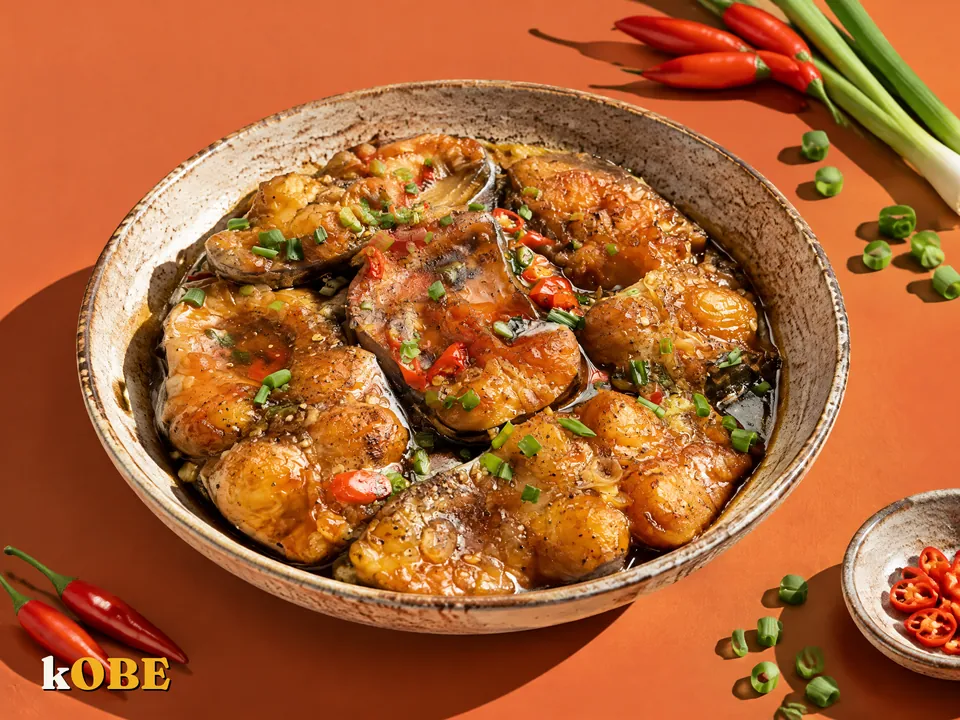
There's just one job they can't do like cane sugar: make nước màu, the dark caramel color. The amber brown of a pot of cá kho (Vietnamese braised fish) comes from sugar burning into caramel. Diet sweeteners don't burn that way.
Inside the kOBE kitchen
The kOBE Signature Monk Fruit Blend is a five-member "team": erythritol, allulose, stevia, monk fruit and inulin (a type of fiber). Each member covers for the others, so the sweetness is round and never bitter.
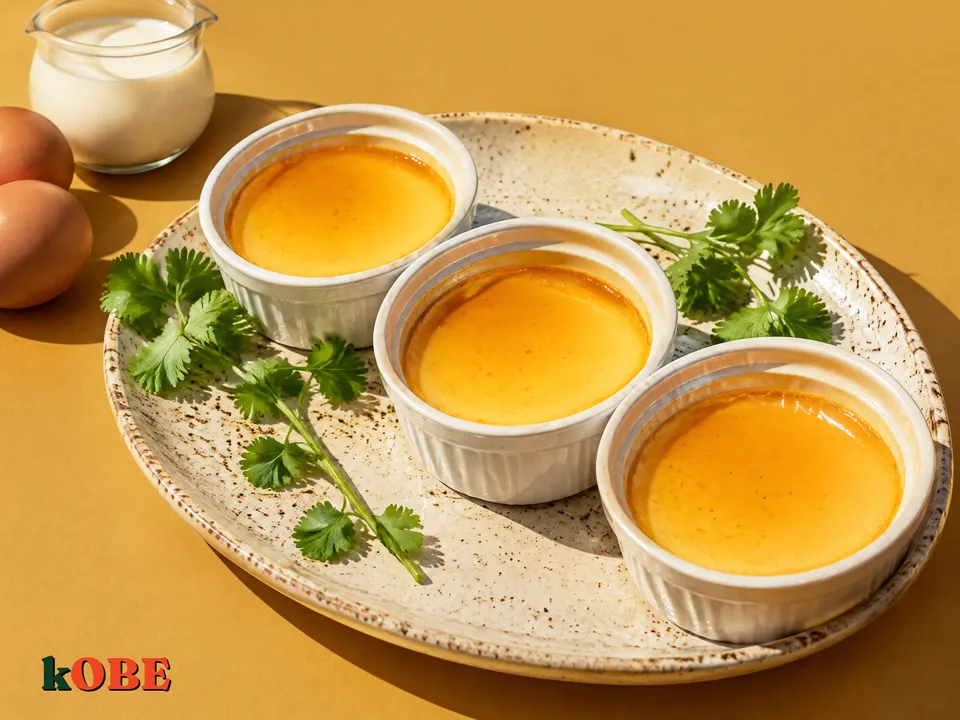
The team swaps for sugar 1:1. If an old recipe says 2 spoons of sugar, you use 2 spoons, no math needed. It's also what we use to sweeten kOBE dishes, from braising sauces to crème caramel.
A small tip from our kitchen: cakes baked with this blend come out a paler gold. For a nice golden top, brush on a little egg yolk.
Frequently asked questions
Does monk fruit sweetener have calories?
Can I use it for braising and dipping sauces?
Can children use it?
Keep reading
Sources
- U.S. FDA, GRAS Notice No. 301, Luo Han Fruit Concentrate (2010), and later GRAS notices on monk fruit extract.
- Murata Y. et al. (2010). Digestion and absorption of Siraitia grosvenori triterpenoids in the rat. Bioscience, Biotechnology, and Biochemistry 74(3):673 to 676.
- Pawar R.S. et al. (2013). Sweeteners from plants: with emphasis on Stevia rebaudiana and Siraitia grosvenorii. Analytical and Bioanalytical Chemistry 405:4397 to 4407.
- Further reading: Understanding Nutrition 16th ed., chapter 4.