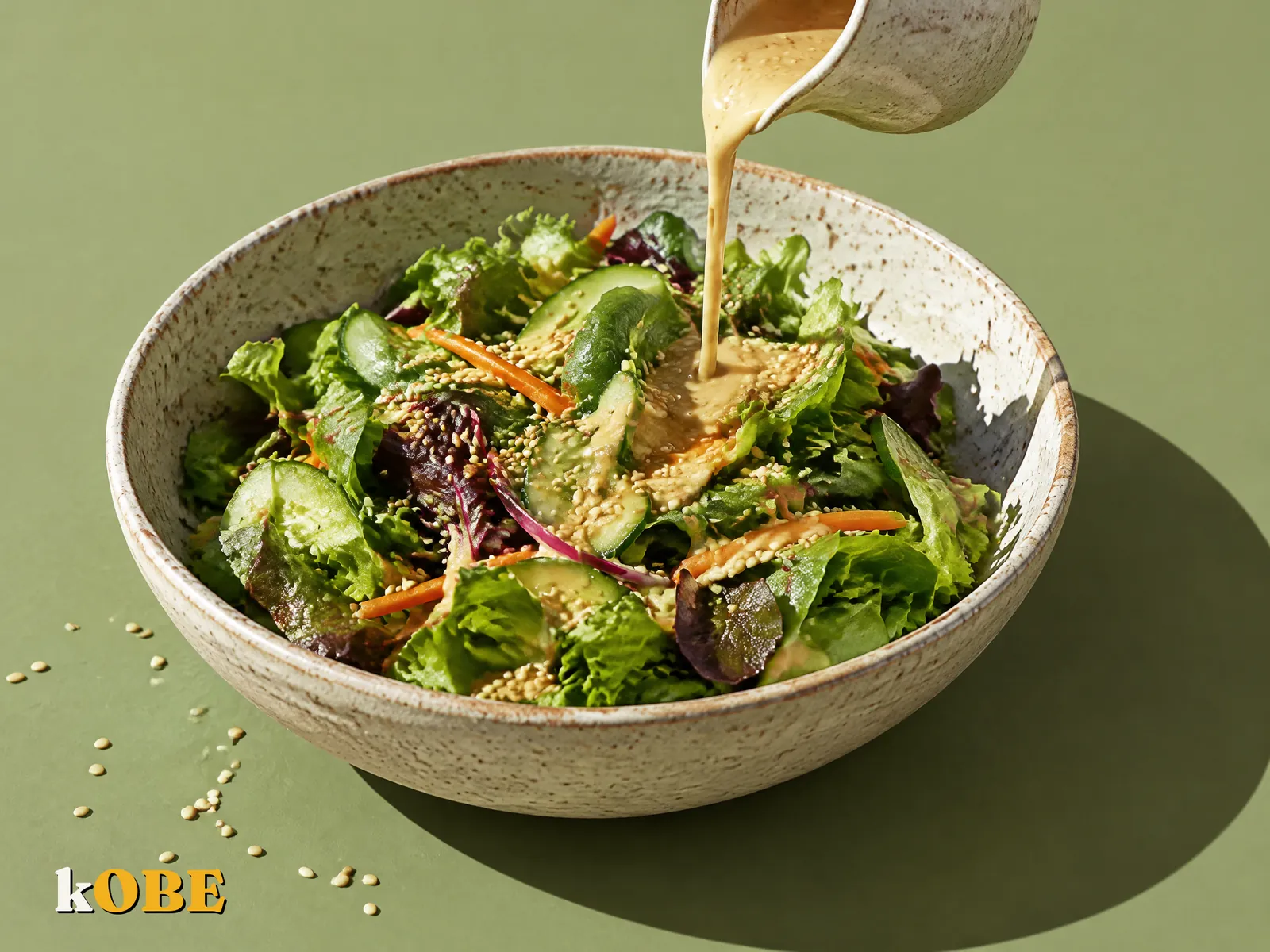
You order a salad at a café and the server asks: "Which dressing would you like? Roasted sesame, vinaigrette or Thousand Island?"
Some people pick roasted sesame and drench the plate. Others shake their heads: "No dressing, keep it healthy." Both have their reasons, and both are missing something interesting.
Salad dressing isn't just there to make greens go down easier. A little fat in the dressing decides how much good stuff your body actually gets from the plate.
In this article
- Greens with zero fat: missing half the story
- Vinaigrette: a 5-minute emulsion
- Roasted sesame dressing: fragrant, rich, and often sweetened
- Yogurt: a naturally light creamy dressing
- Quick comparison by the tablespoon
- Mixing tips for just enough, no counting
- Inside the kOBE kitchen
- Frequently asked questions
Greens with zero fat: missing half the story
Carrots, tomatoes, spinach and dark lettuce are full of carotenoids, the pigment group behind orange, red and deep green colors. Beta-carotene and lycopene are two familiar names.
Carotenoids, along with vitamins A, D, E and K, are all fat-soluble. Without fat alongside, most of them pass through the gut without being absorbed.
In 2004, a team of scientists in the US had participants eat the same salad with three dressings: fat-free, reduced-fat and full-fat. Then they measured carotenoids in the blood. The result: with the fat-free dressing, carotenoid absorption was almost negligible. The dressings with fat did clearly better.
Put simply: eat salad with no dressing, and you chew through the whole plate while your body only "signs for" part of the delivery. You don't need much fat. A spoon of oil, a few slices of avocado or a handful of nuts is enough to unlock it.
Vinaigrette: a 5-minute emulsion
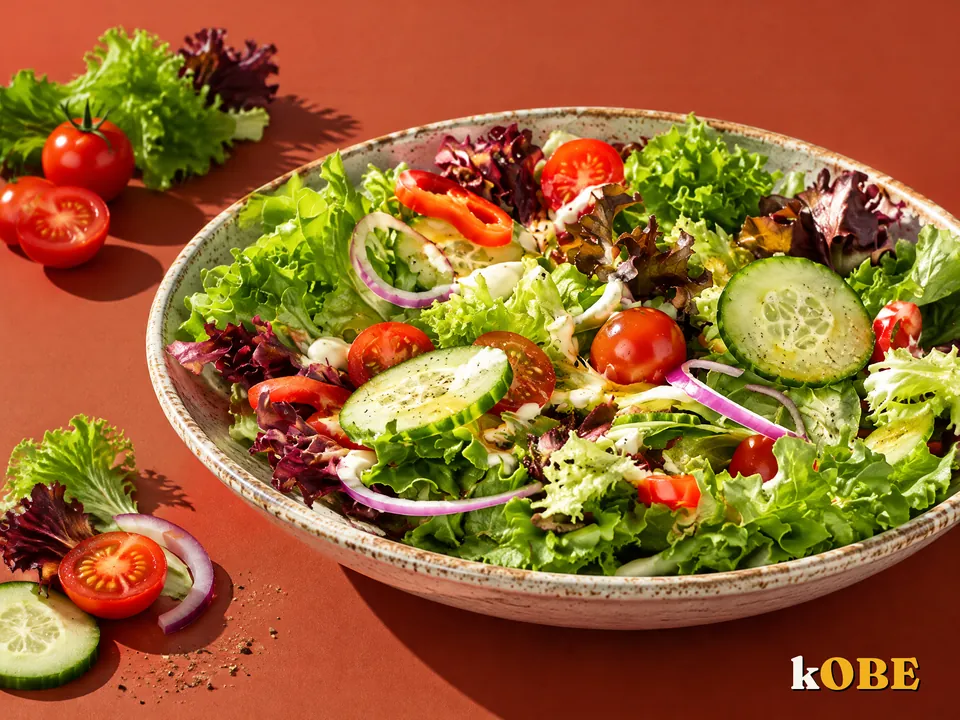
Vinaigrette is the simplest dressing of all: oil, vinegar, salt and pepper.
The classic formula is 3 parts oil, 1 part vinegar. Put it in a jar, close the lid and shake hard. The dressing turns cloudy and slightly thick. That's a temporary emulsion. Leave it a few minutes and the oil and vinegar separate again, so shake before pouring.
For a more stable dressing, add half a teaspoon of mustard. The mustard seed coat has a mucilage that keeps the oil droplets from merging.
On calories: at 3:1, three quarters of every spoon is oil. One tablespoon of vinaigrette is about 90 calories. A few lighter ways that still taste great:
- Change the ratio to 2 parts oil, 1 part vinegar, and add a splash of orange or tắc (kumquat) juice.
- Replace some of the vinegar with lemon juice and add chopped herbs.
- Use a flavorful oil like extra virgin olive oil, so less oil still tastes bold.
Roasted sesame dressing: fragrant, rich, and often sweetened
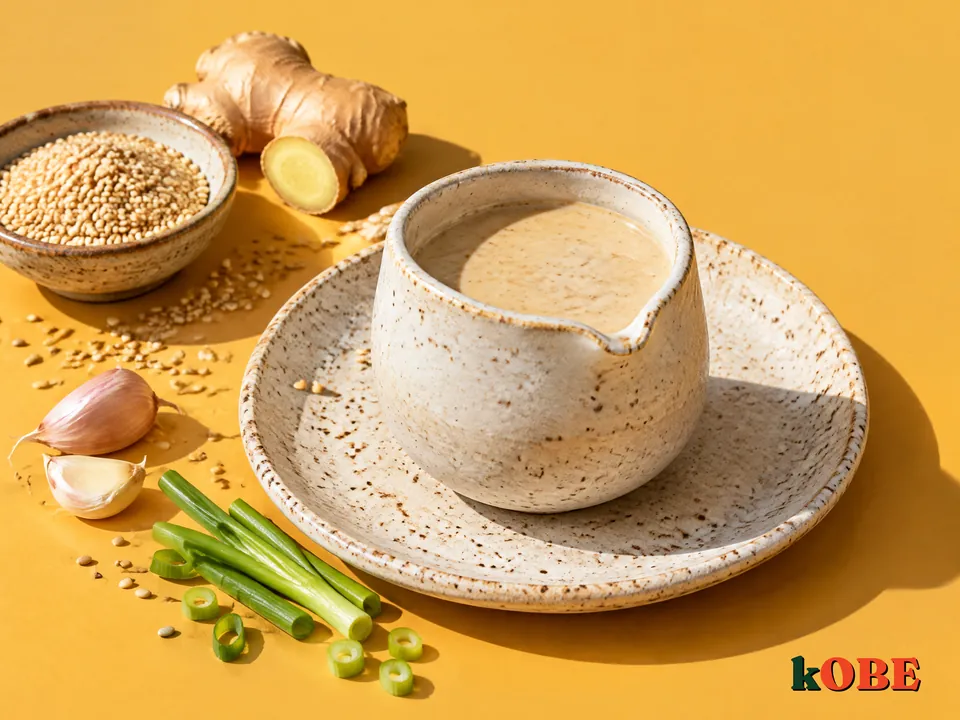
Japanese roasted sesame dressing is the national favorite at salad spots in Vietnam. Toasted sesame is ground fine, usually mixed with mayonnaise or oil, soy sauce, vinegar and sugar.
Sesame itself is great: lots of unsaturated fat, some fiber, calcium, and an irresistible aroma. What's worth watching is the mayo, oil and sugar that come with it. Some bottled roasted sesame dressings taste quite sweet.
Make it at home and you control all three: use less mayo, swap sugar for a zero-sugar sweetener, and add water so the dressing is just thin enough to pour.
For more on sesame and nuts, read Sesame and nuts.
Yogurt: a naturally light creamy dressing
If you love creamy dressing but want it light, unsweetened yogurt is the easiest choice.
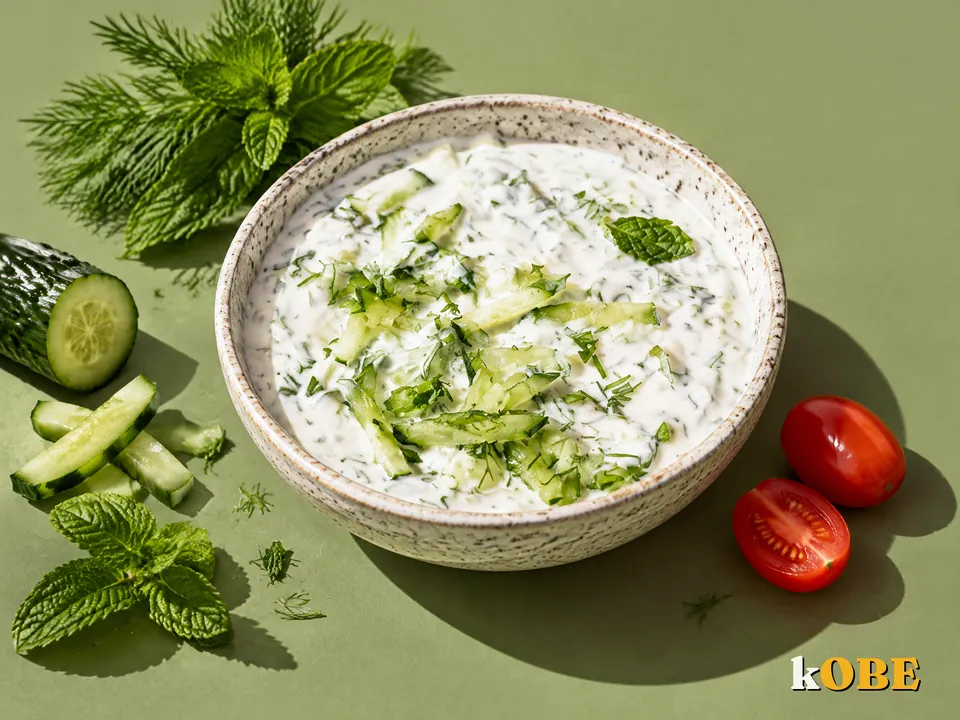
Greek yogurt is thick, gently tangy and brings protein. Mix it with grated cucumber, garlic, dill and a little olive oil for a Greek-style sauce. Mix it with a little mustard and lemon juice for a creamy chicken salad dressing.
A handy trick: half mayo, half yogurt. Still the familiar rich smoothness, with nearly half the calories. Low-fat mayo explains why yogurt can pull this off.
Quick comparison by the tablespoon
The numbers below are estimates and vary a lot by each home's or restaurant's recipe:
| Dressing (1 tablespoon) | Calories, roughly | Notes |
|---|---|---|
| Vinaigrette 3:1 | 90 | Almost all fat from oil |
| Regular mayonnaise | 95 | About 75% oil |
| Roasted sesame dressing | 50 to 90 | Depends on mayo, oil, sugar |
| Unsweetened Greek yogurt | 10 to 20 | Has protein, low fat |
| Sweet and sour fish sauce with sugar | 15 to 25 | No fat, but has sugar |
Look at the table and one surprise stands out: the sweet and sour nước mắm (fish sauce dressing) on a Vietnamese gỏi (herb salad) has almost no fat. Gỏi is tasty and light; just watch the sugar, and remember to add a few roasted peanuts or fried shallots so there's fat to unlock the vitamins.
Mixing tips for just enough, no counting
- Dry your greens well. Wet leaves make dressing slide off, and you'll pour more without noticing.
- Toss in a big bowl, then plate it. The dressing coats evenly, and you need far less than drizzling on top.
- One to two tablespoons of oil-based dressing is plenty for one person's salad.
- Pack dressing separately for your work lunch. Pre-dressed greens go limp and watery after a few hours.
Inside the kOBE kitchen
Our 1,480 home recipes include Japanese roasted sesame dressing, yogurt cucumber sauce and salads with vinaigrette. The recipes are sweetened with monk fruit sweetener, and every dish lists calories, fat and sugar per 100g.
If you want greens ready to go, kOBE Sesame Kale is massaged with sesame oil and toasted sesame, namul style: 78 calories and 4g of protein per 100g. In our frozen poke bowls, the base sauce is kOBE Signature Lean Mayo, a creamy egg-based sauce, thick and clingy like regular mayo.
Want to mix your own? Visit the Sauce Library.
Frequently asked questions
Is it bad to eat salad without dressing?
How long does vinaigrette keep?
Is roasted sesame dressing "healthy"?
Keep reading
Sources
- Brown M.J. et al. (2004). Carotenoid bioavailability is higher from salads ingested with full-fat than with fat-reduced salad dressings, as measured with electrochemical detection. American Journal of Clinical Nutrition 80(2):396 to 403.
- USDA FoodData Central: olive oil, mayonnaise, unsweetened Greek yogurt, sesame seeds.
- Harvard T.H. Chan School of Public Health, The Nutrition Source. Vegetables and Fruits.
- Further reading: Culinary Nutrition, chapter 6; Understanding Nutrition 16th ed., chapter 11 (fat-soluble vitamins).