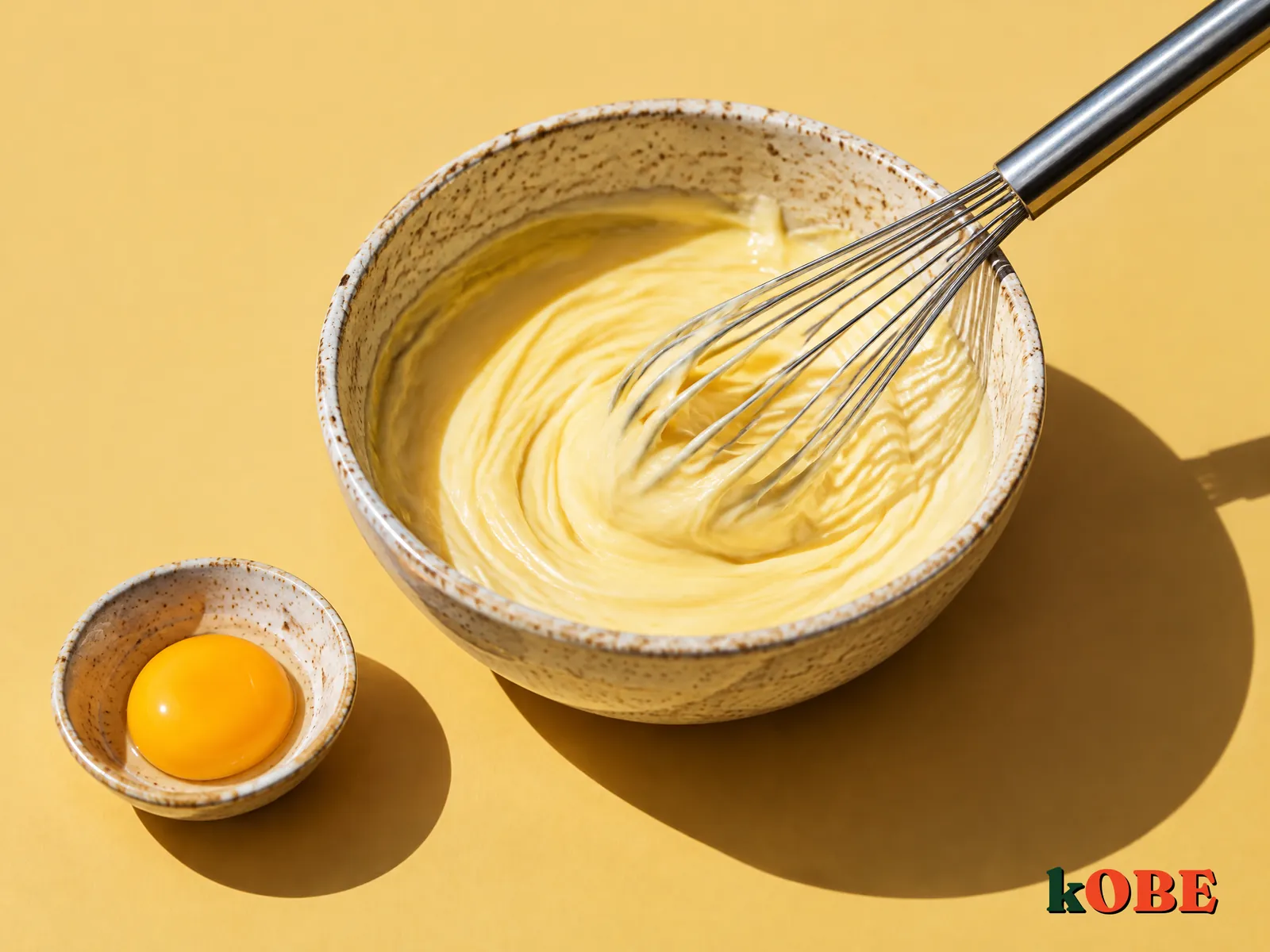
Try a kitchen experiment. Make mayo the usual way: egg yolk, a splash of vinegar, then pour in oil slowly while whisking. The sauce thickens, turns glossy and smooth, and a spoon can stand up in it.
Now make a second batch, but with only a third of the oil. The result? A pale yellow liquid, runny as milk, that slides right off the salad.
You didn't whisk badly. That's physics. And once you get it, you'll understand how low-fat creamy sauces are made.
In this article
Why does less oil mean a runny sauce?
In What is mayonnaise made of, we explained that mayo is an emulsion: billions of tiny oil droplets suspended in a little water.
Mayo's thickness doesn't come from the oil. Oil is a liquid, after all. The thickness comes from the droplets being packed in tight.
Picture a box of marbles. With just a few marbles inside, they roll around freely. Fill the box, and the marbles jam against each other so none can budge.
Mathematicians have worked it out: same-sized marbles, packed as cleverly as possible, fill only about 74% of the space. In regular mayo, oil makes up about 75 to 80%, past that line. The droplets are forced to squash flat against each other like a honeycomb. That's when the sauce can stand on a spoon.
Cut the oil in half and the droplets have room to "swim". The sauce runs straight away.
Method 1: thicken the water
If there aren't enough oil droplets to jam together, you make the water around them thicker instead.
Common helpers:
- Starch: like cornstarch or tapioca starch. Heat it and it thickens, like a pot of thick chè (sweet soup).
- Gums: like xanthan gum or guar gum. Just a pinch makes water noticeably thicker.
- Soluble fiber: like pectin or inulin. It thickens and gives a smooth feel.
Xanthan gum sounds strange, but it's made by fermentation, a bit like making vinegar or yogurt. It's an additive that major food safety authorities have evaluated and approved for use.
Method 2: let protein build a frame
The second method uses protein to build a soft frame that holds water in place.
You've seen this in your kitchen without noticing:
- Raw egg white is runny, but steam it and it sets into a solid.
- Greek yogurt is thick because the milk protein has been concentrated.
- Silken tofu is smooth and soft, and blends into a kind of cream.
Protein builds the frame and can also do the emulsifier's job: wrapping around oil droplets to keep them from merging. That's why many light creamy sauces use an egg, dairy or soy base.
Method 3: smaller droplets, smarter packing
The third method is subtler: change the size of the oil droplets.
With the same amount of oil, smaller droplets means more of them, rubbing against each other more. So the sauce gets a little thicker. Factories use high-pressure homogenizers to do this.
Researchers have also tried "nested" emulsions: water droplets inside oil droplets, with the whole cluster sitting in water. The goal is to keep the rich feel while using less oil. This is still being studied and isn't common in kitchens yet.
In practice, low-fat creamy sauces usually combine several methods at once.
Where does the flavor go when the fat goes?
This is the part we want to be honest about.
Fat doesn't just bring calories. It carries aroma, gives a round, full feel in the mouth, and softens sourness. Take out fat and you take out those things too.
To make up for it, some low-fat products on the market add more sugar, starch or salt. Remember the 1990s story from the article on fat: less fat, more sugar.
So when you pick a "light" mayo, don't just look at the fat line. Look at all three:
- Fat: how much lower than regular mayo.
- Carbs and sugar: have they gone up a lot?
- Sodium: has it been pushed up to make up for flavor?
Mix a light creamy sauce at home
No machines needed. You can use method 2 right in your kitchen:
- Half mayo, half unsweetened Greek yogurt. Add a little mustard and lemon juice. Calories drop by nearly half, and it stays lightly rich and pleasantly tangy.
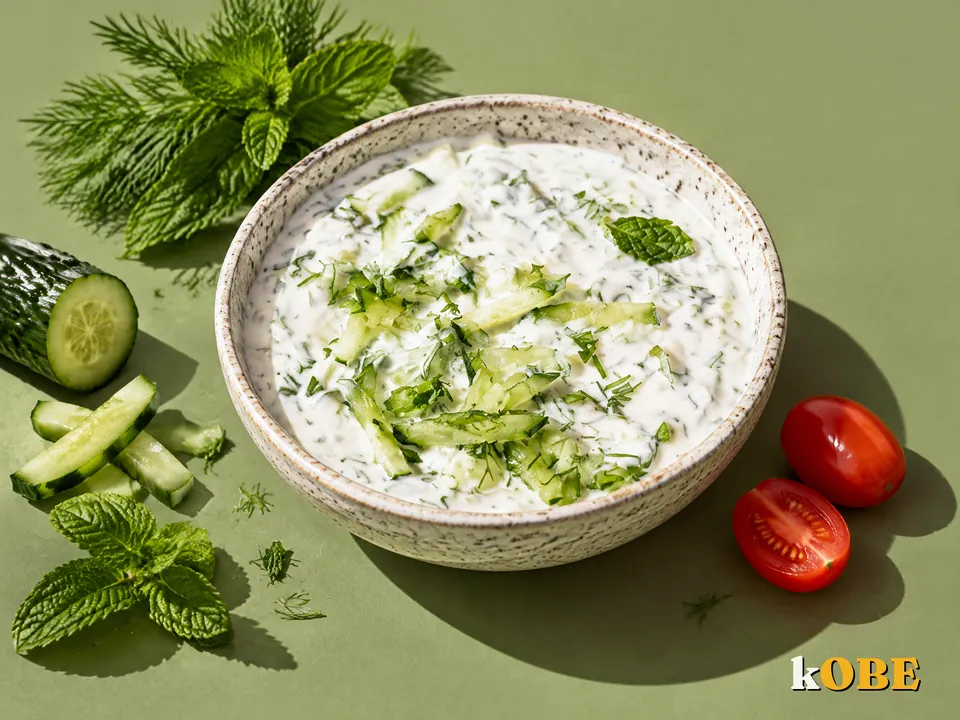
- Yogurt, grated cucumber, garlic, dill. A cool Greek-style creamy sauce that needs almost no oil.
- Silken tofu blended with lemon, garlic and a little olive oil. A smooth plant-based cream sauce.
Small tip: for a thicker sauce without extra oil, chill it in the fridge for 30 minutes before serving.
Inside the kOBE kitchen
kOBE Signature Lean Mayo belongs to the egg-based creamy sauce family: thick and clingy like regular mayo, while regular mayo can be about 75% oil.
The 80% version has 118 calories, 3.1g of protein and 8.7g of fat per 100g. We list the rest too so you can compare for yourself: 8.6g of carbs per 100g. The 90% version is lighter still, with no preservatives.
Remember the advice above? Read all three lines: fat, carbs, sugar. That goes for our sauce too.
Lean Mayo is also the base sauce in our frozen poke bowls. Want to mix more sauces? Visit the Sauce Library.
Frequently asked questions
Is low-fat mayo always lower in calories?
Should I worry about thickeners in sauces?
Can I make low-oil mayo with egg yolk at home?
Keep reading
Sources
- Depree J.A., Savage G.P. (2001). Physical and flavour stability of mayonnaise. Trends in Food Science & Technology 12(5):157 to 163.
- EFSA Panel on Food Additives and Nutrient Sources added to Food (2017). Re-evaluation of xanthan gum (E 415) as a food additive. EFSA Journal 15(7):4909.
- USDA FoodData Central, SR Legacy: regular mayonnaise and reduced-fat (light) mayonnaise.
- Further reading: McClements D.J., Food Emulsions: Principles, Practices, and Techniques; Food Lipids (section on emulsions).