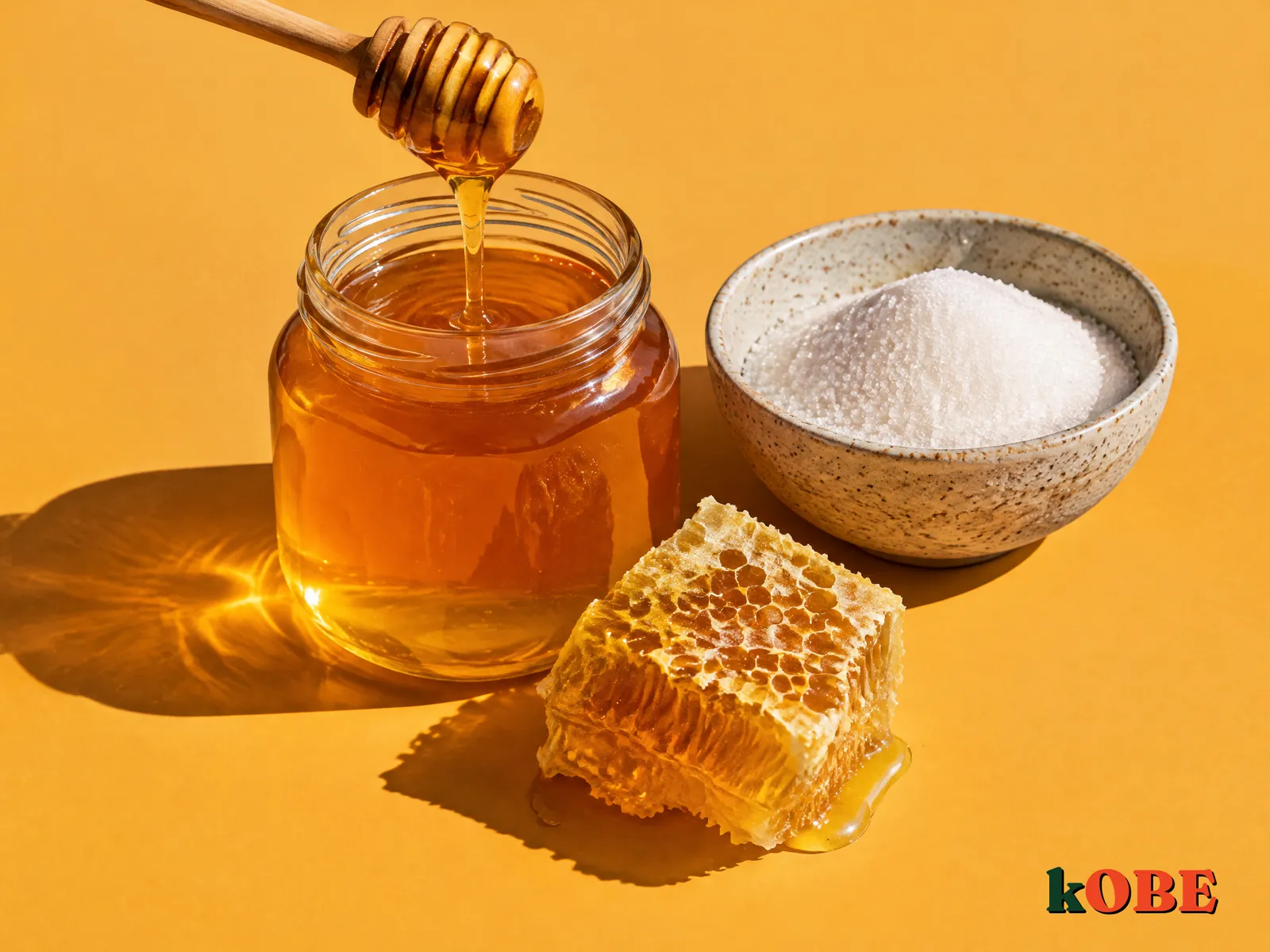
Every home has a jar of honey. A warm honey lemon drink in the morning. A glossy, fragrant marinade for grilled ribs at night.
Plenty of people have switched from sugar to honey altogether, with a very natural thought: honey comes from nature, from bees, so it must be gentler than pure white sugar.
We put the two jars on the scale, quite literally. The results held a few surprises.
In this article
What's actually inside a jar of honey?
Bees sip nectar, a thin sweet liquid made mostly of sucrose. Inside the bee, an enzyme splits the sucrose in two: glucose and fructose. Back at the hive, bees fan their wings to evaporate water until the honey turns thick.
The result is a jar of honey that's roughly:
- 80% sugar. Mostly fructose (fruit sugar) and glucose, plus a little sucrose and maltose.
- 17% water.
- A very small remainder: a bit of protein, organic acids, minerals, enzymes and the compounds behind aroma and color.
Fun fact: a worker bee makes only about one twelfth of a teaspoon of honey in its whole life. Every spoonful of honey is the work of a dozen or so bees.
But looking at those numbers, you can see it. Honey is, first of all, a concentrated sugar solution.
Spoon for spoon, which has more calories?
This is the biggest surprise. According to the US Department of Agriculture (USDA) food database:
| Per 100g | Per tablespoon | |
|---|---|---|
| White sugar | 387 kcal, 100g sugar | about 12.5g: 48 kcal |
| Honey | 304 kcal, 82g sugar | about 21g: 64 kcal |
By the gram, honey has fewer calories than sugar. The reason is simple: honey contains water.
But by the spoon, honey has more calories. Honey is thick and heavy, so a spoonful weighs nearly twice as much as a spoonful of sugar.
Honey is a little sweeter than sugar thanks to fructose, so you might use a bit less. Add it all up and it's roughly a draw. Neither is a "low sugar" choice.
The World Health Organization (WHO) also places honey in the free sugars group, in the same row as white sugar. That's the group WHO advises keeping below 10% of daily energy.
Are the "good stuff" amounts in honey big enough?
Honey really does contain minerals, vitamins and antioxidants. The amounts are another story.
Take potassium. A tablespoon of honey has about 11mg of potassium. A medium banana has about 420mg.
So to get the potassium of one banana, you'd need to eat almost 40 tablespoons of honey. That comes with more than half a kilo of sugar.
Antioxidants are similar. Dark honey usually has more than light honey. But compared with a plate of vegetables or a few slices of fruit, one spoonful contributes very modestly.
To be fair: honey has more going on than white sugar, which is nearly pure sucrose. But those extras are too small to change the story. If you want minerals and vitamins, vegetables and fruit are far better sources.
Does honey raise blood sugar more slowly?
A little, and it depends on the type.
The glycemic index (GI) measures how fast a food raises blood sugar. White sugar has a GI of about 65. Honey varies quite widely from test to test: some types are lower than sugar, some higher.
The reason is the share of fructose. Fructose goes to the liver to be processed first, so it raises blood sugar more slowly than glucose. Honey with more fructose has a lower GI.
But a lower GI doesn't mean less sugar. You're still eating almost the same amount of sugar. Your body is just taking the scenic route.
So what is honey good for?
Flavor, and that's a perfectly good reason.
Honey has floral notes, a gentle tang and its own silky thickness. Coffee blossom honey is different from longan honey, which is different from melaleuca honey. White sugar has none of those aromas.
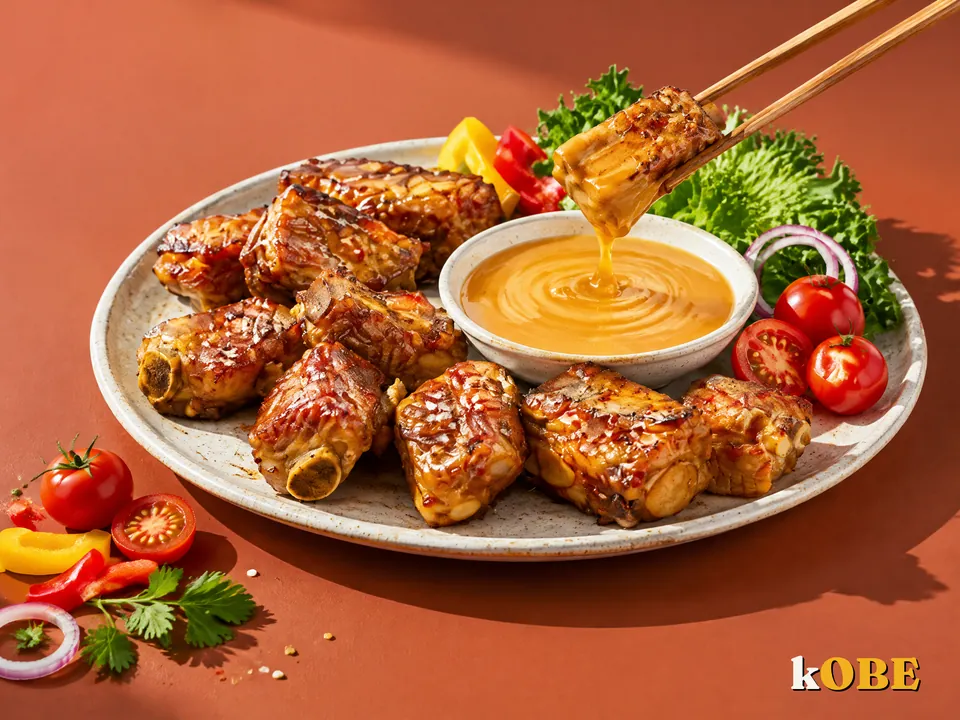
In the kitchen, honey gives grilled dishes a beautiful gloss and keeps cakes moister. A little fragrant honey can make a dish far more memorable than several spoons of sugar.
So the sensible way to use honey is as an aromatic seasoning, not a healthy sugar substitute.
And one important safety note: don't give honey to babies under 1 year old. Honey can contain spores of the bacterium Clostridium botulinum. A baby's gut isn't mature enough to handle them. Adults and older children don't have this problem.
Inside the kOBE kitchen
Sweet dishes at kOBE use the kOBE Signature Monk Fruit Blend, which swaps for sugar 1:1. Our library of 1,480 home recipes on the Recipes page is sweetened with monk fruit sweetener, and every dish lists sugar per 100g.
If you love the aroma of honey, here's a trick to try at home: keep a little honey for flavor and let monk fruit sweetener carry most of the sweetness. For example, if a rib marinade calls for 3 tablespoons of honey, try 1 tablespoon of honey and make up the rest of the sweetness with monk fruit sweetener. The dish still smells of honey, but the free sugars drop noticeably.
Remember that honey burns easily when grilled. Brush it on in the last few minutes so the meat turns glossy without blackening.
Frequently asked questions
Does crystallized honey mean it's fake?
Does honey have more calories than sugar?
Is it a problem to cook honey at high heat?
Can children eat honey?
Keep reading
Sources
- USDA FoodData Central: honey; sugars, granulated; bananas, raw.
- WHO (2015). Guideline: Sugars intake for adults and children.
- Bogdanov S. et al. (2008). Honey for nutrition and health: a review. Journal of the American College of Nutrition 27(6):677 to 689.
- Atkinson F.S., Foster-Powell K., Brand-Miller J.C. (2008). International tables of glycemic index and glycemic load values: 2008. Diabetes Care 31(12):2281 to 2283.
- NHS (UK). Weaning guidance: do not give honey to babies under 12 months.
- Further reading: Understanding Nutrition 16th ed., chapter 4.