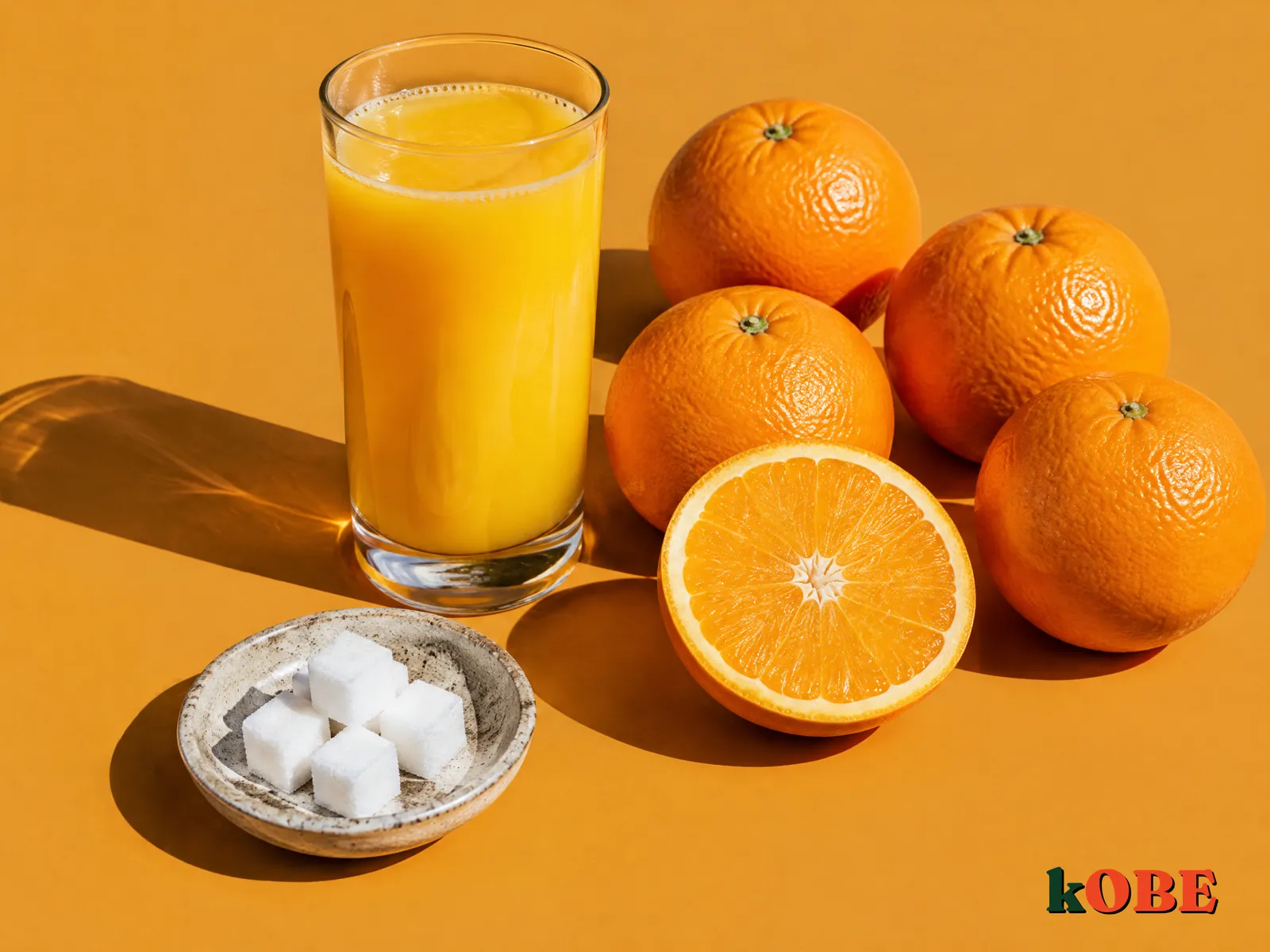
Mornings in Saigon, the orange juice cart at the mouth of the alley always has a crowd. Fresh oranges, squeezed on the spot, no sugar added. It sounds like health in a cup.
But there's a little math few people do. How many oranges go into that glass? And if you ate that many oranges instead of drinking them, could you even finish?
The answer leads to a sugar with a name that's both familiar and mysterious: fructose, fruit sugar.
In this article
Fructose: the sweetest sugar in nature
Fructose is found in fruit, honey and some vegetables. It's also half of table sugar. A molecule of table sugar (sucrose) is one glucose joined to one fructose.
Fun fact: fructose is sweeter than table sugar, about 1.2 to 1.8 times depending on temperature. The colder it is, the sweeter it tastes. That's one reason chilled fruit tastes sweeter than fruit left on the counter.
Among Vietnamese fruits, total sugar (fructose, glucose and sucrose combined) varies quite a lot:
| 100g of fruit | Sugar, roughly |
|---|---|
| Ripe mango | 14g |
| Banana | 12g |
| Orange | 9g |
| Guava | 9g |
| Watermelon | 6g |
None of these numbers is scary. But keep this table in mind for later.
Glucose and fructose: two guests, two different entrances
Glucose is the body's "cash." It goes straight into the blood, and almost every cell can use it. When glucose enters the blood, blood sugar rises and insulin is called in to open the cells' doors.
Fructose takes a different road. It doesn't raise blood sugar much right away. Most fructose is sent to the liver to be processed first. There, the liver turns it into glucose, into glycogen (the body's stored energy), or into other compounds.
There's a fascinating finding from 2018. Scientists found that the small intestine can also process some fructose, especially in small amounts. Think of the small intestine as the first "receiving dock." Only when fructose overwhelms the dock does the overflow head to the liver.
And when the liver gets too much fructose at once, some of it can be turned into fat. This is clearest with large amounts of fructose taken in fast, such as through sweet drinks. With whole fruit eaten in normal amounts, studies haven't found cause for concern. Exactly how much counts as "a lot" is still being studied.
So the issue isn't fructose itself. It's amount and speed.
An orange and a glass of orange juice: same sugar, different delivery
Back to the juice cart at the alley.
One medium orange, about 130g, has about 12g of sugar. A 250ml glass of orange juice takes about 3 oranges and holds about 20g of sugar. That's about 5 teaspoons of sugar, without a single grain added.
Now compare two scenes:
- Eating 3 oranges: you peel, pull apart the segments and chew. It takes ten minutes or so. By the second orange you're already feeling full.
- Drinking 1 glass of orange juice: done in a minute. Your stomach barely notices.
The difference lies in fiber and structure. When you squeeze, most of the pulp and segment walls stay behind with the peel. The sugar escapes its "nest" and enters your body much faster.
That's why the World Health Organization (WHO) counts the sugar in fruit juice as free sugars, in the same row as table sugar. The sugar in whole fruit is not.
What about smoothies? Somewhere in between
A smoothie blends the whole fruit, so it keeps the fiber. That sounds better than juice, and it is.
But the blender has done your teeth's job. The fiber is pulverized, and you drink faster than you'd eat. And a smoothie often uses more fruit than you'd eat in one go.
On top of that, smoothies from street stalls often get condensed milk or sugar. Now the glass holds both fruit sugar and added sugar.
A few tips for smoothie lovers:
- Use a small glass. About 200ml is right for one serving.
- Add vegetables or seeds. Spinach, cucumber and chia seeds make a smoothie more filling without adding much sugar.
- Skip the sugar. Ripe fruit is sweet enough. If you need more, use a sugar substitute instead of condensed milk.
So does fruit have "too much sugar"?
There's no need to fear whole fruit.
Fruit gives you water, fiber, vitamin C, potassium and much more. WHO advises everyone to eat at least 400g of vegetables and fruit a day. Most of us fall short, rather than overdoing it.
Just remember three things:
- Eat fruit rather than drink it when you can.
- Juice is a sweet drink. A small glass now and then is fun, but don't drink it like water.
- Dried fruit is concentrated sugar too. Like beef jerky: the water leaves, the sugar stays. A small handful of raisins equals a whole bunch of fresh grapes.
Inside the kOBE kitchen
Our library of 1,480 home recipes on the Recipes page lists sugar per 100g for every dish. So you can see this article's lesson in numbers.
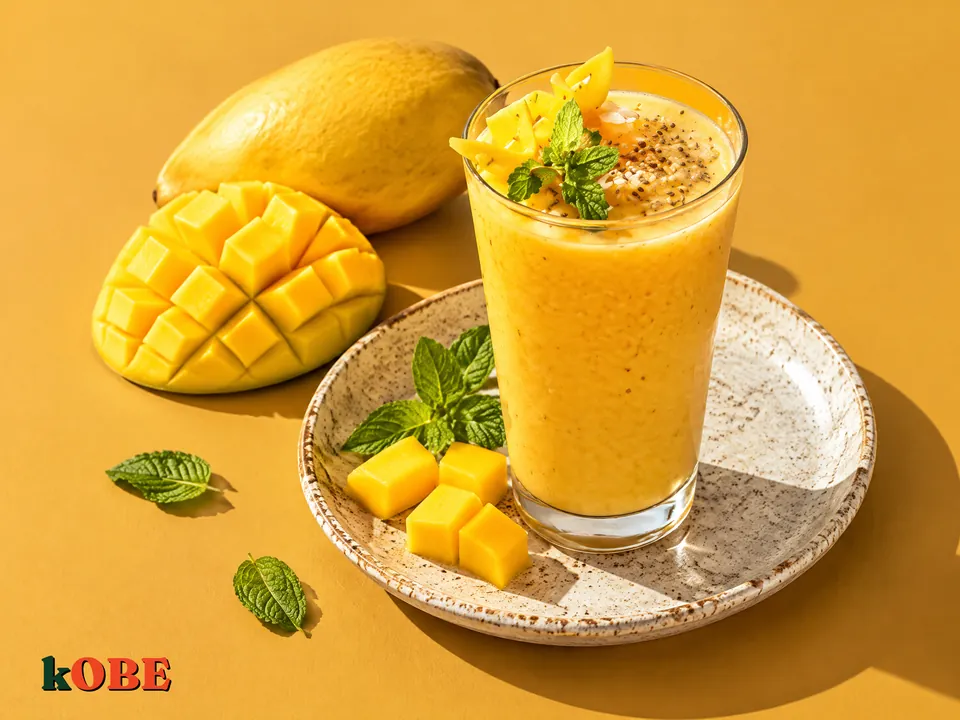
For example, our mango oat milk smoothie, with no added refined sugar, lists 10.8g of sugar per 100g. One serving is about 259g, which comes to about 28g of sugar. Most of it comes from ripe mango and milk. We keep that number as it is, because it's the truth about a mango smoothie.
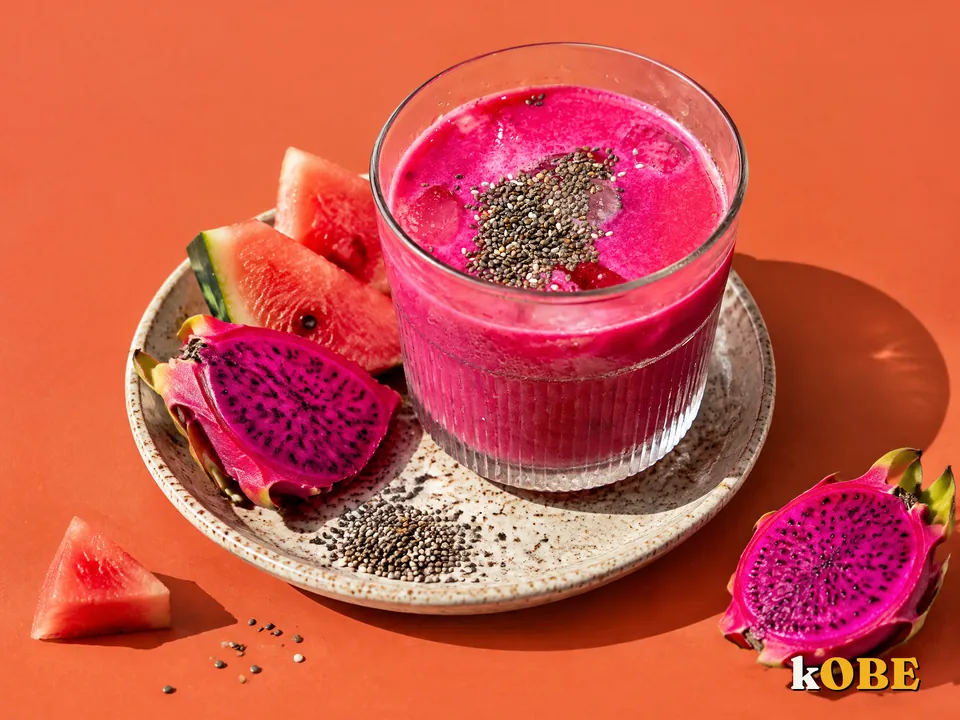
Our dragon fruit, watermelon and chia smoothie lists 8.2g of sugar per 100g, lighter thanks to low-sugar watermelon and chia seeds.
So when you choose a fruit drink, look at the sugar line. "No added sugar" doesn't always mean low in sugar.
Frequently asked questions
Is juice with no added sugar better than soda?
What about sugarcane juice?
What is high fructose corn syrup?
If I'm cutting sugar, should I avoid sweet fruits like mango and durian?
Keep reading
Sources
- WHO (2015). Guideline: Sugars intake for adults and children.
- USDA FoodData Central: oranges, raw; orange juice, raw; mangos; bananas; guavas; watermelon.
- Jang C. et al. (2018). The small intestine converts dietary fructose into glucose and organic acids. Cell Metabolism 27(2):351 to 361.
- Tappy L., Lê K.A. (2010). Metabolic effects of fructose and the worldwide increase in obesity. Physiological Reviews 90(1):23 to 46.
- Further reading: Understanding Nutrition 16th ed., chapter 4.