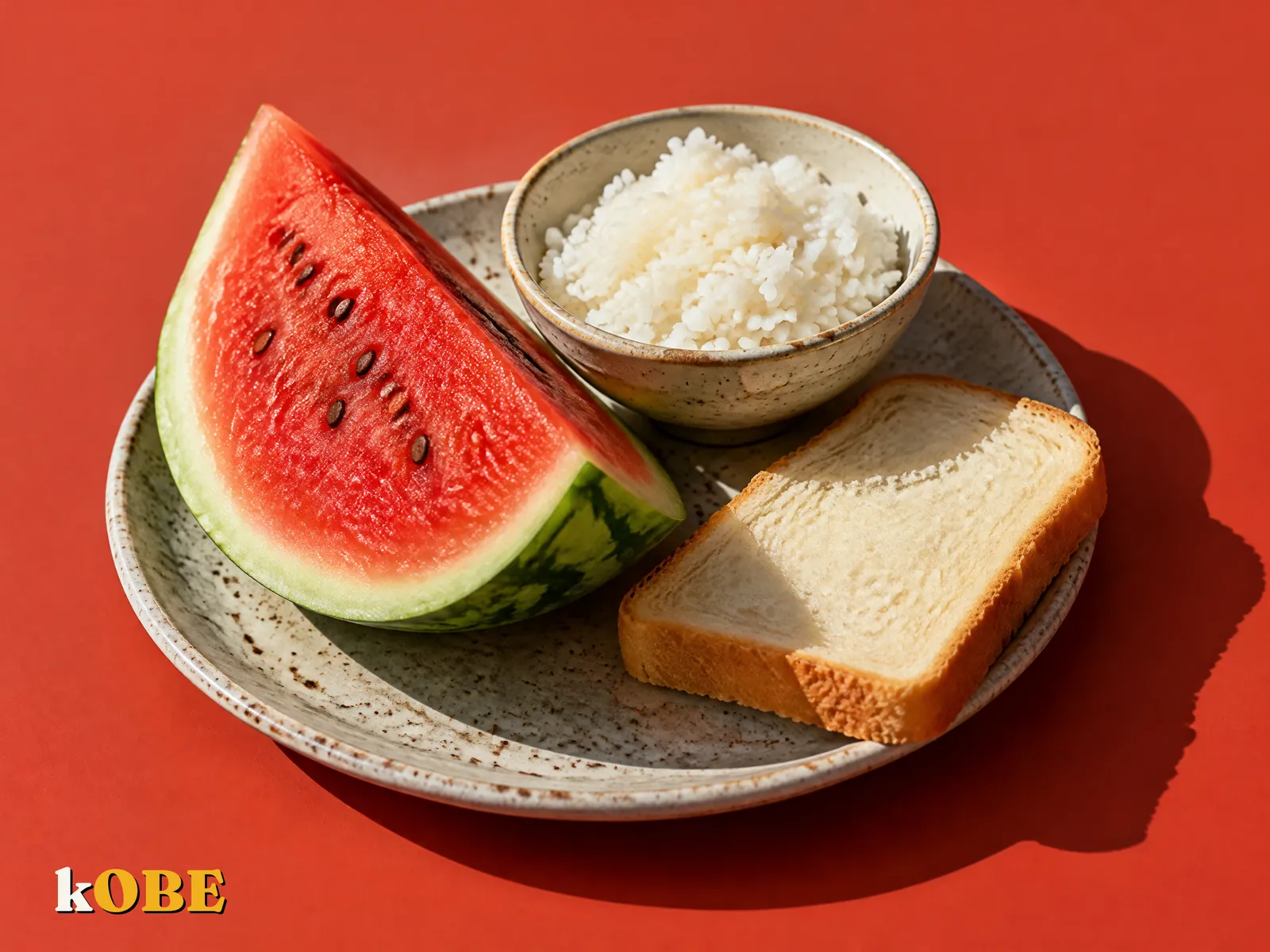
Maybe you've read this somewhere: "Watermelon has a high glycemic index, it sends your blood sugar soaring, so limit it."
Sounds reasonable. But a cold slice of watermelon on a hot day actually has less sugar than a banana. So who's right?
Both, once you know there are two numbers, not one. The first is called GI. The second is called GL, and it often gets forgotten.
In this article
GI is a speed race
The glycemic index (GI) was born in 1981 in Canada. It measures how fast or slow a food raises your blood sugar.
The testing method is pretty interesting:
- Invite about 10 people to fast overnight.
- Feed them an amount of the food containing exactly 50g of carbohydrate.
- Measure their blood sugar continuously for the next 2 hours.
- Compare with when they drink 50g of pure glucose. Glucose scores 100 points.
A food that raises blood sugar almost as fast and high as glucose gets a high score. A food that raises it slowly gets a low score.
| GI level | Score |
|---|---|
| Low | 55 or below |
| Medium | 56 to 69 |
| High | 70 or above |
The GI trap: it tells you speed, not quantity
Remember step 2: every food is tested with 50g of carbohydrate.
For rice, 50g of carbs is about a bowl and a half. Very close to a real meal.
But watermelon has very few carbs, about 7 to 8g per 100g. To get 50g of carbs from watermelon, you'd have to eat about 650g of melon. Nearly half a small watermelon. Hardly anyone eats that much in one sitting.
So yes, watermelon's GI is high. But it describes a situation you almost never face. That's where the second number comes in.
GL: speed multiplied by quantity
Glycemic load (GL) takes into account the carbs in a real serving:
GL = GI × grams of carbs in the serving ÷ 100
| GL level per serving | Score |
|---|---|
| Low | 10 or below |
| Medium | 11 to 19 |
| High | 20 or above |
Now let's work it out for a few familiar foods, using GI values from international tables and carbs from USDA:
| Serving | GI, roughly | Carbs, roughly | GL, roughly |
|---|---|---|---|
| 1 slice of watermelon (120g) | 72 to 76 | 9g | 7 |
| 1 medium banana (120g) | 51 | 27g | 14 |
| 1 medium boiled sweet potato (150g) | 63 (average, depends on variety) | 27g | 17 |
| 1 bowl of white rice (150g) | 73 | 42g | 30 |
| 1 bowl of brown rice (150g) | 68 | 35g | 24 |
| 1 bowl of boiled chickpeas (150g) | 28 | 41g | 11 |
Surprised? Watermelon has the highest GI in the table, but the lowest GL. And the bowl of white rice, the food we eat every day, is the one with a high GL.
That doesn't make rice "bad." Rice is the main energy source of a Vietnamese meal. It just means that how much rice and what you eat with it matter more than skipping a slice of watermelon.
Same food, the score can change
GI isn't carved in stone. It shifts with many things:
- Ripeness. A green banana has a lower GI than a ripe, freckled yellow one. The starch in a green banana hasn't turned into sugar yet.
- Cooking. The softer and mushier the cooking, the higher the GI. Plain rice porridge (cháo) rises faster than steamed rice.
- Cooling. Rice kept in the fridge and reheated gains a little resistant starch. Our article on how cold rice differs from hot rice has the details.
- What you eat with it. GI is measured when a food is eaten alone. Eat rice with vegetables, fish, meat and a little oil, and blood sugar for the whole meal rises more slowly.
- Each person. A large 2015 study in Israel showed that the same food can trigger quite different blood sugar responses in different people.
Low GI doesn't mean "healthy"
This is where a lot of people get confused.
French fries have a lower GI than boiled potatoes. Ice cream has a lower GI than white bread. The reason is that fat slows down digestion, so sugar enters the blood more slowly.
But nobody would say French fries are healthier than boiled potatoes.
So use GI and GL as a supporting tool, to understand why the same amount of starch raises blood sugar differently. Not as a ranking of good and bad foods. Looking at the whole meal, the portion and your habits is still far more useful.
Inside the kOBE kitchen
To apply GL to real meals, you need to know the carbs. The ready-cooked ingredients on our Ingredients page all list them clearly:
| Per 100g | Calories | Carbs |
|---|---|---|
| White Rice | 130 kcal | 28g |
| Red Brown Rice | 123 kcal | 25.6g |
| Black Brown Rice | 100 kcal | 21.2g |
| Chickpeas | 164 kcal | 27.4g |
For example, a 200g pack of White Rice has about 56g of carbs. If one pack feels like a lot, you can split it in half, or mix half white rice with half brown rice.
Then add Sous Vide Chicken Breast (31g protein, 0g starch per 100g) and a portion of Sesame Kale. The plate now has protein, vegetables and a little fat: exactly the kind of "company" that makes blood sugar for the whole meal gentler.
Frequently asked questions
Does brown rice have a much lower GI than white rice?
Should I eat only low GI foods?
Should I avoid high GI fruits like watermelon and pineapple?
What is the GI of monk fruit sweetener?
Keep reading
Sources
- Jenkins D.J.A. et al. (1981). Glycemic index of foods: a physiological basis for carbohydrate exchange. American Journal of Clinical Nutrition 34(3):362 to 366.
- Atkinson F.S. et al. (2021). International tables of glycemic index and glycemic load values 2021: a systematic review. American Journal of Clinical Nutrition 114(5):1625 to 1632.
- Zeevi D. et al. (2015). Personalized nutrition by prediction of glycemic responses. Cell 163(5):1079 to 1094.
- FAO/WHO (1998). Carbohydrates in human nutrition. FAO Food and Nutrition Paper 66.
- USDA FoodData Central: watermelon, bananas, boiled sweet potato, cooked white rice, cooked brown rice, boiled chickpeas.
- Further reading: Understanding Nutrition 16th ed., chapter 4; Science of Rice.