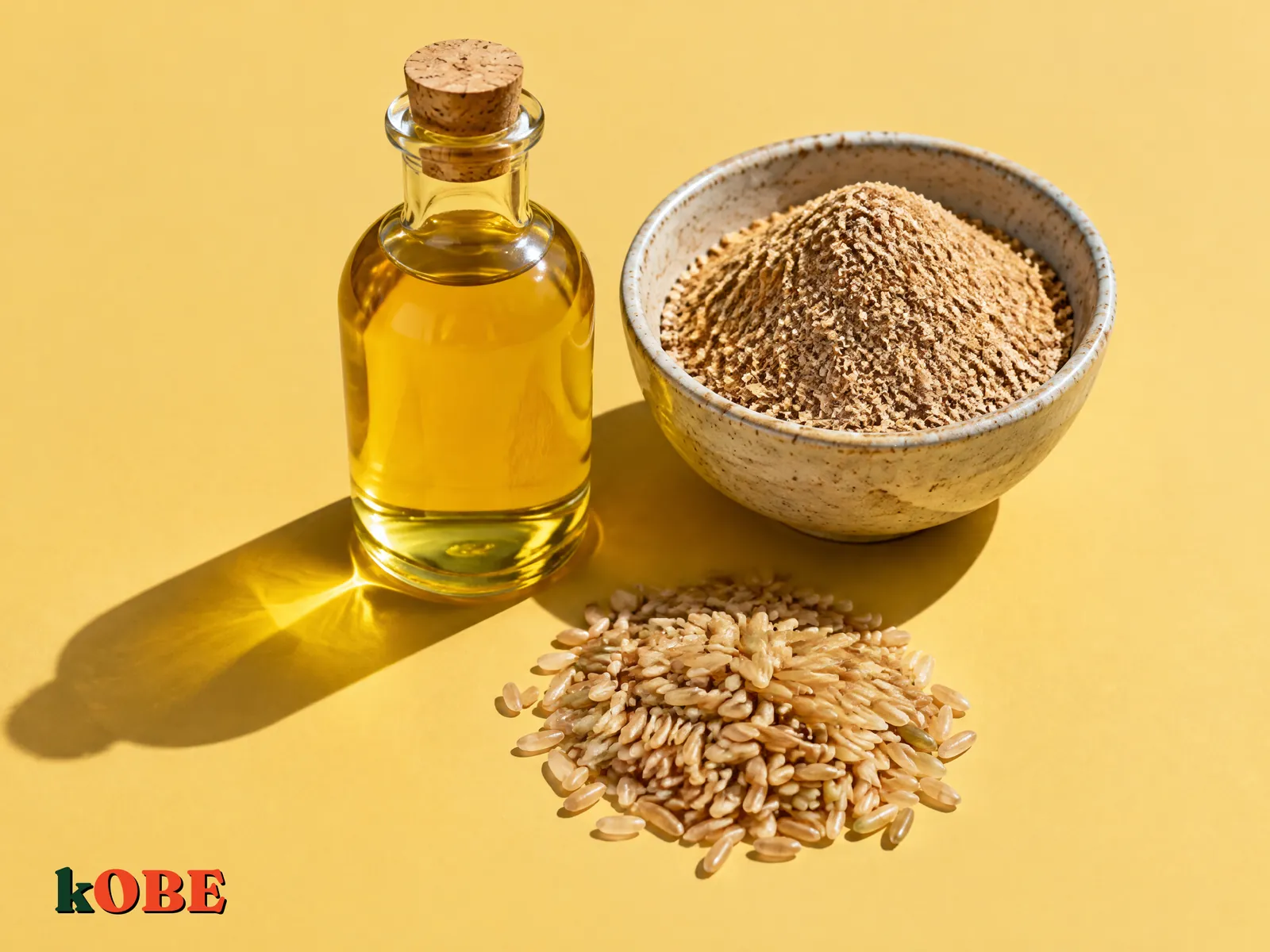
In the Vietnamese countryside, there are always a few sacks of bran sitting next to the rice mill. Farmers buy them, mix them with vegetables and cook them up for the pigs.
Now walk into a supermarket and you'll find bottles of "rice bran oil" lined up next to soybean oil and olive oil. Same bran, two very different destinies. How did that happen?
The answer lies in the paper-thin layer we polish off every time we eat white rice.
In this article
Which part of the rice grain is the bran?
Picture a grain of rice as a tiny onion with several layers.
- The husk is the outermost shell. Hard, and not something you can eat.
- The bran sits just beneath it. Thin as paper, light brown.
- The germ is the little dot at the tip of the grain, where a new rice plant would sprout.
- The endosperm is the white core, almost pure starch.
Brown rice is the grain with the husk removed but the bran and germ still on. Keep polishing it until it turns white, and the bran and germ fall away as a fine powder. That powder is rice bran.
This layer is only a small fraction of the grain's weight. Yet it holds most of the fiber, most of the fat and many of the B vitamins in the whole grain.
What's inside a handful of bran?
According to Science of Rice (2023), the makeup of rice bran varies quite a lot depending on the rice variety and how it is milled:
| In rice bran | Roughly how much |
|---|---|
| Fiber | 20 to 33% |
| Fat | 10 to 23% |
| Protein | 13 to 19% |
| Starch | 16 to 27% |
Compared with white rice, which is almost all starch, bran is a completely different pantry.
Here's the fun part: close to 90% of the fiber in bran is insoluble fiber. It doesn't dissolve in water. Think of it as tiny strands. It adds bulk to stool and helps things move through your gut more regularly.
That's also why brown rice feels a little "gritty" to chew and keeps you full longer than white rice.
Why does bran smell off after a few days?
Anyone who has kept bran around for too long knows the smell: sharp, oily, like old frying oil.
The secret is in how the rice grain "stores its things". In a whole grain, the fat sits in one compartment and the fat-cutting enzyme (lipase) sits in another. The two never meet, so brown rice keeps fairly well.
When the mill grinds up the bran layer, those compartments get mixed together. The enzyme gets straight to work cutting up the fat. Science of Rice notes that the acidity of the oil in fresh bran shoots up within the first 6 hours after milling.
Because bran spoils so fast, most of the world's bran still ends up as animal feed. To make cooking oil, mills have to "stabilize" the bran very early, usually with steam or high-heat extrusion to switch the enzyme off.
A small tip for your kitchen: brown rice still has its bran, so buy only what you'll use, and store it somewhere cool and dry in a sealed container. The bran in brown rice still carries a bit of fat, and if it sits too long it can start to smell.
What makes rice bran oil different?
Bran is about 15 to 20% oil. Press or extract it, refine it, and you get rice bran oil.
In terms of fats, rice bran oil looks a lot like other familiar vegetable oils:
- About 80% is unsaturated fat.
- The biggest share is oleic acid (the same main fat in olive oil), at about 38 to 47%.
- Next comes linoleic acid, an omega-6, at about 32 to 39%.
- Saturated fat makes up about one fifth.
What sets it apart is a few small "guests" that come along for the ride:
- Gamma-oryzanol: a group of compounds found almost only in rice bran oil.
- Tocotrienols: a form of vitamin E you rarely find in other oils.
- Phytosterols (plant sterols): rice bran oil has plenty of them.
Many studies are looking at what oryzanol and phytosterols do for blood lipids. The early results are interesting, but we'll be honest: most of it is still small studies, not nearly enough to think of rice bran oil as some kind of "medicine".
And here's a detail few people know. Refining (removing acids, bleaching, and deodorizing at 200 to 220°C) strips out a significant share of these valuable compounds. So the oryzanol content can differ quite a bit from one bottle to the next.
Is rice bran oil good for frying and stir-frying?
Refined rice bran oil has a mild, almost neutral taste. Many sources put its smoke point at around 230°C, which puts it among the fairly heat-tolerant oils. That makes it a good fit for stir-frying, pan-searing and frying.
But whatever the oil, a calorie is still a calorie. One tablespoon of rice bran oil (about 14g) gives you about 120 kcal, close to a small bowl of rice. Exactly the same story as soybean or olive oil.
A few ways to use oil more wisely:
- Measure with a spoon instead of pouring straight from the bottle.
- Don't reuse frying oil over and over. When it turns dark and smells burnt, it's time to let it go.
- Rotate between a few different oils so your meals get a mix of different fats.
- Cap it and keep it in the dark. Unsaturated fats don't like light or heat.
Inside the kOBE kitchen
We don't make rice bran oil. But if you want to eat the whole bran layer, the simple way is to choose brown rice.
kOBE Red Brown Rice and Black Brown Rice are cooked and then frozen. Red Brown Rice has 123 kcal, 2.7g protein and 25.6g carbs per 100g. Black Brown Rice has 100 kcal, 4g protein, 21.2g carbs, plus anthocyanins, the pigments behind its deep purple-black color.
To reheat it soft: thaw it in the fridge overnight, or warm it in the microwave on low. See our rice options on the Ingredients page.
Frequently asked questions
Can you eat rice bran directly?
Is rice bran oil better than olive oil?
How much more bran does brown rice have than white rice?
Keep reading
Sources
- Tian J. et al. (2023). Science of Rice: Chemistry and Nutrition. Springer. Chapter 4 (rice bran oil: fatty acid profile, oryzanol, refining) and chapter 6 (rice bran fiber).
- USDA FoodData Central: Oil, rice bran; Rice, brown, cooked.
- Harvard T.H. Chan School of Public Health, The Nutrition Source: Types of Fat; Whole Grains.
- National Institute of Nutrition (Vietnam). Vietnamese Food Composition Table (ordinary rice, brown rice).
- Further reading: Science of Rice (2023), chapters 4 and 6; Food Lipids.