Walk past any pharmacy and you will see a shelf of colorful vitamin bottles. Online, the ads say one pill every morning gives you "everything you need for the day".
You may have wondered: do I actually need one? Or does most of it just pass through the body and out again?
The honest answer: it depends on who you are. We will give you both sides, neither cheering for pills nor campaigning against them.
In this article
What were multivitamins made for?
A multivitamin is a single pill bundling many vitamins and minerals, usually at levels close to the recommended daily amount.
It was designed as a "safety net": a backup for times when meals fall short. Not to replace meals, and not to make healthy people healthier.
Once you see that role clearly, the question "do I need one" really becomes "is my diet falling short anywhere".
What does science say for healthy people?
Many large studies have followed tens of thousands of people who did and did not take multivitamins for years.
The overall conclusion so far is fairly consistent: for healthy adults eating a reasonably varied diet, there is no clear evidence that a daily multivitamin helps you live healthier or longer. In 2022, the US Preventive Services Task Force (USPSTF) reviewed the studies and reached a similar view.
To be fair: "no evidence of benefit" does not mean "harmful". For most people, a standard-dose multivitamin is quite safe. It just may not add anything if your meals already cover you.
What does a pill miss compared with food?
A vitamin pill has a dozen or so nutrients. A single sweet potato has hundreds, sometimes thousands of different compounds.
| Food | Multivitamin | |
|---|---|---|
| Vitamins, minerals | Yes, in many natural forms | Yes, fixed doses |
| Fiber | Yes | No |
| Protein, healthy fats | Yes | No |
| Polyphenols, carotenoids and thousands of plant compounds | Yes | Very few or none |
| Feeling full, the joy of eating | Yes | No |
Here is another interesting point: many nutrients in food help each other get absorbed. Vitamin C in greens helps you take in iron. Fat in a stir-fry helps you take in beta-carotene. A pill cannot recreate all those "pairings".
And the familiar fun fact: after a B vitamin pill, urine often turns bright yellow. That is extra vitamin B2 the body is getting rid of. It is harmless, but it is easy-to-see proof that taking in more does not mean keeping more.
Groups with specific needs
There are stages and situations where meals struggle to supply enough of certain nutrients. Health organizations usually mention:
- Women planning a pregnancy, pregnant or breastfeeding. There are specific recommendations on folic acid, iron and some other nutrients.
- Vegans. Especially vitamin B12, which plants barely contain.
- Older adults. B12 absorption can drop, and needs for vitamin D and calcium may be higher.
- People who get little sun, working indoors all day.
- People on very restrictive diets, cutting out whole food groups, or eating too little.
- People with health conditions that affect absorption, or who take long-term medication.
If you are in one of these groups, the sensible step is to ask a health professional: a doctor, pharmacist or dietitian. They can look at your diet, run tests if needed, and suggest exactly the nutrient you need, instead of an "everything" pill. We do not give doses or recommend products in this article.
"The more the better" is a trap
Vitamins sound harmless, so they are easy to overdo. A few things worth knowing:
- Fat-soluble vitamins (A, D, E, K) are stored. Taking high doses for a long time can build up too much.
- Minerals like iron and zinc can get in each other's way. Long-term high-dose zinc can block copper absorption, and high-dose iron can upset the stomach.
- Stacking several products. A multivitamin, plus a separate vitamin D pill, plus fortified milk, plus a "vitamin energy" drink... it is very easy to go over without realizing.
- Interactions with medication. Some vitamins and minerals affect how medicines work. If you take medication, ask a pharmacist first.
On a supplement label you will see a "% daily value" column. Numbers many times over 100% are a signal to pause and ask for professional advice.
Inside the kOBE kitchen
kOBE's job is meals, so we only speak for the food side.
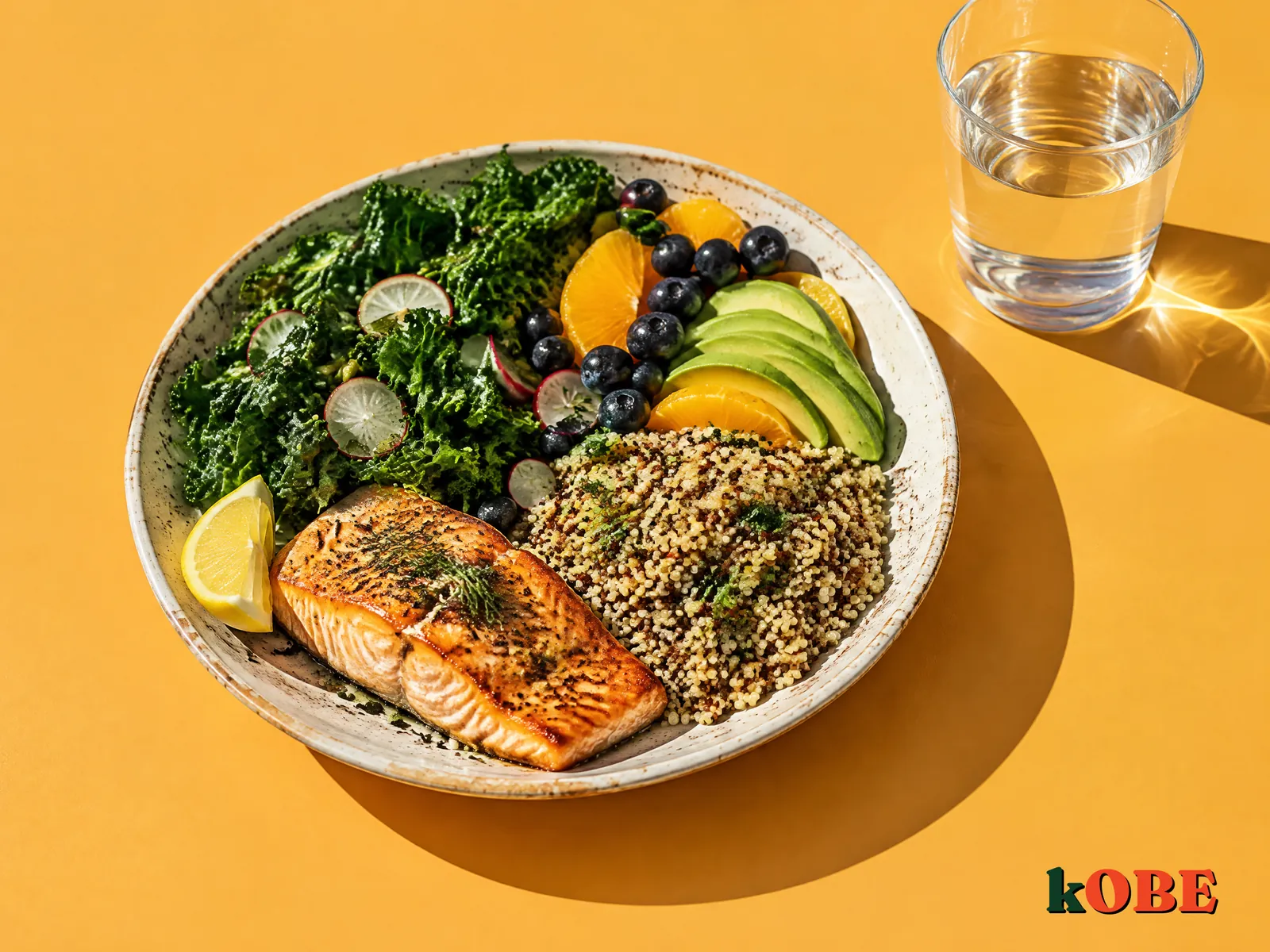
If you want to start with food, our Meals by calorie page gathers ready meals with protein, starch and vegetables. In our 1,480 home recipes, every dish lists calories, protein, fat and sugar per 100g, which makes it easier to rotate dishes through the week. As for vitamins and minerals, as this whole series has said, they come from variety: many colors of vegetables, many kinds of protein, fresh fruit.
Frequently asked questions
Can a multivitamin replace vegetables?
What time of day should I take vitamins?
Do children need a multivitamin?
Keep reading
Sources
- US Preventive Services Task Force (2022). Vitamin, mineral, and multivitamin supplementation to prevent cardiovascular disease and cancer: US Preventive Services Task Force recommendation statement. JAMA 327(23):2326 to 2333.
- Harvard T.H. Chan School of Public Health, The Nutrition Source. Multivitamins (Vitamins and Minerals section).
- NHS (UK). Vitamins and minerals.
- National Institute of Nutrition (Vietnam) (2016). Recommended Dietary Allowances for Vietnamese People [Nhu cầu dinh dưỡng khuyến nghị cho người Việt Nam].
- Further reading: Understanding Nutrition 16th ed., chapters 10 to 13; Nutrition at a Glance.