Noon at the office. The whole floor is lined up in front of one microwave. Your turn comes, you punch in 2 minutes and watch your lunchbox spin round and round.
Beep beep. You take it out, and the edges are too hot to touch. You scoop a spoonful from the middle: still ice cold.
Your microwave isn't broken. This is simply how microwaves work. Understand them a little, and you'll reheat more evenly, more tastily and more safely.
In this article
Microwaves don't cook "from the inside out"
There's a very popular myth that microwaves cook food from the inside. They don't.
The oven gives off microwaves. These make the water molecules in food vibrate very fast. Vibration creates heat, just like rubbing your hands together warms them up.
But the waves only reach a few centimeters below the surface. Anything deeper gets heated indirectly, as warmth slowly travels in from the outer layer.
That's why:
- The edges and corners heat first. Waves hit from several sides, and corners get more of them.
- The middle heats last. Especially when food is thick or piled up in the center.
- Frozen food is even more uneven. Ice absorbs microwaves less well than liquid water, so thawed spots get hot very fast while icy spots stay cold.
These "cold spots" don't just make your rice less tasty. A spot that isn't hot enough is also a spot where bacteria may survive.
Four small moves: cover, stir, rotate, rest
The US Department of Agriculture (USDA) has specific guidance for microwaves. It boils down to four words:
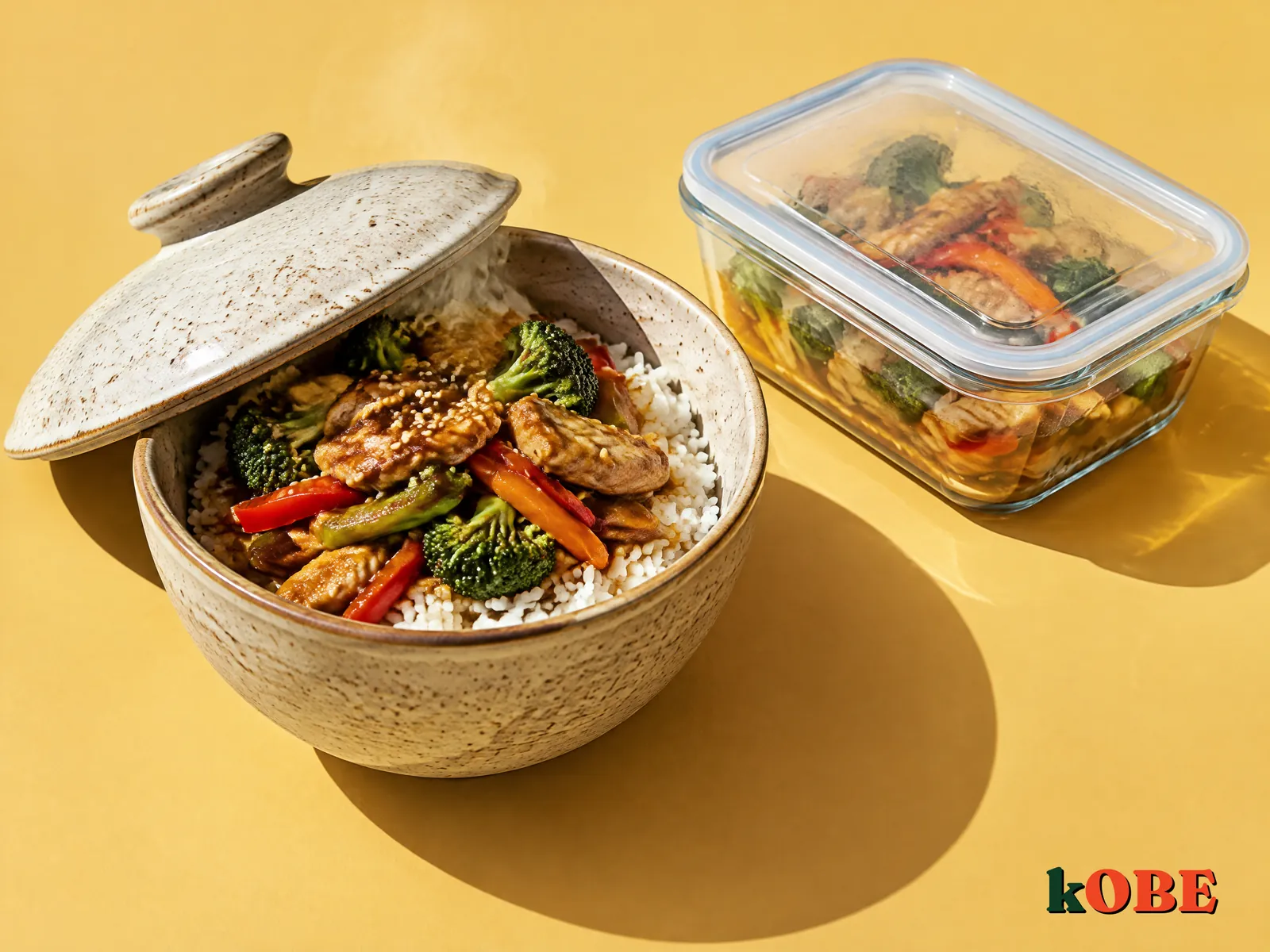
- Cover. Put the lid on loosely or flip a plate over the top. Trapped steam helps food heat evenly without drying out. Leave a gap for steam to escape.
- Stir. Halfway through, take it out and give it a stir. The hot food from the edges mixes into the cold food in the middle.
- Rotate. If your microwave has no turntable, turn the box yourself halfway through. Put thicker parts toward the edge and thinner parts in the center.
- Rest. When it's done, let it sit for about a minute before eating. Heat keeps spreading into the middle while you wait.
One more tip for meal prep boxes: spread the food in a flat layer and leave a small hole in the middle, like a donut. The center is the slowest spot to heat anyway, so leaving it empty makes everything heat far more evenly.
How hot is hot enough?
USDA recommends reheating leftovers until they reach about 74°C everywhere. If you have a food thermometer, check a few spots, especially the middle and the thickest parts.
No thermometer? Use your eyes: the food should be steaming hard all the way to the middle, not just at the edges.
A few more notes:
- Soups, broths and sauces: USDA recommends heating until they bubble.
- Reheat only once. The UK's National Health Service (NHS) recommends this. Take out just the portion you'll eat, don't reheat the whole pot and put it back.
- Frozen food: thawing in the fridge first makes it easier to reheat evenly. If you reheat straight from frozen, use a low power level for longer.
For rice specifically, there's a separate article on reheating frozen rice so it turns soft again in the Rice, grains & starch series.
Which boxes can go in the microwave, and which can't?
Not every container suits the microwave. The general rules:
| Container type | Microwave-safe? | Notes |
|---|---|---|
| Heat-resistant glass, porcelain, ceramic | Yes | Avoid ones with metal or gold rims |
| Plastic labeled "microwave safe" | Yes | Follow the manufacturer's instructions |
| Takeaway boxes, butter tubs, yogurt tubs | Better not | Made for cold food, can warp and melt when hot |
| Foam boxes | Better not | Unless clearly labeled as safe |
| Metal, aluminum foil | No | Can spark |
Cling film: if you use it, pick one labeled microwave safe and don't let the film touch the food. Flipping a porcelain plate or a sheet of paper towel over the top is simpler.
To choose boxes for a whole week of meal prep, see food containers: plastic or glass.
And a few things that should never go in:
- Eggs in their shells. Steam inside can't escape, and the egg can explode.
- Tightly sealed boxes. Built-up steam can pop the lid and spray hot food.
- A cup of plain water heated too long. Water can "superheat" and suddenly boil over when you touch it.
Does the microwave destroy nutrients or make food "radioactive"?
Two familiar worries, and both have pretty reassuring answers.
Radioactive? No. The World Health Organization (WHO) explains that microwaves only heat food. The moment the oven switches off, the waves stop. Food doesn't hold on to any radiation and doesn't become "radioactive".
Nutrient loss? Every heating method costs some heat-sensitive vitamins like vitamin C. But microwaves usually heat quickly and with little water, so the loss is equal to or less than other cooking methods. For vegetables, microwave cooking often keeps vitamins better than boiling in lots of water.
If you're curious which cooking method keeps vitamins better, see steaming, boiling, roasting, stir-frying.
Inside the kOBE kitchen
kOBE's ready-cooked ingredients are cooked and then frozen, so all that's left for you is reheating. We suggest two ways: thaw in the fridge overnight, or use the microwave on a low setting.
Why low? Because, as we said above, ice absorbs microwaves poorly. A high setting makes thawed spots heat very fast while other spots are still icy. A low setting gives the heat time to spread evenly.
Our Sous Vide Chicken Breast has already been cooked at 60°C for 90 minutes to keep it tender and juicy. Reheat it gently with the lid on to hold in the steam, and the chicken is less likely to dry out. See our ready-cooked ingredients.
Frequently asked questions
Is microwave reheating as safe as reheating on the stove?
Should I add water when reheating?
Is it okay to reheat food in a plastic box?
Keep reading
Sources
- USDA FSIS. Cooking Safely in the Microwave Oven.
- USDA FSIS. Leftovers and Food Safety.
- WHO. Electromagnetic fields and public health: microwave ovens (fact sheet).
- U.S. FDA. Microwave Oven Radiation.
- Further reading: Culinary Nutrition; Understanding Nutrition 16th ed., chapter on food safety.