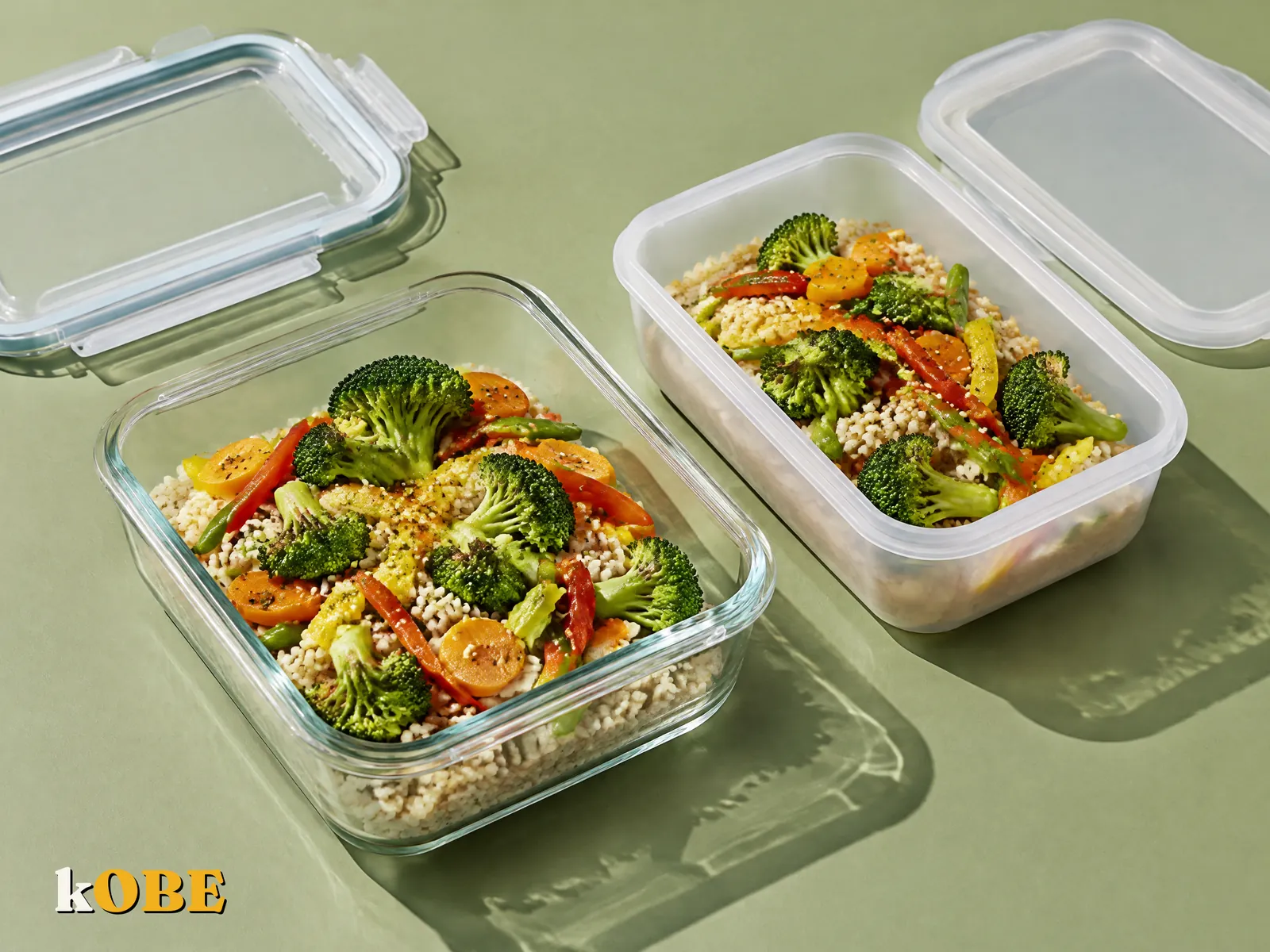
Go ahead, open that kitchen drawer. Is it a mountain of plastic boxes, some missing their lids, some lids that fit no box at all?
There's the chè (sweet dessert soup) tub from last year. There's the one stained orange from curry. There's the one with a slightly warped lid because it went in the microwave a few too many times.
Then one day you read a "plastic containers are toxic" post online and start wondering: should you switch everything to glass? The short answer: no need to throw it all out, but do give each box the right job.
In this article
- It's not about the material, it's about heat, grease and scratches
- BPA: what's settled and what's still debated
- Glass: heavy, breakable, but happy in the microwave
- Give each box the right job: plastic for cold, glass for hot
- What does a good meal prep box look like?
- Inside the kOBE kitchen
- Frequently asked questions
It's not about the material, it's about heat, grease and scratches
Plastic is a huge family of materials. Some types become food containers, some become water pipes, some become phone cases. They're not all the same.
For food containers, what scientists care about is migration: a very small amount of substances moving from the plastic into the food. That amount goes up when food is:
- Hot. Reheating in a box that isn't heat-resistant is the most common case.
- Greasy. Some substances in plastic dissolve better in oil than in water.
- Acidic. Dishes with vinegar, tomato or lime.
- Stored a long time.
- In an old box that's scratched, cloudy or warped.
In other words, the same plastic box holding cucumber in the fridge is a world away from holding hot curry that then goes in the microwave.
BPA: what's settled and what's still debated
BPA (bisphenol A) is the name that comes up most. It used to be found in some hard, clear plastics and in the inner coating of cans.
What's settled:
- In 2012, the US Food and Drug Administration (FDA) stopped allowing BPA in baby bottles and sippy cups.
- In 2023, the European Food Safety Authority (EFSA) re-evaluated BPA and lowered its tolerable daily intake to many times below the previous level.
What's still debated:
- The agencies don't fully agree with each other. The FDA still considers current BPA levels from food packaging to be safe.
- "BPA free" doesn't mean the box contains nothing else. Some replacement chemicals from the same family are still being studied.
We don't want to scare you. The sensible approach is to cut down on the situations that increase migration, not to panic over every single box.
Glass: heavy, breakable, but happy in the microwave
Glass releases almost nothing into food. It doesn't stain from curry or hold on to fish sauce smells. You can see straight through to what's inside.
But it has its downsides too:
- Heavy. Carrying five glass boxes to work is a light weights session.
- Breakable. One drop and it's over.
- Sensitive to thermal shock. Taking a box from the freezer straight into a hot oven, or pouring boiling water into a cold box, can crack the glass.
- The lid is usually still plastic. When reheating, take the lid off or rest it loosely on top, don't seal it.
Stainless steel boxes are durable, light and great for cold food and packed lunches. But stainless steel can't go in the microwave.
Give each box the right job: plastic for cold, glass for hot
Here's the simple formula we like to use:
| Job | Use | Why |
|---|---|---|
| Fridge, cold food | Good plastic or glass | Low temperature, very little migration |
| Freezing | Freezer-safe plastic, zip bags | Light, unbreakable, can be pressed flat |
| Microwave reheating | Heat-resistant glass, porcelain | No worries about migration when hot |
| Hot, greasy or acidic dishes | Glass, porcelain, stainless steel (not in the microwave) | All three migration triggers at once |
| Taking to work, needs to be light | Plastic labeled microwave safe | Tip onto a porcelain plate to reheat if the office has one |
And a few small habits:
- Don't reuse takeaway boxes, butter tubs or yogurt tubs for reheating. They're made for cold food and single use.
- Replace boxes once they're heavily scratched, cloudy, warped or cracked.
- Don't let cling film touch the food when reheating.
- Let food cool a little before putting the lid on a plastic box and refrigerating.
More on reheating is in reheating in the microwave the right way.
What does a good meal prep box look like?
Beyond material, the shape of the box affects both taste and safety.
- Shallow and flat. Shallow boxes help food cool faster before it goes in the fridge, and reheat more evenly. The US Department of Agriculture (USDA) recommends dividing large amounts of food into shallow containers.
- Tight lid. Keeps smells from spreading to other food and stops food drying out.
- Compartments, or a small pot for sauce. Keep sauce separate and the veggies won't go soggy.
- Same size, stackable. A tidy fridge lets cold air circulate more easily.
- Room for a date. A strip of masking tape on the lid is enough.
No need for an expensive set. Four or five glass boxes for the dishes you reheat often, plus a few good plastic ones for cold food and freezing, is plenty to start.
Inside the kOBE kitchen
kOBE's ready-cooked ingredients come pre-portioned. Sous Vide Chicken Breast comes in 90 to 120g packs, about one meal, or a 1kg bag for people cooking for the whole week. White Rice comes in 200g packs.
Pre-portioned means less shuffling food between boxes. Take the pack you need and thaw it in the fridge overnight.
A tip from our kitchen: when reheating, tip the food onto a porcelain plate or into a heat-resistant glass bowl, cover loosely, and use the microwave on a low setting. It follows the "glass for hot" formula above and helps the food heat evenly. See our ready-cooked ingredients.
Frequently asked questions
How can I tell if a plastic box can be reheated?
Is it a problem if a box is stained by curry or turmeric?
Can glass boxes go in the freezer?
Keep reading
Sources
- U.S. FDA. Bisphenol A (BPA): Use in Food Contact Application.
- EFSA (2023). Re-evaluation of the risks to public health related to the presence of bisphenol A (BPA) in foodstuffs. EFSA Journal.
- USDA FSIS. Cooking Safely in the Microwave Oven.
- USDA FSIS. Leftovers and Food Safety.
- Further reading: Culinary Nutrition.