Stand in front of the oat shelf at the supermarket and you'll see a string of labels: rolled oats, quick oats, instant oats, steel-cut. Some come in bags as big as a sack of rice, others in little boxes of single-serve strawberry and chocolate sachets.
They look like lots of different products. In fact they all come from the same oat grain.
The difference is how much the grain gets cut, steamed and rolled. And that's exactly what makes them travel through your body at very different speeds.
In this article
From oat grain to instant sachet: a journey of getting "rolled"
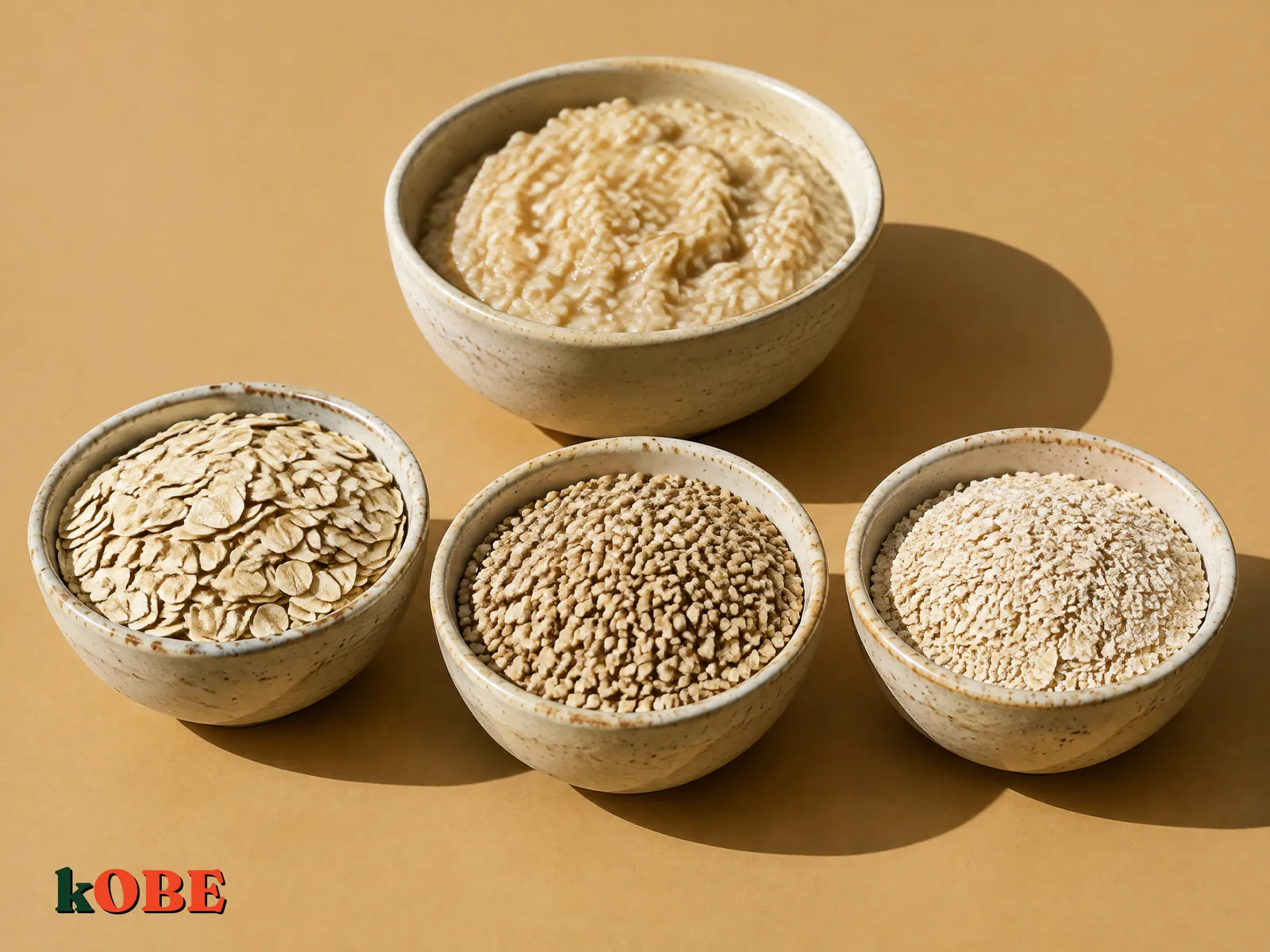
Once the husk is removed, the oat grain is called an oat groat. It's long and hard, and looks a bit like a grain of brown rice. From here, there are four paths:
- Steel-cut: the groat is chopped into 2 to 3 small pieces with steel blades. It looks like broken rice.
- Rolled oats: the groat is steamed soft and then pressed flat into thin flakes. This is the most familiar type.
- Quick oats: steamed longer, rolled thinner, sometimes chopped before rolling.
- Instant oats: precooked, dried and rolled very thin. Just add boiling water and eat.
Think of a block of wood. Steel-cut is chopping it into chunks. Rolled is planing it into boards. Instant is shaving it into paper-thin curls.
The nutrition is almost identical
The good news is that all four are whole grains. None of them has had the bran or germ removed.
So for the same dry weight, they're pretty much equal. About 40g of dry oats (roughly half a rice bowl) gives you:
| 40g dry oats | About |
|---|---|
| Calories | 150 kcal |
| Carbs | 27g |
| Protein | 5g |
| Fiber | 4g |
Half a bowl of dry oats swells into a full bowl of porridge once cooked. And that amount of fiber is already several times what's in a bowl of white rice.
Part of the fiber in oats is a special one called beta-glucan. When it meets water, it forms a thick gel. That's why oat porridge turns really thick if you let it sit. This gel makes food move through your stomach and gut more slowly.
The difference is speed: the smaller the piece, the faster it digests
This is the most important point.
The more the grain is chopped, steamed and rolled thin, the easier it is for digestive enzymes to reach the starch. Just like kindling burns faster than a big log.
International glycemic index (GI) tables show this clearly:
| Oat type | Approximate GI | Group |
|---|---|---|
| Steel-cut | 50 to 55 | low |
| Rolled | about 55 | low to medium |
| Instant | about 80 | high |
Same grain, but instant oats raise blood sugar almost as fast as white rice. Steel-cut and rolled oats are much gentler.
To be fair, we'll add this: GI is measured with the food eaten alone on an empty stomach. Add eggs, unsweetened yogurt or a handful of nuts to your bowl and the real-life number gets gentler.
The trap in flavored instant packs
Instant oats aren't the problem. The problem usually lies in what gets added to the flavored packs.
Many fruit, chocolate and honey flavored packs have sugar in second or third place on the ingredients list. Some also add creamer powder, flavorings and sugar-coated dried fruit.
A 10-second label-reading trick:
- Check the ingredients line. Just "oats" or "100% whole grain oats" is the ideal.
- Look for sugar, syrup, maltose, dextrose. The closer to the top of the list, the more there is.
- Compare "sugars" on the nutrition panel. Plain oats have almost no sugar.
Want convenience without the catch? Buy plain instant oats, then add banana, fresh fruit, nuts, and a little sweetener of your choice.
Which one to choose, and how to cook it?
No need to force yourself to eat the "hardest" type. Pick the one that fits your routine:
- Steel-cut: cook for 20 to 30 minutes, chewy and nutty. Great for weekends or for cooking a big batch ahead.
- Rolled: cook for about 5 minutes, or soak overnight in milk (overnight oats). A good balance between convenience and slow digestion.
- Quick oats: 1 to 2 minutes. Good for baking and blending into smoothies.
- Plain instant: just add boiling water and take it to the office. Remember to add protein and nuts to the bowl.
A Vietnamese-style tip: make savory oat cháo (porridge) with shredded chicken, fried shallots and black pepper. Or mix rolled oats into the batter for meatballs to add some fiber.
Inside the kOBE kitchen
For overnight oats, you can soak rolled oats overnight in kOBE Oat Milk. It's cooked fresh in small batches with no added refined sugar, and every 100ml has 34 kcal, 0.6g protein, 4.5g carbs and 1.5g fat.
For a lightly sweet oat bowl, you can add kOBE Signature Monk Fruit Blend. It swaps for sugar 1:1: if the recipe says one spoon of sugar, you use one spoon. It's also what we use to sweeten kOBE's dishes. See kOBE Signature Monk Fruit Blend.
Frequently asked questions
Are instant oats "bad" processed food?
Can you eat oats raw?
Do oats contain gluten?
Keep reading
Sources
- Atkinson F.S., Foster-Powell K., Brand-Miller J.C. (2008). International tables of glycemic index and glycemic load values: 2008. Diabetes Care 31(12):2281 to 2283.
- USDA FoodData Central: Oats, raw (or Cereals, oats, regular and quick, not fortified, dry).
- Harvard T.H. Chan School of Public Health, The Nutrition Source: Oats.
- EFSA Panel on Dietetic Products, Nutrition and Allergies (2011). Scientific opinion on oat and barley beta-glucan. EFSA Journal.
- Further reading: Understanding Nutrition 16th ed., chapter 4 (fiber, glycemic index).