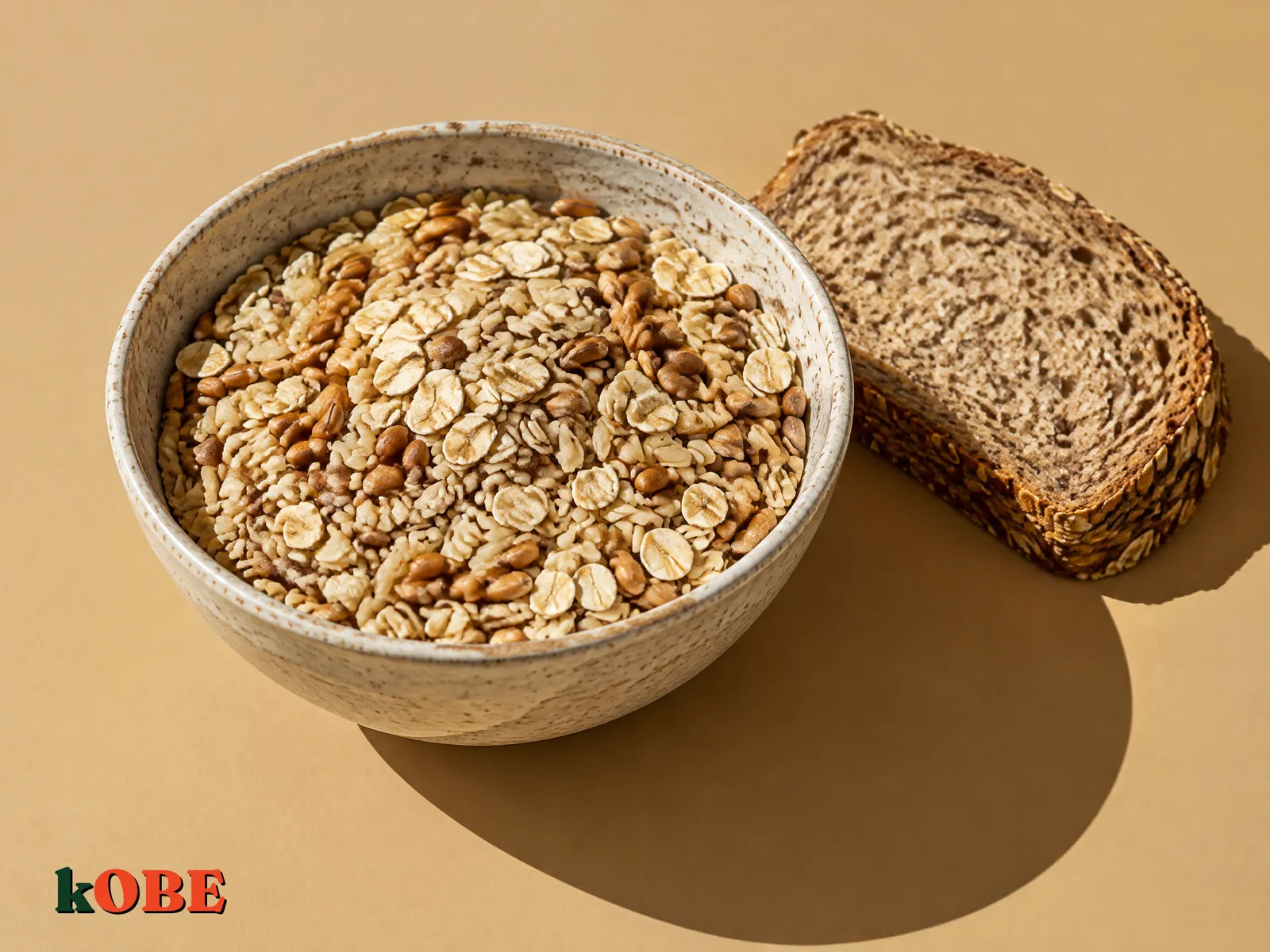
A box of cookies with golden wheat stalks painted on it. A bag of breakfast drink powder with "CEREAL" printed in big letters. A loaf labeled "multigrain", its top covered in sunflower seeds.
At a glance, they all look very "wholesome". But flip them over and read closely: on some, the first ingredient is white flour. On others, it's sugar.
Understand just one phrase, "whole grain", and you'll dodge almost all of these traps.
In this article
A grain has three parts
Whether it's rice, wheat or oats, the structure is the same:
| Part | Think of it as | What it holds |
|---|---|---|
| Bran | the outer coat | fiber, B vitamins, minerals |
| Germ | the grain's "heart" | healthy fats, vitamin E, B vitamins |
| Endosperm | the inside | mostly starch, a little protein |
Whole grain means keeping all three parts, in the grain's natural proportions. It can be the intact grain, like brown rice, or ground into flour, like whole wheat flour, as long as nothing is removed.
Refined grain is when the bran and germ have been polished or milled away, leaving only the inside. White rice, white flour, bún and phở (rice noodles) all belong to this group.
When the bran and germ go, the grain loses most of its fiber and a significant share of its vitamins and minerals. In return, it becomes softer, whiter and keeps longer.
Familiar whole grains at the Vietnamese market
You eat more whole grains than you might think:
- Brown rice of all kinds: regular brown, red brown, black brown, nếp cẩm (black sticky rice).
- Corn, boiled or grilled.
- Oats, including rolled and plain instant.
- Popcorn you pop yourself, with little butter and sugar.
- Millet, coix seed, buckwheat.
- Quinoa, which botanically is a "pseudocereal" but still gets grouped here because it's used the same way.
Which words on the label can you trust?
This is the most important part. Words on the front of the package are usually there to sell. Words in the ingredients list are there to tell you the truth.
Trustworthy words when they come first in the ingredients list:
- "Whole wheat flour".
- "Whole grain" plus the name of the grain, for example "whole grain oats".
- "Brown rice".
- "Oats" (almost always whole grain).
Words that sound nice but don't say much:
- "Multigrain": only means there are several kinds of grain. They could all be refined.
- "Cereal": a general name, it doesn't mean whole grain.
- "Wheat flour": this is white flour, even though it sounds very "natural".
- "Made with wheat", "contains oats": could be just a small amount.
- Brown color: could come from brown sugar, malt or caramel coloring.
Some countries use the Whole Grain Stamp from the Whole Grains Council. The "100%" stamp means every grain in the product is whole grain. In Vietnam you'll sometimes see it on imported goods, but it's not common.
The 10:1 rule for choosing in 10 seconds
Researchers at Harvard compared several ways of picking whole grain products. One simple and effective method is the 10:1 ratio.
Here's how:
- On the nutrition panel, find the total carbohydrate line (starch and sugars).
- Find the fiber line.
- Divide carbohydrate by fiber. 10 or lower is a good pick.
Example: a pack of crackers has 20g of carbohydrate and 2g of fiber. 20 divided by 2 is 10. It passes.
Another pack has 25g of carbohydrate but only 1g of fiber. That's a 25:1 ratio. It's very likely mostly white flour and sugar, whatever the front of the package says.
According to that study, products that meet this ratio also tend to have less sugar and less trans fat.
The "instant cereal drink" trap
Cereal powder mixed with hot water is a breakfast staple in many Vietnamese homes. But read its ingredients list.
Quite a few brands have sugar or non-dairy creamer in first or second place, ahead of the cereal itself. That means with every glass, you're drinking more sugar than grain.
That doesn't mean you have to give it up completely. Just pick one with whole grains listed first, or make your own with oats, unsweetened milk and a ripe banana.
Inside the kOBE kitchen
If you want more whole grains in your meals without soaking and long cooking, our ready-cooked ingredients have a few options:
- Red Brown Rice: 123 kcal, 2.7g protein, 25.6g carbs per 100g.
- Black Brown Rice: 100 kcal, 4g protein, 21.2g carbs, with anthocyanins.
- Quinoa: 120 kcal, 4.4g protein.
- Glutinous Coix Seed: 130 kcal, 4g protein.
All are cooked and then frozen. Thaw in the fridge overnight or warm in the microwave on low, and they're ready to eat. See them on the Ingredients page.
Frequently asked questions
How much whole grain should I eat each day?
Is brown rice bún whole grain?
Do whole grains have fewer calories?
Keep reading
Sources
- Mozaffarian R.S., Lee R.M., Kennedy M.A., Ludwig D.S., Mozaffarian D., Gortmaker S.L. (2013). Identifying whole grain foods: a comparison of different approaches for selecting more healthful whole grain products. Public Health Nutrition 16(12):2255 to 2264.
- Whole Grains Council (Oldways). Whole Grain Stamp and the definition of whole grain.
- Harvard T.H. Chan School of Public Health, The Nutrition Source: Whole Grains.
- U.S. Department of Agriculture and HHS. Dietary Guidelines for Americans 2020 to 2025 (recommends at least half of grains be whole grains).
- Further reading: Understanding Nutrition 16th ed., chapter 4; Science of Rice (2023), chapter 6.