Six in the morning, and the bakery at the mouth of the alley already smells amazing. A Vietnamese bánh mì with a shatteringly crisp crust and a crumb as light as cotton, stuffed with chả (pork roll), pâté, cucumber and cilantro.
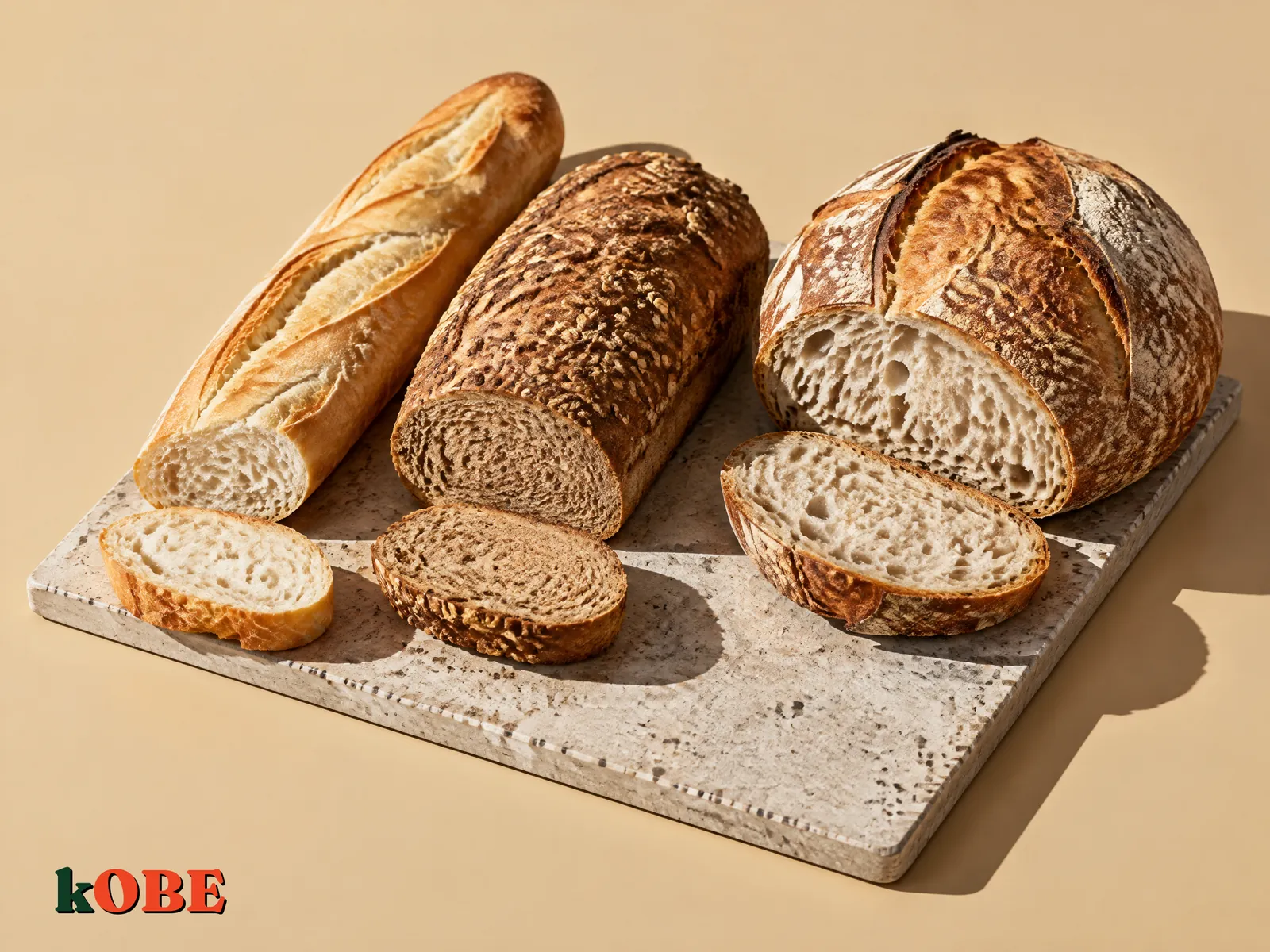
In recent years, the supermarket bread shelf has welcomed plenty of new faces: "black" bread, whole wheat bread, seeded bread, and that fancy-sounding name, sourdough.
How are they different? And why isn't a brown loaf necessarily whole wheat?
In this article
How many bowls of rice is one Vietnamese bánh mì?
White bread is made from flour that has had the bran and germ milled away, keeping only the white core of the wheat grain. That's why the crumb is white, smooth and very airy.
According to the Vietnamese Food Composition Table, 100g of bread has about 250 kcal and over 50g of carbs. Bread is nearly twice as calorie-dense as rice, because it's much drier.
A medium bánh mì weighs about 80g. That's around 40g of carbs, roughly one medium bowl of rice, before you count the filling.
So a breakfast bánh mì isn't a "light snack". It's a proper starchy meal. That's totally fine, as long as you know it so you can balance your other meals.
Whole wheat bread: keeping what white bread throws away
Whole wheat flour is milled from the entire wheat grain: the bran, the germ and the starchy core.
Compared with white bread, genuine whole wheat bread has:
- More fiber, usually two to three times as much.
- Extra B vitamins, vitamin E and minerals like magnesium, iron and zinc, which are concentrated in the bran and germ.
- A denser, slightly heavier crumb with a nutty, faintly bitter taste from the bran.
Calories are almost the same as white bread. Whole wheat bread isn't "diet" bread. It's simply the version that keeps every part of the grain.
The "brown bread" trap
This one catches a lot of people off guard.
The brown color of a loaf doesn't tell you much. Many brown breads on the market are actually made mostly from white flour, with added:
- Brown sugar, molasses or malt for a nice color.
- Caramel coloring.
- A little whole wheat flour, or seeds sprinkled on top to "look healthy".
To know for sure, flip the bag over:
- The first word in the ingredients should be "whole wheat flour". If it just says "wheat flour", that's white flour.
- Look for a percentage. Some bags clearly say "100% whole wheat", others only 20 or 30%.
- Compare the fiber. Genuine whole wheat bread usually has about 6g of fiber per 100g or more.
More on reading "whole grain" on labels in our article on whole grain labels.
Sourdough: bread that rises "slow and steady"
Regular bread rises with commercial yeast in just a few hours. Sourdough rises with a natural starter: a jar of flour and water "fed" over many days, full of wild yeast and lactic acid bacteria.
Lactic acid bacteria are best friends with pickled mustard greens and yogurt. They produce acid, giving the bread a gentle tang and a thick, crunchy crust. The dough is usually left to ferment for a long time, sometimes overnight or longer.
This long fermentation brings a few interesting things that scientists are studying:
- The acid in the bread may make the starch digest a little more slowly. Some studies have found sourdough has a lower glycemic index than regular white bread.
- Some phytate gets broken down. Phytate is a compound in bran that "locks up" minerals. Less phytate means iron, zinc and magnesium are easier to absorb.
- Some hard-to-digest carbs get "eaten" by the microbes during fermentation. Some people find sourdough easier on their stomach.
We'll be clear so there's no misunderstanding: sourdough still contains gluten, and it's still bread. And sourdough made from white flour is still white bread, just fermented differently. Whole wheat sourdough is the one that brings both bonuses together.
A quirky trick: the freezer and the toaster
Remember how cold rice gains some resistant starch? Bread has a similar story.
A 2008 study in the UK had participants eat white bread prepared in several ways. The result: bread that was frozen and then thawed, or toasted, raised blood sugar after eating less than fresh bread. Frozen, thawed and then toasted gave the biggest drop.
The reason: as bread cools and dries out, its starch "lines up" again, and part of it becomes harder to digest.
This study was small, only about ten people. But the trick is easy and costs nothing: slice your bread when you get home, keep it in the freezer, and toast a slice in the morning. It won't go moldy, and it comes out crisp and fragrant.
Inside the kOBE kitchen
Bread is delicious, but the filling and sauce make a big difference. Regular mayonnaise can be up to about 75% oil, so a thick smear can carry more calories than the bread itself.
kOBE Signature Lean Mayo is an egg-based creamy sauce, thick and clingy like regular mayo. The 80% version has 118 kcal, 3.1g protein, 8.6g carbs and 8.7g fat per 100g. The 90% version is lighter still, with no preservatives. And if you eat plant-based, kOBE Signature Lean Mayo, Vegan is made from soybean tofu, with no eggs and no dairy.
Our 1,480 home recipes also include plenty of homemade bread dishes, each listing calories, protein, fat and sugar per 100g.
Frequently asked questions
Is black bread the same as whole wheat bread?
Does whole wheat bread have fewer calories than white bread?
Can people who need to avoid gluten eat sourdough?
Keep reading
Sources
- Burton P., Lightowler H.J. (2008). The impact of freezing and toasting on the glycaemic response of white bread. European Journal of Clinical Nutrition 62:594 to 599.
- Poutanen K., Flander L., Katina K. (2009). Sourdough and cereal fermentation in a nutritional perspective. Food Microbiology 26(7):693 to 699.
- National Institute of Nutrition (Vietnam). Vietnamese Food Composition Table (bread, cooked rice).
- Harvard T.H. Chan School of Public Health, The Nutrition Source: Whole Grains.
- Further reading: Understanding Nutrition 16th ed., chapter 4; Culinary Nutrition.