Hold a flame to a roasted peanut and it will catch fire. It burns for quite a while, with a small, steady flame.
That is not a magic trick. Peanuts are full of oil, and oil burns well. That little flame is energy being released.
Scientists once measured the calories in food exactly that way: by burning it. The calorie story starts here.
In this article
A calorie is heat, quite literally
A calorie is a unit of energy, rooted in measuring heat.
An easy definition to remember: 1 kcal is the energy needed to warm 1 liter of water by 1°C.
On food labels, "calorie" almost always means kcal (kilocalorie). One kcal equals 1,000 small calories. People shorten it for convenience, so "a 200-calorie bowl of rice" is really 200 kcal.
Many labels also show kJ (kilojoules), the energy unit of the international system. Conversion: 1 kcal is about 4.2 kJ. The two numbers on the label say the same thing, just in different units.
Measuring calories by burning food
The instrument is called a bomb calorimeter. It sounds scary, but the principle is very simple.
- Put a dried food sample into a sealed steel chamber filled with oxygen.
- Burn the sample completely.
- The steel chamber sits in water. Measure how many degrees the water warms up.
The more the water warms, the more energy the food holds.
There is a catch, though. Fire can burn everything, but your body cannot. Fiber burns beautifully in the steel chamber, yet your small intestine does not digest it. Part of the protein also leaves your body in urine.
In the late 19th century, the American scientist Wilbur Atwater corrected for this. He measured the part the body does not use, then subtracted it. The result is the set of numbers food labels still use today.
The 4, 9, 4 set (plus a 7)
These are the Atwater factors, per gram:
| Component | Calories per gram (approx.) |
|---|---|
| Protein | 4 kcal |
| Carbs (starch, sugars) | 4 kcal |
| Fat | 9 kcal |
| Alcohol | 7 kcal |
| Fiber | about 2 kcal |
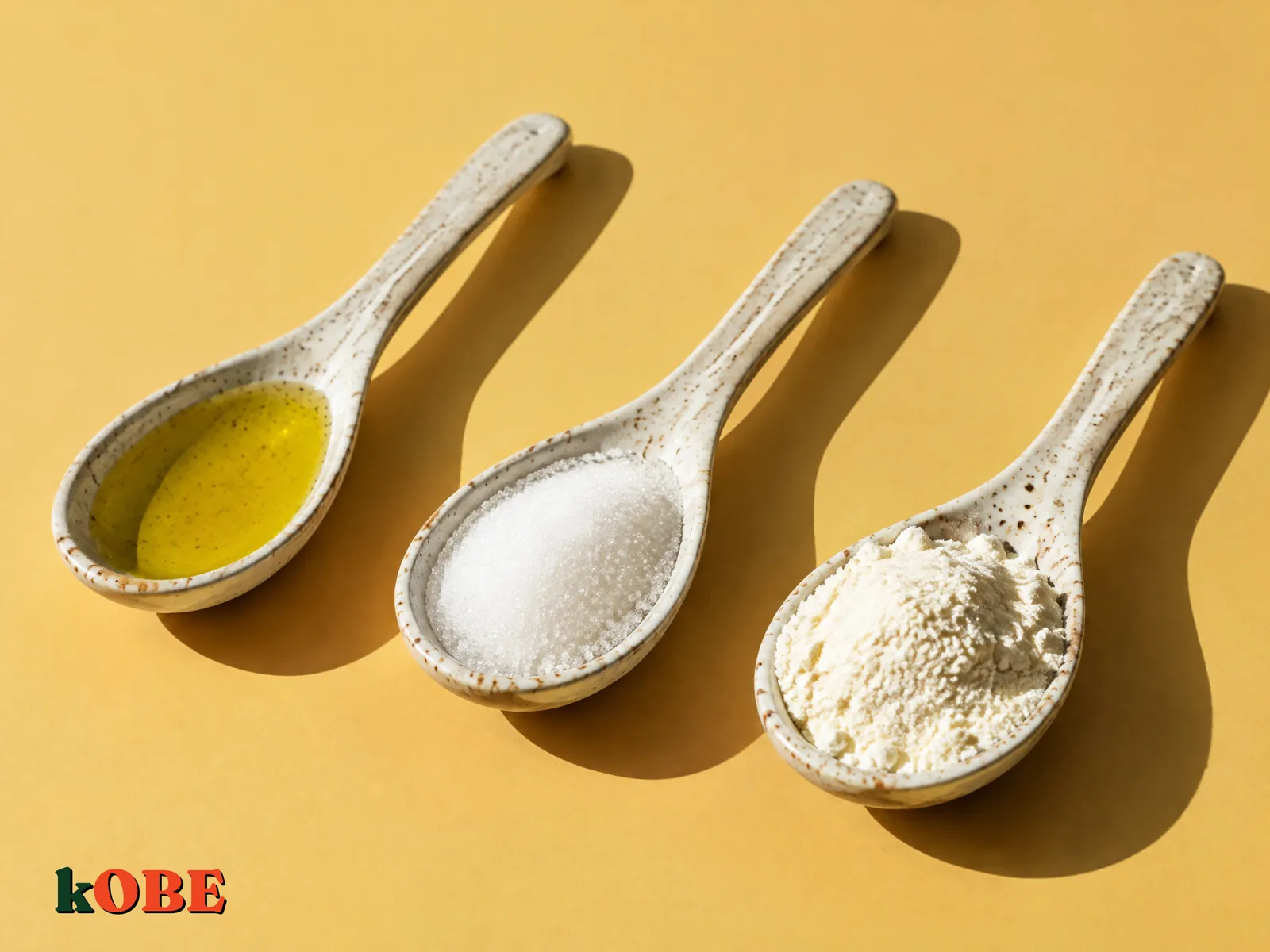
Fat is more than twice protein and carbs. Picture two tablespoons in your kitchen:
- One tablespoon of cooking oil (about 13g): roughly 120 kcal.
- One tablespoon of sugar (about 12g): roughly 50 kcal.
Same spoon, but the oil "weighs" twice the calories. That is why deep-fried dishes usually carry more calories than boiled ones, even with the exact same main ingredient.
Alcohol deserves a mention too: 7 kcal per gram, close to fat. So a can of beer is not "just water".
Fiber gives only about 2 kcal, because most of its energy is used by your gut bacteria. Some sweeteners, such as erythritol, are counted as close to 0 under European labeling rules.
Add up a label's calories: try it once for fun
Take any label. Multiply grams of protein by 4, grams of carbs by 4, grams of fat by 9, then add them up.
Say a tub of yogurt has 4g protein, 12g carbs and 3g fat per 100g:
- Protein: 4 × 4 = 16 kcal
- Carbs: 12 × 4 = 48 kcal
- Fat: 3 × 9 = 27 kcal
- Total: about 91 kcal
If the label says 90 or 92 kcal, it matches. Sometimes it is a bit further off. The usual reasons:
- Rounding: each line was rounded before printing.
- Fiber and low-calorie sweeteners: they sit inside the carb line but give less than 4 kcal per gram.
- The manufacturer's method: some use specific factors for each type of food.
This sum helps you see where a food's calories "come from". A 200 kcal food with 150 kcal from fat is very different from a 200 kcal food with most of its energy from protein.
Calories measure energy, not quality
200 kcal could be a medium bowl of white rice. It could also be one and a half cans of sugary soda.
Same number, completely different experience. A bowl of rice with fish and greens keeps you full for a long time. Soda slips down fast, and before long you feel hungry again.
Protein and fiber usually make a meal more filling. Sugary drinks barely fill you up at all, even though their calories are not small.
So calories are a useful number, but only one number. They tell you "how much energy". They do not tell you whether a food has vitamins, fiber or protein.
To learn how much energy your body needs each day, read what are BMR and TDEE.
Inside the kOBE kitchen
Let us try the calorie sum on kOBE Oat Milk. Every 100ml has 0.6g protein, 4.5g carbs and 1.5g fat.
- Protein: 0.6 × 4 = 2.4 kcal
- Carbs: 4.5 × 4 = 18 kcal
- Fat: 1.5 × 9 = 13.5 kcal
- Total: 33.9 kcal
The number we publish is 34 kcal per 100ml. An almost perfect match. The milk is cooked fresh in small batches with no refined sugar added.
In the 1,480 home recipes on our recipe page, every dish also lists calories, protein, fat and sugar per 100g. Pick any dish and do the sum yourself. When you see high fat, you will instantly understand why the calories are high.
Frequently asked questions
Are "calories" and "kcal" on a label different?
Why does my own sum not match the label exactly?
Is "low-calorie" food healthier food?
Keep reading
Sources
- FAO (2003). Food energy: methods of analysis and conversion factors. FAO Food and Nutrition Paper 77.
- European Union. Regulation (EU) No 1169/2011, Annex XIV (energy conversion factors).
- USDA FoodData Central: vegetable oil, white granulated sugar.
- Further reading: Understanding Nutrition 16th ed., section 1.4.