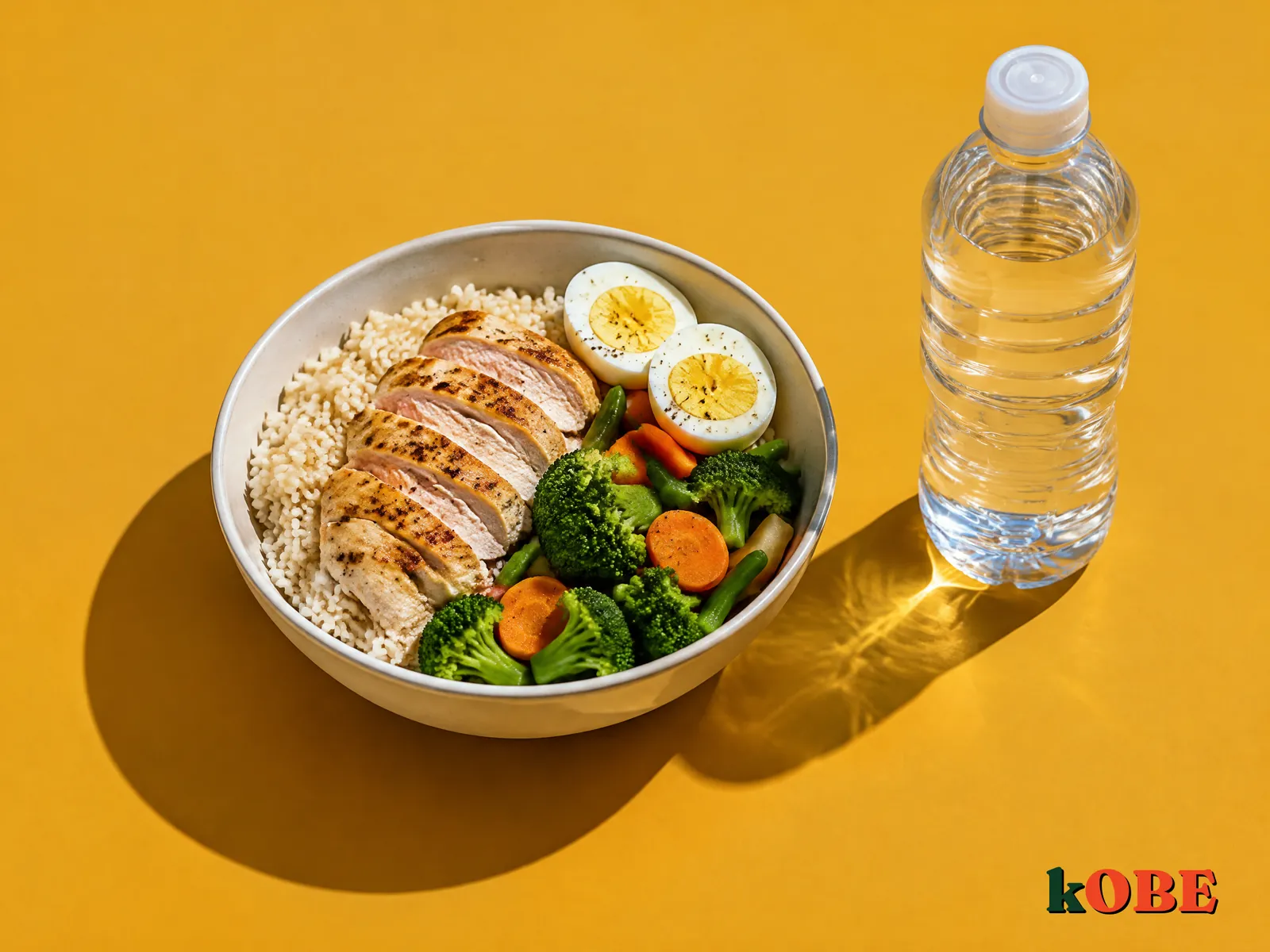
Sign up at a gym and the advice comes pouring in. The trainer says eat six egg whites every morning. The guy at the next rack says drink your whey within 30 minutes of training, or you'll "lose muscle." Social media is wall-to-wall boxes of boiled chicken breast and broccoli.
Eating for lifting is actually much simpler. There are just three main questions: how much protein, are you eating enough carbs, and how do you split your meals.
In this article
Protein: more than average, but more isn't always better
Every lifting session sends your muscles a signal: "get stronger." Your body answers by using protein to build new muscle fibers. Without enough protein, the order goes out but the builders have no bricks.
The International Society of Sports Nutrition (ISSN) gives a number for people who train regularly: about 1.4 to 2g of protein per kilo of body weight per day. A large 2018 review also found that the muscle-building benefit mostly levels off around 1.6g.
Here's what that looks like in real food for someone who weighs 60kg:
| Level | Protein per day | Picture it as |
|---|---|---|
| Fairly inactive person | about 50g | 1 egg, 1 carton of milk, 1 piece of chicken, 1 block of tofu |
| Regular lifter | about 85 to 120g | Almost double the row above |
Eating far beyond that doesn't grow muscle faster. The extra simply gets used for energy, like starch.
Spread protein across meals instead of piling it into dinner
Many Vietnamese families eat a quick breakfast, a moderate lunch, and save the meat and fish for dinner. For people who train, that split is a bit wasteful.
Your body has no "warehouse" for protein the way it does for fat. At each meal, muscles make good use of about 20 to 40g of protein. More in one meal still gets used, but spreading it out "resupplies" your muscles more times a day.
Instead of one 70g protein dinner, try:
- Breakfast: 2 eggs and a glass of milk, about 18g.
- Lunch: a palm-sized piece of fish or chicken, about 25 to 30g.
- Afternoon snack: a pot of Greek yogurt or a bowl of edamame, about 10g.
- Dinner: stir-fried beef, or tofu with eggs, about 25 to 30g.
That adds up to about 80 to 90g, without a single scoop of whey. Whey is just a handy protein source when you're busy, not a must.
Carbs: lifters need fuel too
Many beginners fear starch. In fact, muscles use glycogen, a form of starch stored right inside the muscle, as their main fuel for heavy lifting.
Each heavy set burns through glycogen fairly quickly. Short on carbs, your session runs out of steam and you lift less. And lifting less sends a weaker signal to your muscles.
No need to count every gram. An easy rule: on training days, add half a bowl of rice or one more sweet potato. On rest days, eat as usual.
What to eat before and after training?
The famous "30-minute window" after training is actually much wider than many people think. If you had a meal with protein a few hours before your session, there's no need to rush for a whey shake the moment you rack the weights.
An easy framework:
- 1 to 3 hours before training: a light meal with starch and a little protein. A bánh mì (Vietnamese baguette) with egg, a bowl of rice with chicken, a sweet potato with a pot of yogurt.
- Early morning training on an empty stomach: a banana or a carton of milk is enough to keep you from feeling faint.
- Within 1 to 2 hours after training: a meal that fills all three sections: protein, starch, veg.
What matters more than timing is your total protein for the whole day. Timing is just the fine-tuning.
Water, sleep and a few things people forget
- Drink water steadily through the day, don't wait until you're thirsty. Gyms in Saigon are hot, and you lose more water through sweat than you'd guess.
- Sleep enough. Muscles do a lot of their recovery while you sleep. Training hard on four hours of sleep is like building a house while the builders are off shift.
- You still need vegetables. A pot of chicken with no veg gets boring fast, and it's short on fiber.
- Vary your protein sources. Rotating fish, eggs, meat and tofu helps you keep going without getting sick of it.
Inside the kOBE kitchen
kOBE's Sous Vide Chicken Breast is simply brined in sea salt, cooked sous vide at 60°C for 90 minutes, then frozen. Each 100g cooked has 31g of protein, 165 calories, 3.6g of fat and 0g of starch.
The 90 to 120g pack is just right for one protein serving. For example, a 100g pack gives 31g of protein. If you cook for the whole week, there's the 1kg bag.
For a change of flavor, there are our Sous Vide chicken thighs, about 25g of protein per 100g (estimated). An afternoon snack could be Edamame, with 11.9g of protein per 100g. Add Red Brown Rice or Sweet Potato and you've got enough fuel for a training day. See them on our Ingredients page.
Frequently asked questions
Can I build muscle without whey?
Is eating that much protein okay?
How should I eat if I train late at night?
Keep reading
Sources
- Jäger R. et al. (2017). International Society of Sports Nutrition Position Stand: protein and exercise. Journal of the International Society of Sports Nutrition 14:20.
- Morton R.W. et al. (2018). A systematic review, meta-analysis and meta-regression of the effect of protein supplementation on resistance training-induced gains in muscle mass and strength in healthy adults. British Journal of Sports Medicine 52(6):376 to 384.
- Schoenfeld B.J., Aragon A.A. (2018). How much protein can the body use in a single meal for muscle-building? Implications for daily protein distribution. Journal of the International Society of Sports Nutrition 15:10.
- Thomas D.T., Erdman K.A., Burke L.M. (2016). American College of Sports Medicine Joint Position Statement: Nutrition and Athletic Performance. Medicine & Science in Sports & Exercise 48(3):543 to 568.
- Further reading: Campbell B., Sports Nutrition, chapters 5 and 6.