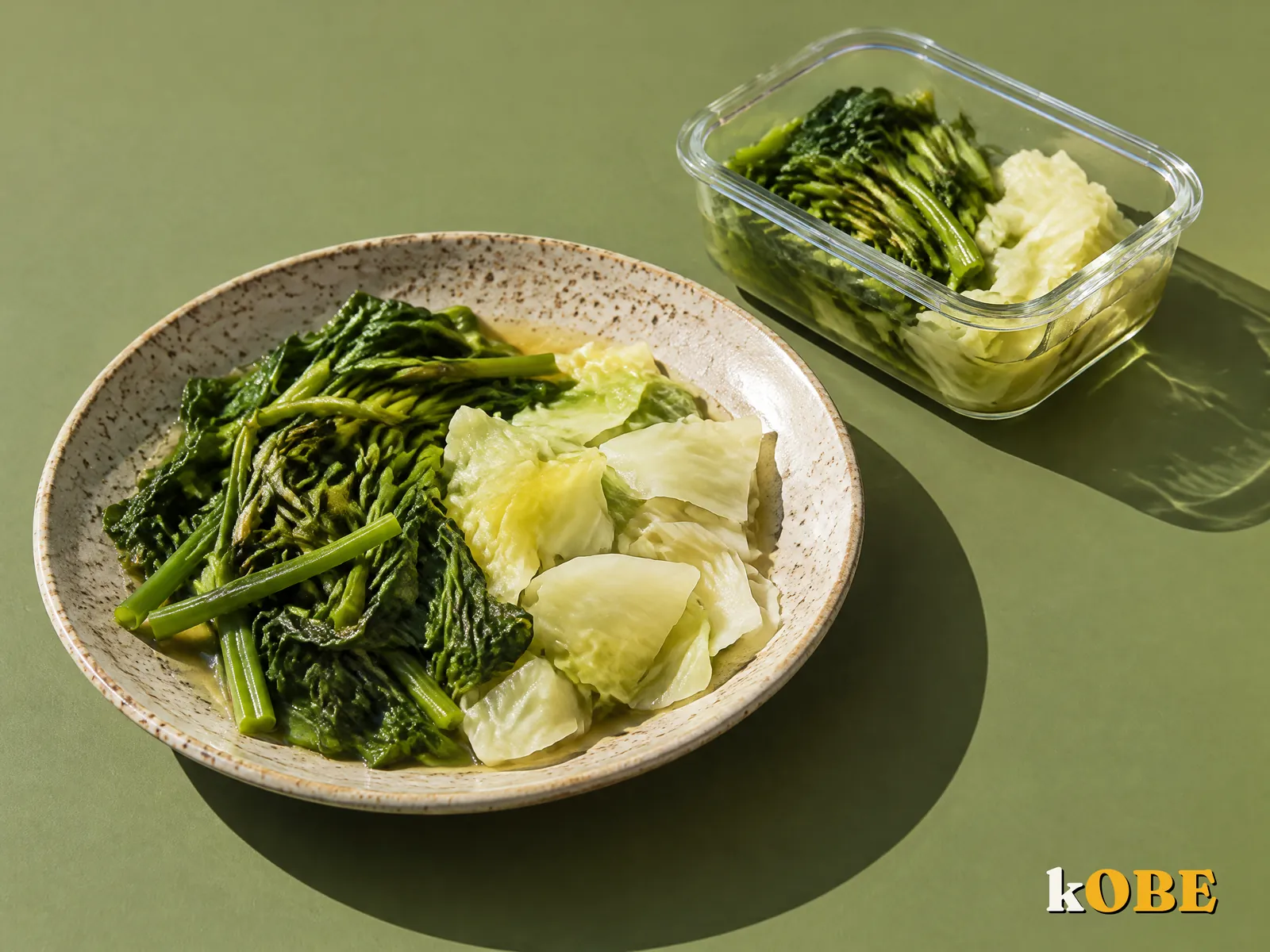
Half a plate of yesterday's boiled rau muống (morning glory) is left over. You're about to put it in the fridge when Mom calls out from the living room: "Vegetables left overnight turn toxic, throw them out!"
Plenty of Vietnamese families have heard this. Some believe it completely, others call it an old wives' tale.
The truth sits in the middle, and it's more interesting than either side. Let's untangle it piece by piece: how long boiled veggies keep, where the "toxic" rumor comes from, and how to keep your meal prep greens bright and crisp until day three.
In this article
How long do boiled vegetables keep in the fridge?
According to general guidance from the US Department of Agriculture (USDA), cooked vegetables keep in the fridge for about 3 to 4 days, if they're refrigerated promptly.
But "safe" and "tasty" are two different things. Leafy greens and firm vegetables fade at very different speeds:
| Type of boiled vegetable | Tasty for about | What happens after |
|---|---|---|
| Soft leafy greens: morning glory, choy sum, Malabar spinach, amaranth | 1 to 2 days | Darken, go limp, release water |
| Firm brassicas: broccoli, cauliflower, bok choy | 2 to 3 days | Slowly yellow, smell gets stronger |
| Firm vegetables: carrots, green beans, chayote, squash, green peas | 3 to 4 days | Hold their shape quite well |
| Boiled veggies left on the table overnight | Throw out | Already past the 2-hour limit at room temperature |
So the meal prep trick is: leafy greens for the first two days of the week, firm vegetables for days three and four.
If your household includes older people, pregnant women or young children, follow the more cautious guideline from the UK's National Health Service (NHS): eat cooked food within 2 days.
"Overnight greens turn toxic": partly right, partly wrong
This rumor has a scientific root, but the story got exaggerated.
Leafy greens like spinach, amaranth and mustard greens naturally contain quite a lot of nitrate. Nitrate in vegetables is perfectly normal; plants absorb it from the soil.
The issue: if cooked greens sit a long time somewhere warm, bacteria can convert some of that nitrate into nitrite. Too much nitrite isn't good, especially for babies, because their bodies handle it less well than adults' do.
So what makes this process happen? Warm temperatures and time. Exactly the same as bacteria multiplying.
So the fair conclusion is:
- Boiled greens left on the table overnight: throw them out. Not just because of nitrite, but because of bacteria in general.
- Boiled greens refrigerated promptly and eaten within a few days: for healthy adults, this is normal storage according to food safety guidance.
- For young children: European food safety authorities advise more caution with cooked leafy greens. Cook just enough, refrigerate right away, and don't leave them at room temperature.
In short, the culprit isn't "overnight", it's "overnight out on the counter".
The secret to green veggies: blanch, then ice bath
Boiled veggies stored in the fridge often turn a dull olive green. That's because chlorophyll changes when exposed to long heat and acid.
Restaurant chefs have a simple trick called blanch and shock:
- A big pot of water at a rolling boil, with a pinch of salt.
- Drop in the veggies and blanch briefly. Leafy greens need just a few dozen seconds, broccoli and green beans about 1 to 3 minutes. As soon as they turn bright green, scoop them out.
- Plunge them straight into a bowl of ice water. This "locks in" the green color and stops the cooking.
- Drain really well and pat dry with paper towels. Leftover water makes veggies go soggy fast in the fridge.
- Store in a box lined with a paper towel, lid on tight.
Veggies blanched this way are a little crunchier than boiled-soft ones. But when you reheat or quickly stir-fry them, they end up just tender, not mushy.
Two more tips:
- Don't add sauce or fish sauce in advance. Salt and acid pull water out of the veggies and make them soggy very quickly. Add it at mealtime.
- Don't add lime or vinegar to green veggies before storing. Acid dulls the green.
And what about the cooking water?
Vietnamese families have a lovely habit: drinking the vegetable cooking water, or squeezing lime into a bowl of morning glory broth.
This habit makes nutritional sense. When boiling, some water-soluble vitamins like vitamin C and the B vitamins move into the water. Drinking it "catches" some of them back.
But vegetable cooking water is an environment bacteria adore: warm and full of nutrients. So if you want to keep it, refrigerate it right away like soup, and use it within a day or two.
For which cooking method keeps vitamins better, see steaming, boiling, roasting, stir-frying.
Can you freeze boiled vegetables?
Yes, but it depends on the type.
- Blanched firm vegetables like broccoli, carrots, green beans and green peas freeze quite well. They're still tasty stir-fried or in soup.
- Soft leafy greens turn limp once thawed. They're only good for soups, not for eating as boiled greens.
Whether freezing costs nutrients has its own article: does freezing food lose nutrients.
Inside the kOBE kitchen
kOBE's frozen ready-cooked ingredients include three vegetables: Sesame Kale, Green Peas and Edamame.
Sesame Kale is kale massaged with sesame oil and toasted sesame seeds, Korean namul style. Each 100g has 78 calories and 4g of protein. Green Peas have 84 calories and 5.4g of protein, and Edamame has 121 calories and 11.9g of protein per 100g.
Because they're frozen, you're not racing against the "leafy greens are tasty for 1 to 2 days" clock. Thaw only as much as you need: in the fridge overnight, or in the microwave on a low setting. See our ready-cooked ingredients.
Frequently asked questions
Should boiled veggies be reheated, or can I eat them cold?
How long do washed raw veggies last in the fridge?
If boiled veggies smell strong after a few days, have they gone bad?
Keep reading
Sources
- USDA FSIS / FoodSafety.gov. Cold Food Storage Chart and the FoodKeeper app.
- EFSA (2008). Nitrate in vegetables: Scientific Opinion of the Panel on Contaminants in the Food Chain. EFSA Journal.
- NHS (UK). How to store food and leftovers safely.
- USDA FSIS. Leftovers and Food Safety.
- Further reading: Culinary Nutrition; Understanding Nutrition 16th ed., chapter on water-soluble vitamins.