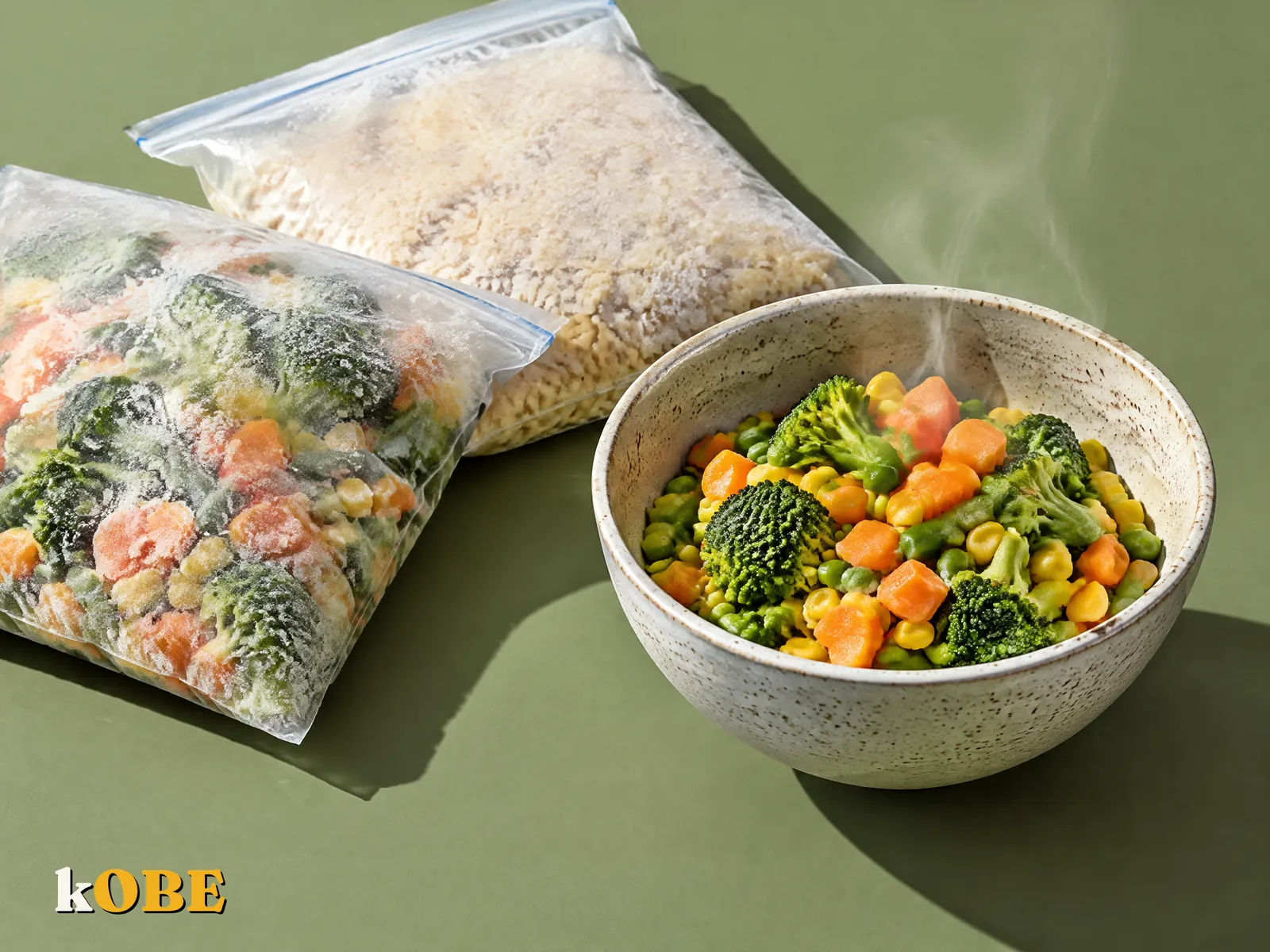
"Frozen food has lost all its goodness, dear." You've probably heard this at least once, from your mom, your grandma or the auntie next door.
Then you go to the market and buy a beautifully fresh head of broccoli. You put it in the fridge, life gets busy, and five days later you finally cook it.
Quick question: which has more vitamins left, that broccoli or a bag of frozen broccoli? The answer might surprise you.
In this article
The freezer is a "pause" button, not a nutrient shredder
Let's start with the easy part. Protein, fat, starch, fiber and minerals barely change when frozen.
A 100g piece of chicken breast has about 31g of protein when it goes into the freezer. Three months later, it still has about 31g of protein. Same with the calories.
The reason is simple: at minus 18°C, almost every reaction in food slows way down. Bacteria hibernate, and enzymes work so slowly they are, quite literally, frozen in place.
What changes most over a long time is flavor and texture, not the amount of protein or calories.
Vitamin C: who's really losing?
Vitamin C is the most "fragile" vitamin. It dislikes heat, oxygen and water, and it slowly declines over time.
So here's the fun twist: fresh vegetables sitting in the fridge lose vitamin C every single day. Commercially frozen vegetables, on the other hand, are usually blanched quickly and frozen right after harvest.
Researchers at the University of California, Davis put this to the test. They measured vitamins in eight fruits and vegetables bought fresh and kept in the fridge for 5 days, and in the same items frozen. The results:
- In most cases, frozen produce was on par with fresh.
- For a few measures, the frozen version even came out slightly ahead of fresh produce that had sat in the fridge for 5 days.
To be fair: the blanching step before freezing does cost some water-soluble vitamins. And vegetables eaten right after picking are still the freshest and tastiest. But "freezing kills all the nutrients" simply isn't true.
If you're curious about frozen vegetables, the Veggies, fiber & gut series has its own article on them.
Ice crystals: the real culprit behind "mushy" meat
If frozen food loses so little, why does meat sometimes thaw out mushy and watery?
The answer is ice crystals.
Food is full of water. When it freezes, that water forms crystals. Slow freezing makes big, sharp crystals that pierce cell walls. When the food thaws, water leaks out of the cells and pools on the plate.
Fast freezing does the opposite: small crystals, less damage to cells, and the food stays juicy after thawing.
A few tips to freeze faster at home:
- Let food cool a bit before it goes in the freezer. A steaming box warms up the whole compartment.
- Portion small and flat. A zip bag pressed flat freezes much faster than a thick round container.
- Don't overpack the freezer. Cold air needs gaps to circulate.
Freezer burn: ugly, but not harmful
Ever seen those dry, grayish-white patches on meat that has been in the freezer too long? That's freezer burn.
The name sounds scary, but it's just a spot where the surface has lost moisture and been exposed to air for too long. USDA says freezer burn doesn't make food unsafe. It just makes that spot dry, tough and less tasty.
What to do: trim off the freezer-burned part before or after cooking. How to avoid it: wrap tightly and squeeze all the air out of the bag.
There's one more slow change: fats oxidize, giving food a "stale" smell. That's why fatty fish like salmon is usually recommended to be eaten sooner than lean fish when frozen.
What freezes well, and what doesn't?
A freezer keeps food safe for a very long time as long as it stays at minus 18°C. But quality varies from dish to dish:
| Food group | Freezes well? | Notes |
|---|---|---|
| Soups, broths, curries, bò kho (Vietnamese beef stew) | Very well | Leave space in the box, since liquid expands as it freezes |
| Braised dishes, cooked meat | Well | Tastiest within the first few months |
| Cooked rice, quinoa, beans | Well | Portion one meal per pack |
| Blanched firm veggies | Well | Good for stir-fries or soups later |
| Raw veggies, cucumber, lettuce | No | Turn limp and soggy when thawed |
| Hard-boiled eggs | No | The whites turn rubbery |
| Mayonnaise-style sauces | Not great | Tend to split when thawed |
| Crispy fried food | So-so | Loses its crunch, but reheating in an oven or air fryer helps |
Frozen it, now how do you thaw it right? See three safe ways to thaw.
Inside the kOBE kitchen
Our whole range of ready-cooked ingredients follows the same "pause" principle above: cooked, then frozen.
Sous Vide Chicken Breast is cooked at 60°C for 90 minutes and rapidly chilled before freezing. Red Brown Rice, Black Brown Rice, White Rice, Chickpeas, Quinoa and diced roasted Sweet Potato are also cooked, then frozen.
The nutrition numbers we list are per 100g of cooked food. Sous Vide Chicken Breast, for example: 31g of protein and 165 calories per 100g. As we said above, the freezer doesn't change those protein or calorie numbers.
To keep things juicy, we suggest thawing in the fridge overnight, or using the microwave on a low setting. See our ready-cooked ingredients.
Frequently asked questions
Does freezing kill bacteria?
How long before frozen food has to go?
What if the power goes out and the freezer stops?
Keep reading
Sources
- Bouzari A., Holstege D., Barrett D.M. (2015). Vitamin retention in eight fruits and vegetables: a comparison of refrigerated and frozen storage. Journal of Agricultural and Food Chemistry 63(3):957 to 962.
- Rickman J.C., Barrett D.M., Bruhn C.M. (2007). Nutritional comparison of fresh, frozen and canned fruits and vegetables. Part 1. Journal of the Science of Food and Agriculture 87(6):930 to 944.
- USDA FSIS. Freezing and Food Safety.
- USDA FoodData Central, SR Legacy: roasted chicken breast (FDC 171477).
- Further reading: Culinary Nutrition; Understanding Nutrition 16th ed., chapter on water-soluble vitamins.