Try a little experiment this week.
On Monday, have a parcel of plain xôi (sticky rice) drizzled with scallion oil for breakfast. On Tuesday, have a bánh mì with two fried eggs. The two meals have fairly similar energy.
Then watch the clock. Which day does your stomach start growling before lunch? Many people find that on the sticky rice day, by 10 a.m. they're rummaging through the drawer for a snack.
You're not imagining it. Protein has its own way of talking to your brain.
In this article
Your stomach sends "texts" to your brain
Feeling full doesn't only come from a stretched belly. It's also a chemical message your gut sends up to your brain.
When protein reaches your gut, the gut releases more of certain fullness hormones, like GLP-1 and PYY. They travel through the blood to the brain and say: "That's enough, you can stop now".
At the same time, protein also lowers ghrelin, the hormone that makes you feel hungry. Ghrelin is like a dinner bell. Protein helps the bell ring more quietly, and later.
Protein is "hard to snip"
Your gut has to work harder to process protein. Protein chains are long and intricately folded, and have to be snipped bit by bit into individual amino acids.
Picture refined starch as a spool of thread that unwinds easily. Protein is more like a tangled ball of yarn. It takes longer to untangle, so food stays in your digestive system a little longer. You feel "something in your stomach" for longer.
That's also why a meal with protein, fiber and a little fat usually makes blood sugar rise more gradually than a meal of plain white starch alone. Blood sugar that spikes and then drops fast often comes with hunger and sugar cravings.
Your body "works hard" to process protein
Here's a fun fact few people know. Your body burns energy just to digest and process food. This is called the thermic effect of food.
Each nutrient takes a different amount of effort:
| Nutrient | Energy used to process it, about |
|---|---|
| Protein | 20 to 30% of its own energy |
| Starch, sugar | 5 to 10% |
| Fat | 0 to 3% |
That means for every 100 calories of protein, your body uses about 20 to 30 calories just to process it. Some scientists think this "extra effort" also adds a little to the feeling of fullness. But don't think of it as a magic trick. It's just an interesting detail about how your body runs.
What does the research say, and not say?
In 2016, a group of researchers pooled many trials on protein and fullness. The result: higher-protein meals gave a slightly greater feeling of fullness than lower-protein meals.
The key word is "slightly". The effect is real, but modest. It also varies between people and between foods.
A few other things strongly affect fullness too:
- Fiber and volume. A big bowl of watery vegetable soup takes up more room in your stomach than a candy with the same calories.
- Solid or liquid. Chewing a piece of meat usually fills you up more than drinking the same protein as a liquid.
- Eating slowly. Fullness signals need about 15 to 20 minutes to reach the brain. Eat too fast and your brain hasn't caught up yet.
There's also an interesting idea called the "protein leverage" hypothesis. It suggests the body tends to keep eating until it has enough of the protein it needs. With low-protein meals, it's easier to keep eating. This is still a hypothesis, not a conclusion.
Putting it on a Vietnamese table
You don't need to change all your habits. Just give each meal a clear "protein star":
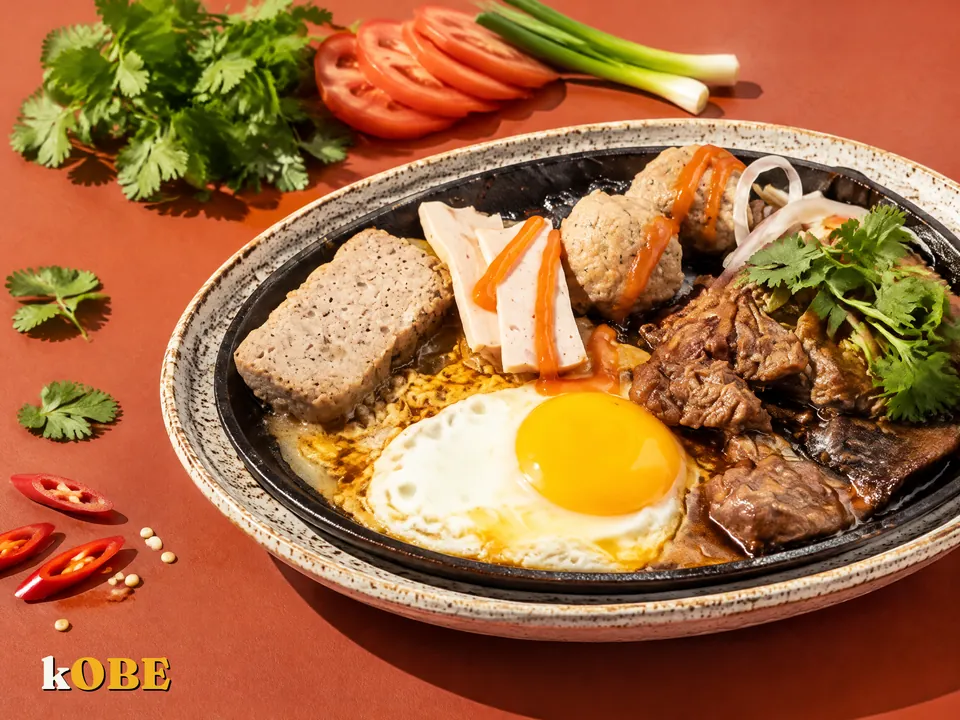
- Add eggs or milk to breakfast. Put an egg on your xôi. Add chả (Vietnamese pork roll) or an egg to your bánh mì. Swap a milk tea for a glass of soy milk. See Which Vietnamese breakfasts are high in protein.
- At the office lunch, choose a dish with a clear piece of meat or fish, instead of just a plate of starchy fried noodles.
- Swap your afternoon cake for yogurt, a boiled egg or a handful of edamame.
- Eat protein and vegetables first, rice after. Many people find this slows the meal down and leaves them more comfortably full.
Inside the kOBE kitchen
A protein meal doesn't have to be fancy. Our Sous Vide Chicken Breast has 31g of protein per 100g of cooked meat and 0g of starch. A few slices in a bánh mì or on top of a rice bowl and your meal has its "protein star" straight away.
For an afternoon snack, our Edamame has 11.9g of protein per 100g. Thaw it in the fridge overnight and take a small box with you in the morning.
If you love a sauce, the 80% version of kOBE Signature Lean Mayo has 3.1g of protein and 118 kcal per 100g, much lighter than regular mayo, which is about 75% oil. We list calories, protein, fat and sugar per 100g on every recipe, so it's easy to spot which dishes bring protein.
Frequently asked questions
Is a protein shake as filling as eating meat?
Will eating only protein and cutting all carbs keep me fuller?
Why do I still crave sweets after eating?
Keep reading
Sources
- Dhillon J. et al. (2016). The Effects of Increased Protein Intake on Fullness: A Meta-Analysis and Its Limitations. Journal of the Academy of Nutrition and Dietetics 116(6):968 to 983.
- Simpson S.J., Raubenheimer D. (2005). Obesity: the protein leverage hypothesis. Obesity Reviews 6(2):133 to 142.
- Harvard T.H. Chan School of Public Health, The Nutrition Source. Protein.
- Further reading: Understanding Nutrition 16th ed., chapters 6 and 8.