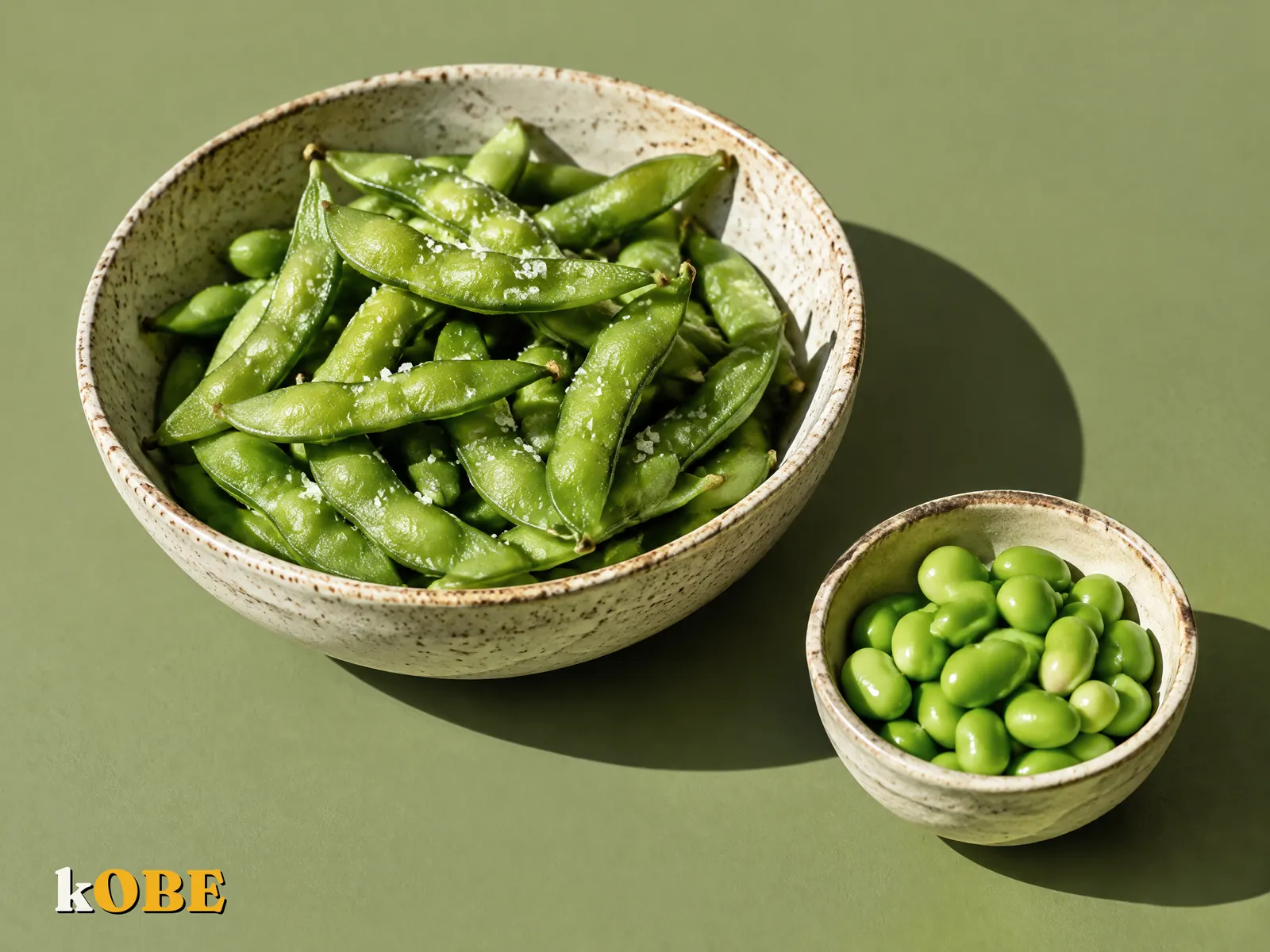
At a Japanese izakaya, the first thing to land on the table is often a plate of bright green pods sprinkled with coarse salt. Give one a gentle squeeze and the beans pop straight into your mouth. Nutty and salty, you could eat them all night.
That's edamame. Plenty of people have eaten it a dozen times without knowing: it's soybeans. The very same plant as the yellow beans that become tofu and soy milk.
The only difference is when they're picked.
In this article
Same soybean, different harvest time
In Japanese, eda means branch and mame means bean. Edamame means "beans on the branch". In the old days, Japanese sellers sold the whole branch, and people boiled it that way.
Leave soybeans to mature on the plant and the beans dry out, turning yellow and hard. Those are the soybeans you buy at the market to make soy milk. Edamame is picked early, while the beans are still green, soft and sweet.
Think of baby corn versus mature corn. Same plant, yet one gets boiled and eaten right away, and the other is dried and ground into flour.
What's in 100g of edamame?
According to the USDA database, 100g of cooked edamame has about:
| Nutrient | Amount, about |
|---|---|
| Energy | 121 kcal |
| Protein | 11.9g |
| Carbs | 8.9g |
| Fiber | 5.2g |
| Fat | 5.2g |
A quick comparison with other beans: edamame has more protein and less starch than chickpeas or red beans. A bowl of shelled edamame, about 150g, gives you about 18g of protein. Nearly as much as three eggs.
Edamame also stands out for folate, one of the B vitamins. According to the USDA, 100g of edamame has about 300 micrograms of folate, close to 80% of the daily recommendation for adults in the US tables. It also has vitamin K, iron and manganese.
A rare plant protein with the "full set"
Remember the 9 essential amino acids? Most plant proteins run short on one or two. Soy is a notable exception.
Soy protein has all 9, in proportions fairly close to what your body needs. Under FAO's protein quality scoring, soy sits in the high-scoring group among beans.
That makes edamame a handy choice for vegetarians, or for anyone who wants to skip meat a few meals a week. We go deeper in Complete protein and plant protein.
How are young soybeans different from dried ones?
Dried soybeans have more protein per 100g, because nearly all the water has gone. It's the familiar beef jerky story: less water, and everything left behind gets more concentrated.
But you can't eat dried soybeans as they are. They have to be soaked, cooked, blended and strained. Through those steps, water goes back in, and the number per 100g drops again.
Edamame is different. Boil a few minutes and eat. No soaking, no blending. That's why it became such a convenient high-protein snack.
What about "soy and hormones"?
Soybeans contain isoflavones, a group of plant compounds with a structure a little like the hormone estrogen. That's why so many rumors swirl around them.
To be honest with you: this topic is still being studied a lot. We won't draw conclusions on science's behalf. What's fairly certain is that soy has been an everyday food in Asia for thousands of years, and eating it in meals as a normal food suits most healthy people.
If you have a thyroid condition, or you're taking hormone medication, ask your doctor how much soy is right for you.
How to boil edamame so it tastes great
Edamame in supermarkets is usually frozen, either in the pod or already shelled.
- Bring water to a boil with a pinch of salt.
- Add the edamame and boil for about 3 to 5 minutes. Frozen edamame is usually already blanched, so it doesn't need long.
- Drain and sprinkle with coarse salt. Squeeze the pods and eat the beans. The pods are tough and not edible.
A few other ways to eat it: toss the beans into rice, salads or poke. Stir-fry with garlic and a splash of soy sauce. Mash with lime into a spread for bread.
Inside the kOBE kitchen
Our Edamame is cooked and then frozen, ready to eat. Each 100g has 121 kcal and 11.9g of protein.
Just thaw it in the fridge overnight, or reheat in the microwave on low. A handful scattered over a bowl of brown rice, or tossed with our namul-style Sesame Kale, gives your lunch a few more grams of full-set plant protein.
Want a more complete meal? Add a few slices of Sous Vide Chicken Breast, with 31g of protein per 100g cooked, and a little Black Brown Rice.
Frequently asked questions
Can you eat edamame raw?
Is edamame the same as green peas?
Can children eat edamame?
Keep reading
Sources
- USDA FoodData Central, SR Legacy: Edamame, frozen, prepared.
- FAO (2013). Dietary protein quality evaluation in human nutrition. FAO Food and Nutrition Paper 92.
- EFSA ANS Panel (2015). Risk assessment for peri- and post-menopausal women taking food supplements containing isolated isoflavones. EFSA Journal 13(10):4246.
- Harvard T.H. Chan School of Public Health, The Nutrition Source. Straight Talk About Soy.
- Further reading: Understanding Nutrition 16th ed., chapter 6; Plant-Based Sports Nutrition.