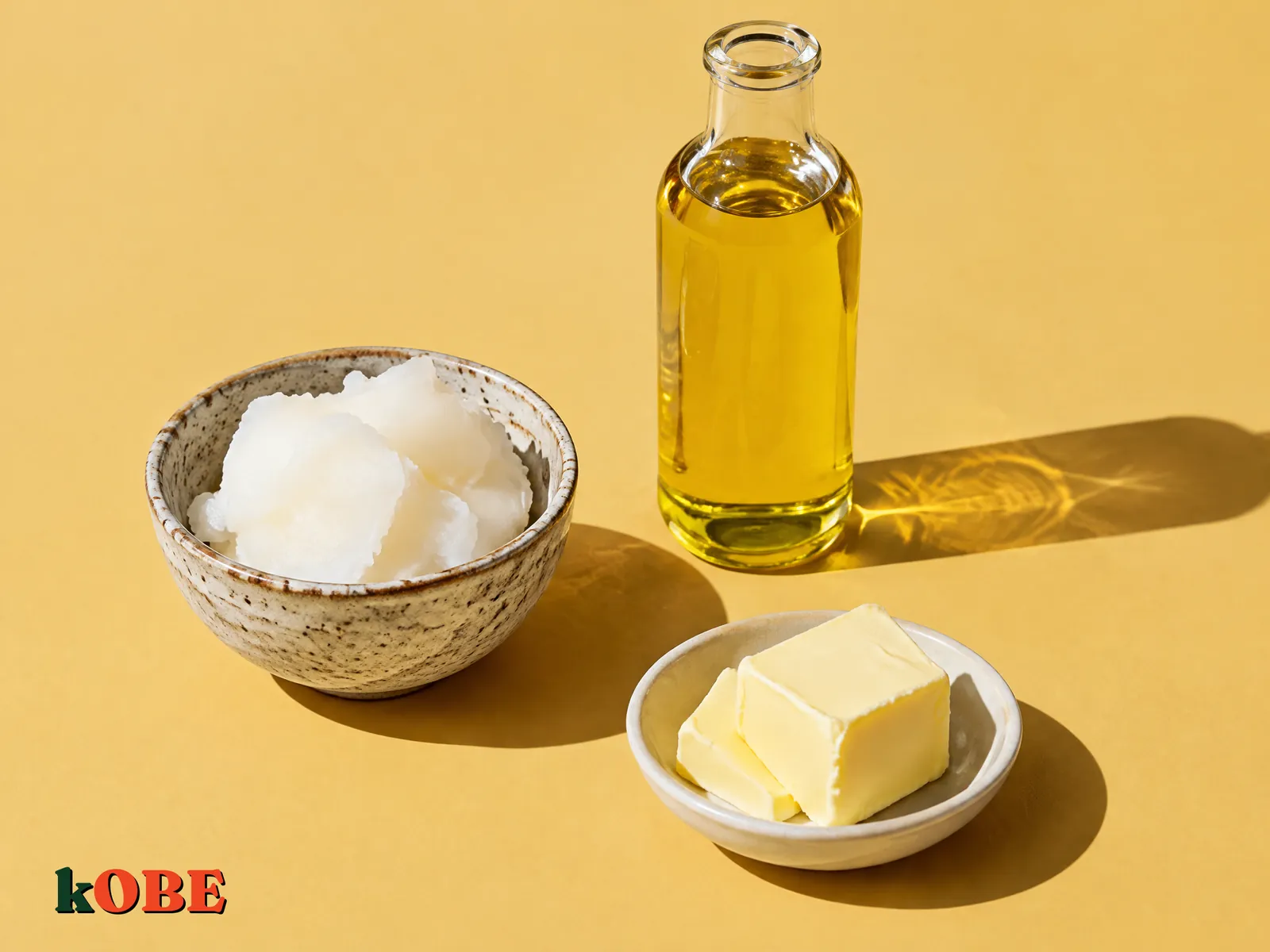
Is there a jar of pork lard in your kitchen? Fresh from rendering, while still hot, it's as clear as oil. After a night in the fridge, it sets into an opaque white block you can scoop with a spoon.
The bottle of soybean oil next to it stays runny. A bottle of olive oil in the fridge turns a little cloudy and grainy, but never solid.
Three fats, three reactions to the cold. Behind them is the story of saturated, unsaturated and trans fat, told without a single chemical formula.
In this article
Straight chains pack tight, bent chains pack loose
Every fat molecule has long "tails" called fatty acids. Imagine each tail as a toothpick.
- Saturated fat: the toothpicks are perfectly straight. Straight sticks stack tightly, like a bundle of chopsticks. Tight stacking means solid at room temperature.
- Unsaturated fat: the toothpicks are bent in one or more places. Bent sticks pile up messily and leave gaps. So the fat stays liquid.
"Saturated" means the fat chain is "full" of hydrogen atoms. Wherever hydrogen is missing, the chain kinks.
One kink is called monounsaturated (MUFA). Several kinks are called polyunsaturated (PUFA). Omega-3 and omega-6 belong to the poly group.
Lard isn't as "saturated" as you think
This is the fun fact that surprises people most: no food contains just one type of fat. Every fat and oil is a mix.
The numbers below are estimated shares of the fat, rounded from the USDA database:
| Fat | Saturated | Monounsaturated | Polyunsaturated |
|---|---|---|---|
| Coconut oil | over 80% | about 6% | about 2% |
| Butter | about 63% | about 26% | about 4% |
| Palm oil | about 50% | about 37% | about 9% |
| Lard | about 39% | about 45% | about 11% |
| Peanut oil | about 17% | about 46% | about 32% |
| Soybean oil | about 16% | about 23% | about 58% |
| Olive oil | about 14% | about 73% | about 11% |
Look closely and two surprises jump out:
- Lard has more monounsaturated fat than saturated fat. It sits in the middle, not the "king of saturated fat" its reputation suggests.
- Coconut oil is a plant oil, yet more saturated than both butter and lard. That's why coconut oil turns white and solid on a cool morning.
So "plant oil good, animal fat bad" isn't necessarily true.
Saturated fat: not poison, but it needs a ceiling
Saturated fat shows up in fatty meat, chicken skin, butter, cheese, coconut milk and palm oil.
What science is fairly sure about: eating a lot of saturated fat raises LDL, the blood cholesterol you often hear called "bad cholesterol". That's why WHO advises keeping saturated fat under 10% of daily energy.
For someone eating about 2,000 calories, 10% is about 22g of saturated fat. Picture it:
- 1 tablespoon of butter has about 7g of saturated fat. Three spoons and you're at the ceiling.
- 100g of raw pork belly can hold close to 20g of saturated fat, depending on how fatty or lean the cut is.
But here's a subtle point. If you cut back on fatty meat and fill up on pastries and white rice instead, the benefit almost disappears. Reviews show the clearest benefit comes from replacing saturated fat with unsaturated fat: fish instead of fatty meat, vegetable oil instead of rendered lard, a handful of nuts instead of butter cookies.
Unsaturated: how is mono different from poly?
Monounsaturated fat is the star of olive oil, peanut oil, avocado and cashews. With just one kink, the chain is fairly sturdy and handles heat relatively well.
Polyunsaturated fat is in soybean oil, sunflower oil, corn oil, sesame, walnuts and oily fish. This group has two special members: omega-3 and omega-6. Your body can't make them, so they must come from food (more in article S4-05).
The weak spot of poly fats: more kinks mean more "weak points" for oxygen to attack, especially under long high heat or light. So keep oil bottles tightly closed, in a cool dark place.
Trans fat: the real bad guy
If there's one fat worth dodging, it's industrial trans fat.
It's born when liquid oil is turned solid by partial hydrogenation (partially hydrogenated oil). The result was cheap and long-lasting, so it used to turn up in old-style margarine, shortening, cookies, snacks and factory-fried foods.
The problem: trans fat raises LDL and lowers HDL, the "good" cholesterol, at the same time. Two wrong moves in one. That's why WHO advises under 1% of energy, and in 2018 launched the REPLACE program to remove it from the global food supply.
To steer clear, read the ingredient list:
- "Partially hydrogenated oil": the clearest red flag.
- Shortening and hard margarine: check the label carefully. Many newer products have been reformulated, but not all.
- The "trans fat" line on the nutrition panel: in some countries, under 0.5g per serving gets rounded down to 0g. So the ingredient list is still more reliable.
Milk, beef and goat meat also carry a small amount of natural trans fat. The amount is small, and so far there's no clear evidence it causes the same problems as the industrial kind.
Inside the kOBE kitchen
We don't ban any fat. We label it clearly so you can see for yourself. Every dish in our 1,480 home recipes lists calories, protein, fat and sugar per 100g.
Among our ready-cooked ingredients, the Japanese, Purple and Honey Sweet Potatoes are roasted with a little olive oil, an oil rich in monounsaturated fat. Our Sesame Kale uses sesame oil and toasted sesame. And our Sous Vide Chicken Breast is simply brined in sea salt, with 3.6g of fat per 100g of cooked meat.
Frequently asked questions
So should I give up lard completely?
Is coconut oil a "superfood"?
Is margarine all trans fat?
Keep reading
Sources
- USDA FoodData Central, SR Legacy: coconut oil, butter, palm oil, lard, peanut oil, soybean oil, olive oil, raw pork belly.
- WHO (2023). Saturated fatty acid and trans-fatty acid intake for adults and children: WHO guideline.
- WHO (2018). REPLACE: An action package to eliminate industrially-produced trans-fatty acids.
- Harvard T.H. Chan School of Public Health, The Nutrition Source. Types of Fat.
- Further reading: Understanding Nutrition 16th ed., chapter 5; Food Lipids.