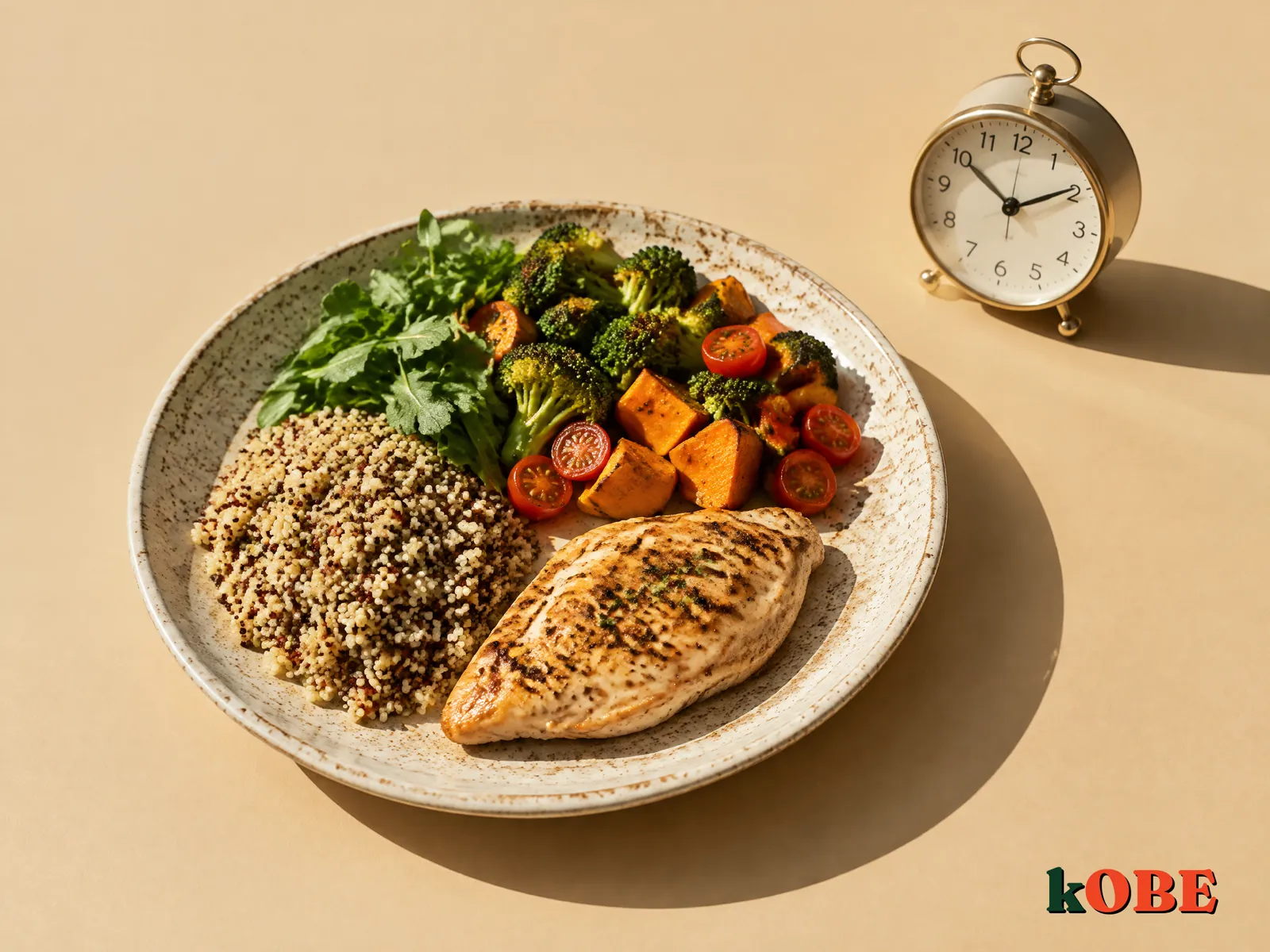
It is 10am and your colleague is still on a single black coffee. "I don't eat until 12, and at 8pm my mouth is closed for business." After a while, the whole office gets used to hearing "16:8".
It sounds a bit austere. But if you eat dinner at 8pm, sleep, and then skip breakfast, you have already fasted for nearly 16 hours without noticing.
So what is special about intermittent fasting? Or is it just a tidier way to time your meals?
In this article
What does 16:8 mean?
Intermittent fasting is the umbrella name for eating patterns that alternate between eating periods and fasting periods. The most popular office version is time-restricted eating.
With 16:8, you eat all your meals within 8 hours, then rest for 16. For example, you eat from 11am to 7pm. During the 16-hour break you drink water, tea or unsweetened coffee.
Besides 16:8, there are a few other styles:
- 14:10: rest for 14 hours, eat within 10. Gentler.
- 5:2: eat normally 5 days a week, and very little on 2 days.
- Alternate-day fasting: one day eating, one day eating very little or nothing.
The interesting part: 16:8 does not tell you what to eat, only when.
Why do so many people like it?
The reasons are very down to earth:
- Simple rules. No counting calories dish by dish. Just look at the clock.
- Less late-night snacking. "Closing the kitchen" at 8pm naturally cuts out the bag of snacks during a movie.
- Simpler mornings. People rushing to work feel relieved not to have to think about breakfast.
There are also some attractive biological ideas. When you fast long enough, the body gradually shifts to using stored fat. Cells may step up their internal "housekeeping", called autophagy. Many animal studies have produced intriguing results.
But mice are not people. And when tested on real humans, the story becomes more modest.
What do the big trials say?
This is the part we want to tell fairly.
- In 2020, a US trial (TREAT) had one group eat within an 8-hour window and another eat three normal meals. After 12 weeks, the difference in weight between the groups was not statistically significant.
- In 2022, a trial in China was published in the NEJM. Both groups cut calories, and one group also ate within an 8-hour window. After 12 months, the two groups had nearly the same results.
In other words: when the total amount eaten is the same, the clock does not add much magic. 16:8 helps mainly because it nudges some people to eat a little less and more regularly.
Still debated:
- Eating in an early window (say 8am to 4pm) may fit the body clock better than a late one. A few small studies suggest this, but not enough to draw conclusions.
- In 2024, a conference report caused a stir by suggesting that eating within an 8-hour window was linked to heart risks. It was observational data, not yet fully peer reviewed, and many experts pointed out its limitations. No conclusion should be drawn yet.
In short: 16:8 is a reasonable way to schedule meals for some people. It is not a must, and it is nothing to be scared of either.
Who should be careful, and who should ask a doctor first?
A 16-hour fast is not a small thing for every body. The people below should check with a doctor first:
- People with underlying conditions, or those taking medication for blood sugar or blood pressure. Long fasts can push blood sugar too low while on medication.
- Women who are pregnant or breastfeeding.
- Children, teenagers and older adults, who need enough energy and protein.
- Anyone with a history of disordered eating. A rigid eating window can easily turn into pressure.
- People who get stomach pain when hungry.
If you are healthy and want to try it, start gently with 12:12, then 14:10. There is no need to jump straight to 16:8.
The meal that breaks the fast is what really counts
16:8 does not say what to eat. That is both its strength and its trap.
Fast until noon, then break it with a milk tea and a plate of fried chicken, and even the prettiest clock will struggle to help. A few principles for your first meal:
- Clear protein: eggs, chicken, fish, tofu. Protein keeps you full and helps hold on to muscle.
- Vegetables and fibre, eaten before or with your carbs.
- Moderate carbs, favouring brown rice, sweet potato or rice vermicelli over pastries.
- Eat slowly. After 16 hours, it is easy to eat fast and overeat.
And within your 8 hours, do not try to fill the gap with sugary food. Meal quality is still the main event.
Inside the kOBE kitchen
Whether you follow 16:8 or not, your first meal of the day should still have protein, vegetables and moderate carbs.
A ready-made example: the frozen Chicken Kale Namul Poke, 350g, has 379 kcal and 29g protein. If you build your own, you can combine Sous Vide Chicken Breast (31g protein per 100g), Sesame Kale and a portion of Japanese Sweet Potato.
A kitchen tip: the night before, move your portion from the freezer to the fridge. The next day, reheat it in the microwave on low and your fast-breaking meal is ready in minutes. See more on the Ingredients page.
Frequently asked questions
Can I have coffee with milk during the 16-hour fast?
Does intermittent fasting make you lose muscle?
Do I have to fast exactly 16 hours every day?
Keep reading
Sources
- Lowe D.A. et al. (2020). Effects of time-restricted eating on weight loss and other metabolic parameters in women and men with overweight and obesity: the TREAT randomized clinical trial. JAMA Internal Medicine 180(11):1491 to 1499.
- Liu D. et al. (2022). Calorie restriction with or without time-restricted eating in weight loss. New England Journal of Medicine 386:1495 to 1504.
- de Cabo R., Mattson M.P. (2019). Effects of intermittent fasting on health, aging, and disease. New England Journal of Medicine 381:2541 to 2551.
- Further reading: Nutrition: Concepts and Controversies 16th ed., chapter 9; Diet Cults (Matt Fitzgerald), chapter 1.